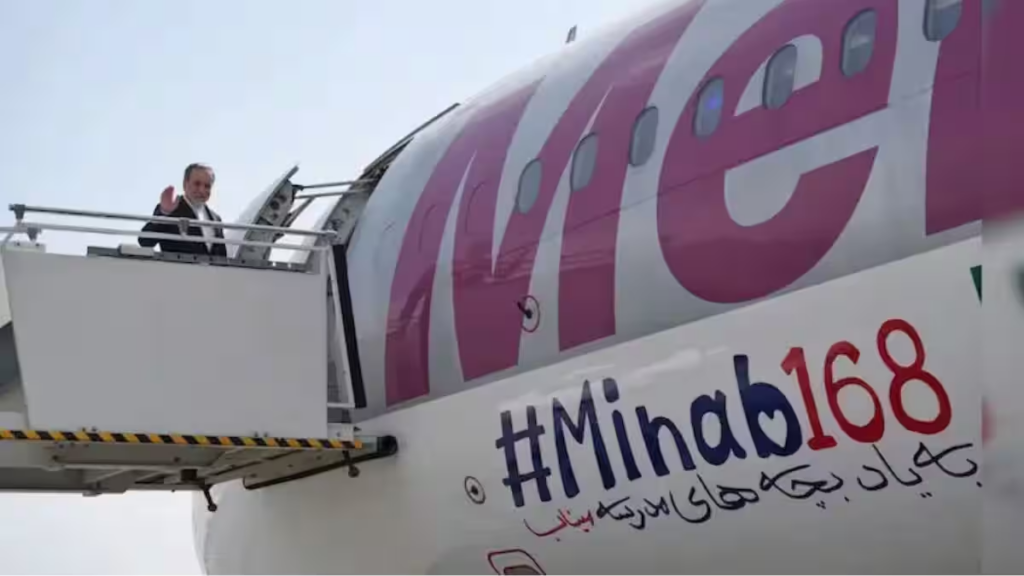
When Iranian Foreign Minister Abbas Araghchi landed in New Delhi this week for the BRICS foreign ministers’ meeting, it wasn’t just another diplomatic arrival. Painted prominently on the fuselage of his aircraft were the words: “Minab 168.”
The message immediately drew attention from diplomats, analysts, and regional observers. According to Iranian officials, the phrase refers to 168 schoolchildren allegedly killed during a US strike on a primary school in Minab, a city in Iran’s southern Hormozgan province near the Strait of Hormuz.
By carrying that phrase into India during a high-profile BRICS gathering, Tehran appeared to be making a calculated political statement — one aimed at Washington, global public opinion, and emerging powers like India, China, and Brazil.
What Does “Minab 168” Mean?
Iran says the phrase commemorates children killed in a missile strike on the Tayyebeh primary school in Minab during the opening phase of the US-Israel conflict with Iran earlier this year.
According to Tehran:
- The strike occurred on February 28
- The school was near an Islamic Revolutionary Guard Corps (IRGC) facility
- Many of the victims were between the ages of 7 and 12
- A total of 168 students reportedly died
Iranian state-linked messaging has framed the incident as evidence of civilian casualties caused by Western military operations.
The Pentagon later acknowledged an investigation into whether American forces may have been responsible after preliminary findings raised concerns about the strike.
Why the Number Matters
The wording itself is significant.
Rather than using a slogan or direct accusation, Iran chose a short coded phrase — “Minab 168” — similar to how countries and activist groups often memorialise major tragedies through shorthand references.
The strategy serves several purposes:
- It creates an emotionally charged symbol
- It keeps international attention on civilian casualties
- It avoids lengthy diplomatic statements
- It makes the message easy to circulate on social media and television imagery
In geopolitical communication, symbols often travel faster than policy papers.
Why Iran Displayed the Message During the BRICS Meeting
The timing was unlikely to be accidental.
The BRICS meeting in New Delhi gave Iran a global stage involving several nations that have increasingly pushed for a more multipolar world order. Iran has been deepening ties with BRICS-aligned countries as it seeks alternatives to Western diplomatic and economic pressure.
By displaying “Minab 168” in India, Tehran may have been trying to achieve three things at once:
1. Shape the Narrative Around the War
Wars are fought not only militarily, but also through information campaigns.
Iran appears determined to highlight civilian suffering inside its territory, especially involving children. The message helps Tehran reinforce its argument that Western-backed military operations have crossed humanitarian lines.
2. Pressure Non-Western Powers to Take a Position
India, China, Russia, Brazil, and South Africa have all attempted to balance relationships across competing global blocs.
Iran’s message places moral and diplomatic pressure on these countries to address the humanitarian fallout of the conflict — even if they avoid directly criticising the United States or Israel.
3. Elevate Iran’s Strategic Importance
Iran remains central to regional energy security because of its position near the Strait of Hormuz, one of the world’s most critical oil shipping lanes.
By linking wartime losses with international diplomacy, Tehran is reinforcing the idea that instability involving Iran affects the broader global economy.
Why India Is Paying Close Attention
India’s relationship with Iran has always involved a careful balancing act.
New Delhi maintains strong ties with the United States and Israel while also relying heavily on stability in West Asia for trade, energy imports, and maritime security.
That balancing act has become even more delicate during the ongoing conflict.
The Strait of Hormuz Is a Major Concern
The Strait of Hormuz handles a significant portion of global oil shipments. Any escalation in the region can affect:
- Crude oil prices
- Shipping insurance costs
- Supply chain stability
- India’s energy imports
Indian officials are reportedly expected to discuss safe passage for merchant vessels during meetings with Iranian representatives.
BRICS Gives India Diplomatic Space
The BRICS platform allows India to engage Iran multilaterally without signalling a full strategic alignment.
That matters because India’s foreign policy increasingly focuses on maintaining relationships across rival geopolitical camps rather than choosing one side outright.
Who Is Abbas Araghchi?
Abbas Araghchi is one of Iran’s most experienced diplomats and has long been involved in high-stakes negotiations involving sanctions, nuclear policy, and regional security.
His visit to India marks the first major diplomatic outreach from Tehran to New Delhi since the outbreak of the US-Israel conflict involving Iran.
During the trip, Araghchi is expected to:
- Attend the BRICS foreign ministers’ meeting
- Hold bilateral talks with Indian External Affairs Minister S. Jaishankar
- Participate in meetings involving regional security and economic cooperation
- Join a delegation expected to meet Prime Minister Narendra Modi
Could “Minab 168” Become a Wider Diplomatic Symbol?
Possibly.
Modern geopolitical conflicts increasingly rely on symbolic messaging that can travel quickly through digital media. Images from airport arrivals, aircraft markings, and summit appearances are now part of international political communication.
Iran likely understands that:
- A phrase painted on a plane generates immediate visual impact
- Media outlets will amplify the imagery globally
- The symbolism may resonate beyond traditional diplomatic audiences
Whether the claim surrounding Minab becomes internationally verified at scale remains an open question. Independent confirmation of casualty figures and strike responsibility will likely continue to face scrutiny from governments, journalists, and international organisations.
Still, the phrase itself has already succeeded in one respect: it shifted attention from a routine diplomatic visit to the humanitarian and political messaging surrounding the war.
What This Means for the Broader Region
The appearance of “Minab 168” highlights how the conflict involving Iran, the United States, and Israel is evolving beyond direct military exchanges.
The next phase increasingly involves:
- Narrative warfare
- Diplomatic signaling
- Global coalition-building
- Public opinion campaigns
For countries like India, the challenge is maintaining strategic neutrality while protecting economic and energy interests.
For Iran, the goal appears to be ensuring that civilian casualties remain central to the global conversation surrounding the conflict.
And for BRICS nations, the episode underscores a larger reality: regional wars now arrive directly at international summits, carrying political messages designed for a worldwide audience.
TL;DR
- Iran’s foreign minister arrived in India with “Minab 168” displayed on his aircraft.
- Tehran says the phrase refers to 168 schoolchildren killed in a US strike on a school in Minab.
- The message appears aimed at shaping international opinion during the BRICS meeting.
- India is closely watching the situation because of energy security and the Strait of Hormuz.
- The incident reflects how modern diplomacy increasingly uses symbolism and media optics alongside formal negotiations.