
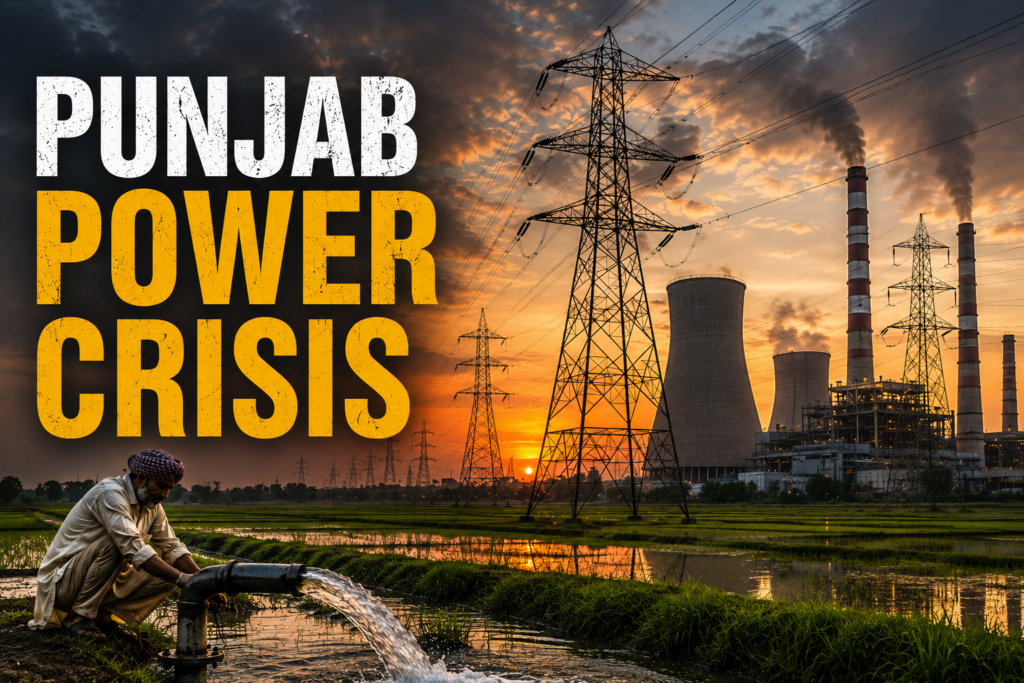
Punjab Power Crisis: Once the powerhouse behind India’s Green Revolution, Punjab is now grappling with a deepening electricity crisis. As peak summer demand coincides with the paddy sowing season, the state has witnessed multiple thermal plant shutdowns, rising dependence on expensive power purchases, irregular electricity supply to farmers, employee protests, and mounting concerns from industries.
While the immediate crisis has unfolded under the Aam Aadmi Party (AAP) government, experts say the roots of Punjab’s power problems stretch back over several administrations. Ageing thermal plants, delayed infrastructure upgrades, financial stress within the Punjab State Power Corporation Limited (PSPCL), and years of policy inertia have combined to create one of the state’s biggest governance challenges.
Six Thermal Units Shut During Peak Demand
Punjab’s power generation capacity suffered a significant setback after six units across state-owned thermal power plants went offline, reducing electricity generation by more than 1,800 MW during one of the year’s highest demand periods.
To bridge the gap, PSPCL was forced to purchase electricity from power exchanges at prices reportedly touching ₹10 per unit, substantially higher than the cost of generating electricity through its own thermal plants. These emergency purchases have placed additional financial pressure on an already stretched utility.
The situation has raised a critical question: Why was Punjab left vulnerable during one of its most crucial agricultural seasons?
The 920-MW Thermal Plant That Went Silent
At the center of the crisis is the Guru Hargobind Thermal Plant at Lehra Mohabbat, one of Punjab’s largest state-owned power stations.
The entire 920-MW facility went offline after all four generating units shut down. While one unit was later restored, reports linked the widespread shutdown to severe fly ash accumulation, technical failures, and delays caused by an employee strike.
Such failures rarely occur overnight. Power sector experts note that they often reflect years of deferred maintenance, aging infrastructure, and inadequate modernization.
Punjab’s thermal fleet has steadily grown older. Two units at the Ropar Thermal Plant had already crossed 30 years of operation before retirement, while several remaining units are approaching or have exceeded the 25-year economic life benchmark identified by the Central Electricity Authority for subcritical thermal plants.
Successive governments largely delayed investments in renovation, life-extension projects, and newer supercritical technology, leaving today’s administration responsible for managing an increasingly fragile system while also being accountable for ensuring uninterrupted operations.
Employee Protests Add to Operational Challenges
Punjab’s electricity crisis is not limited to aging infrastructure.
Nearly 1,852 outsourced PSPCL employees have staged phased protests demanding regularisation of their services. The strikes have disrupted operations at key thermal facilities, particularly Lehra Mohabbat, forcing skeleton staff to manage essential operations.
Industry observers note that critical infrastructure depends as much on skilled manpower as on machinery. When labor disputes coincide with technical failures, operational risks increase significantly.
Farmers Feel the Impact During Paddy Season
The timing of the crisis has been especially challenging for Punjab’s agricultural sector.
The state’s paddy transplantation season relies heavily on uninterrupted electricity for groundwater pumping and irrigation. However, declining thermal generation has forced greater dependence on purchased power, while several districts have reported supply regulation and outages.
For Punjab’s farmers, unreliable electricity directly affects irrigation schedules, crop productivity, groundwater extraction, and ultimately rural incomes.
Can Punjab’s Industries Afford Uncertain Power Supply?
Reliable electricity remains one of the first factors investors evaluate before expanding manufacturing operations.
Punjab was once regarded as one of India’s leading industrial states. However, repeated thermal plant outages, rising dependence on costly market power, and operational uncertainty are raising concerns about the state’s competitiveness.
For micro, small, and medium enterprises (MSMEs), every disruption increases production costs and reduces operational efficiency. As Punjab competes with states such as Haryana, Gujarat, and Uttar Pradesh for new investments, dependable electricity has become a critical economic requirement rather than merely a public utility.
Financial Pressure on PSPCL
The crisis has also renewed attention on PSPCL’s financial position.
Reports suggest the utility has explored monetizing land assets while simultaneously purchasing high-cost electricity to maintain supply. Critics argue this highlights deeper fiscal stress, although PSPCL has maintained that such measures are part of routine financial management.
The broader concern remains whether recurring operational expenses can be sustainably managed without structural reforms.
Punjab vs Haryana: A Growing Development Gap?
The comparison with neighboring Haryana has become increasingly prominent.
Both states share similar geography, agricultural dependence, and climatic conditions. Yet Haryana has steadily expanded its transmission network, supported industrial growth in Gurugram, Manesar, Panipat, and Faridabad, and maintained relatively stable power availability.
Official economic data also reflects widening differences. According to government estimates, Punjab’s per-capita NSDP stood at ₹1,73,873 in 2022–23, compared with Haryana’s ₹2,96,685.
Reliable electricity has been one of several factors supporting Haryana’s industrial expansion, while Punjab continues to confront recurring power shortages during peak demand.
A Structural Crisis Beyond Political Parties
Although the current government faces immediate accountability for operational failures, Punjab’s power sector problems have accumulated over many years.
Previous Congress governments struggled to modernize aging thermal infrastructure and improve PSPCL’s financial health. The AAP government came to power promising governance reforms and uninterrupted electricity, but the current crisis has intensified scrutiny over whether those commitments have translated into lasting structural improvements.
The debate has increasingly shifted from political rhetoric to governance outcomes.
Punjab’s Bigger Challenge
Punjab’s electricity crisis extends far beyond temporary summer shortages.
Electricity powers agriculture, manufacturing, healthcare, education, startups, and investor confidence. When power plants shut down, workers protest, utilities face financial stress, and farmers struggle during the sowing season, the consequences ripple across the state’s economy.
The central question facing Punjab is no longer simply how to overcome this year’s electricity shortage. It is whether the state can modernize its aging power infrastructure, restore financial stability, and rebuild investor confidence before recurring energy crises begin to undermine its long-term economic growth.