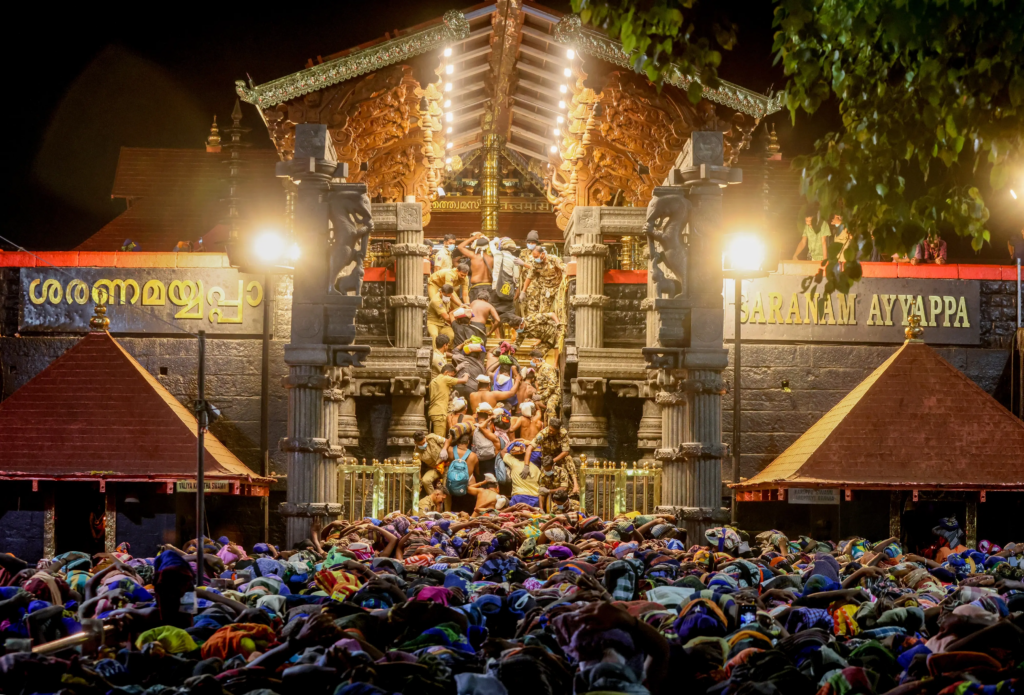
In Kerala, Sabarimala is far more than a place of worship. It carries immense emotional weight, cultural meaning, and a sense of identity that resonates deeply with Malayalees. Every year between November and January, millions of devotees journey to the hilltop shrine.
Because of its profound cultural significance, any development related to Sabarimala inevitably transcends religion, evolving into a wider social and political debate. As the 2026 Kerala Assembly elections draw closer, Sabarimala is once again dominating public discourse. But this time, voters are asking a more reflective question: When the traditions of the shrine were challenged, who actually fought on the ground, and who simply cashed in at the ballot box?
The 2018 Turning Point: Law vs. Belief
The modern political battle over Sabarimala began in 2018 when the Supreme Court permitted the entry of women of all age groups into the shrine. What started as a legal ruling quickly sparked a statewide public movement.
The ruling CPI(M)-led LDF government chose to enforce the apex court’s verdict with an iron fist. For the government and its supporters, it was a matter of constitutional duty and gender equality. For millions of devotees, however, it was viewed as a direct state interference in a deeply personal and long-standing religious practice. This widening gap between legal enforcement and public sentiment turned a sensitive issue into a visible confrontation.
The Street Fight: BJP’s Massive Mobilization
As the LDF stood firm, the agitation moved far beyond symbolic opposition. It was during this volatile phase that the BJP stepped in aggressively, aligning itself with the protesting devotees and framing the issue as a battle to protect ancient traditions.
The party maintained that faith practices should not be altered without the consent of the believers. BJP leaders and grassroots workers were highly visible on the ground, leading to intense clashes with the administration.
The toll of the protests on the BJP was severe:
- 12,000+ Cases: The state registered thousands of cases against BJP leaders, workers, and devotees.
- Targeted Leadership: K. Surendran, the then-State General Secretary who led mobilizations across multiple districts, had 242 cases filed against him alone.
- Jail Time: Surendran was taken into custody across several districts, paraded before various courts, and spent nearly 30 days in jail.
Beyond the streets, the BJP ensured the issue remained alive in legislative spaces. In the Kerala Assembly, BJP MLA O. Rajagopal and independent MLA P.C. George protested by wearing black. In Parliament, actor-turned-politician Suresh Gopi delivered a passionate speech that drew national attention to the devotees’ plight.
The Electoral Paradox: Why Congress Reaped the Rewards
While the BJP was fighting on the streets, the Congress-led UDF adopted a remarkably measured approach. The party voiced support for the devotees’ sentiments but carefully avoided the scale of direct, on-the-ground mobilization seen from the BJP. Consequently, there were no major police cases registered against Congress leaders during the agitation.
Yet, when the 2019 Lok Sabha elections arrived, the results stunned political observers. Public anger against the LDF’s handling of Sabarimala was palpable, but it was the Congress-led UDF that swept the polls, not the BJP.
Why did this happen?
- The “Winnability” Factor: Voters looking to punish the LDF viewed the UDF as the more mathematically viable option to defeat the ruling front.
- The Rahul Gandhi Wave: Rahul Gandhi’s decision to contest from Wayanad gave the election a national dimension. Many voters viewed him as a potential Prime Ministerial candidate, heavily skewing the anti-incumbency vote toward Congress.
This created a lingering political paradox: the BJP sacrificed its cadre and leadership to the protests but faced limits in its perceived electoral strength, while Congress—despite avoiding the messy legal consequences of the agitation—emerged as the primary political beneficiary.
Echoes in 2025 and the Road to 2026
This dynamic hasn’t just stayed in the past; it has repeated itself. When the Sabarimala gold controversy erupted in 2025, bringing the shrine’s administration back into the spotlight, the familiar pattern re-emerged. The BJP organized protests and faced a fresh wave of police cases. Meanwhile, the Congress aggressively integrated the issue into its campaign messaging and wider outreach, once again positioning itself to gain the most electoral advantage.
The debate continues to surface on the campaign trail for the 2026 Assembly elections. Recently, Rahul Gandhi questioned why Prime Minister Narendra Modi did not mention Sabarimala during a rally in Palakkad, proving that the Congress is still eager to keep the issue alive on its own terms.
The Verdict Awaits in 2026
For the Malayalee voter, the Sabarimala issue has created a layered, complex political reality. Some voters are still nursing the religious wounds of 2018, while others are frustrated by recent administrative scandals like the gold controversy.
As Kerala heads to the polls in 2026, Sabarimala remains highly relevant, not just because politicians keep bringing it up, but because the public has never truly forgotten it. The BJP continues to argue that they stood with the believers when it counted, prioritizing faith over immediate electoral math. The Congress, meanwhile, relies on its established track record of translating public sentiment into practical electoral victories.
The core question facing Kerala’s voters is now simple, yet profound: Who stood present when the issue demanded action, and who benefited when it translated into votes? In 2026, that distinction is becoming increasingly difficult to ignore.