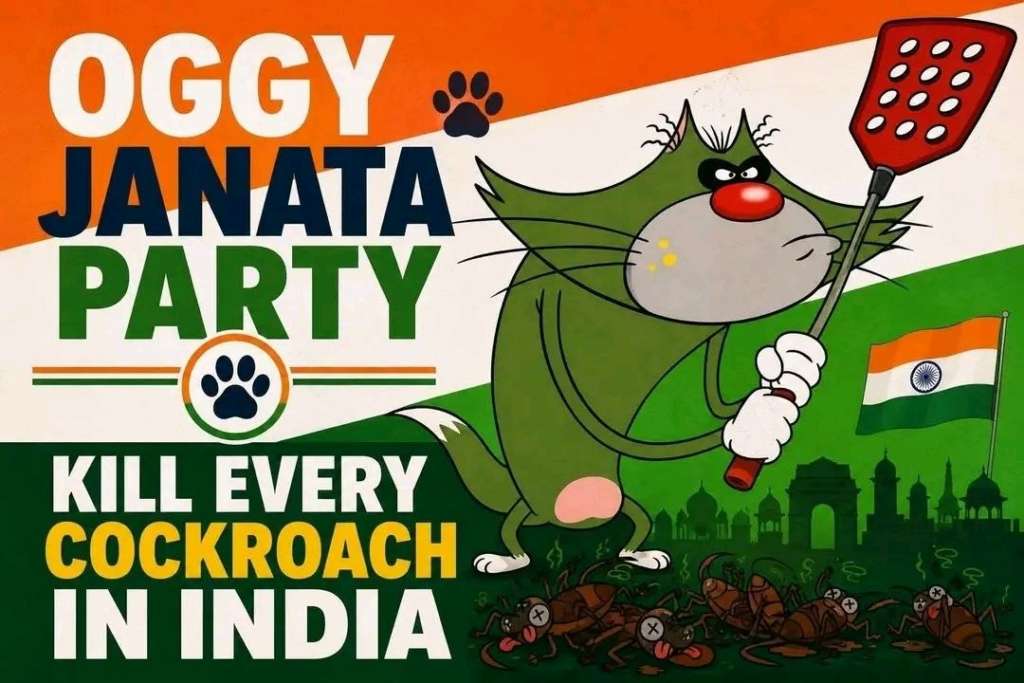
India’s meme-driven political internet has found a new rivalry. After the rapid rise of the satirical Cockroach Janta Party (CJP), another online group—the Oggy Janata Party (OJP)—has emerged claiming to “expose” its political links and question its neutrality.
What began as internet satire has now evolved into a wider online debate involving political affiliations, influencer culture, youth engagement, and digital propaganda.
What is Oggy Janata Party?
Oggy Janata Party and India’s meme-politics culture
Oggy Janata Party, or OJP, is an online social media movement that positions itself as a counter to the Cockroach Janta Party.
The group describes itself as:
- Independent from political parties
- Focused on “questioning everything”
- Critical of what it calls hidden political agendas
Its social media messaging strongly targets CJP and its founder, accusing them of indirect political alignment.
Why the name stands out
Like CJP, OJP uses humor, satire, and meme culture to attract younger internet audiences.
The naming style itself appears intentionally playful and internet-friendly—part of a broader trend where political commentary is packaged through viral content formats.
Why did OJP become popular?
The group gained traction after publicly raising questions about the background of Abhijeet Dipke, the founder of Cockroach Janta Party.
The controversy
OJP shared screenshots allegedly showing Dipke’s previous association with the Aam Aadmi Party (AAP).
According to the posts:
- Dipke worked on AAP’s social media campaigns between 2020 and 2023
- He participated in meme-based election campaigning
- He publicly praised AAP leaders in older posts
These revelations fueled online speculation over whether CJP is genuinely neutral or politically aligned.
What exactly did OJP accuse CJP of?
The central accusation is that Cockroach Janta Party presents itself as politically independent while allegedly having indirect ideological links.
Claims made by OJP
The group highlighted:
- Dipke’s past work with AAP
- His social media posts praising leaders like Arvind Kejriwal and Manish Sisodia
- Connections involving social media influencers associated with AAP-linked figures
OJP also questioned why opposition politicians were engaging with or supporting a supposedly youth-driven satirical movement.
Why this resonated online
Indian political social media increasingly revolves around:
- Meme warfare
- Influencer amplification
- Questions around “organic” vs coordinated campaigns
That made OJP’s accusations highly shareable and controversial.
What is Cockroach Janta Party?
Cockroach Janta Party and viral political satire
Cockroach Janta Party is a viral internet movement known for:
- Satirical political content
- Meme-heavy communication
- Criticism of mainstream politics
The movement rapidly gained millions of followers online, especially among younger users frustrated with traditional political discourse.
Why it went viral
Its content blends:
- Political jokes
- Pop-culture references
- Anti-establishment messaging
- Short-form social media humor
This style mirrors global trends where meme pages increasingly shape political narratives.
What is in OJP’s manifesto?
Unlike many purely satirical pages, OJP also released a manifesto outlining policy positions.
Major issues highlighted by OJP
Its agenda includes:
- Stray animal protection
- Free healthcare for animals
- Expansion of shelters and rescue systems
- Stricter animal cruelty laws
- Adoption awareness campaigns
Other political positions
The group also posted demands related to:
- Justice in the NEET paper leak controversy
- Resignation of Education Minister Dharmendra Pradhan
- A complete ban on beef slaughter and export
- Mandatory educational qualifications for lawmakers
This mix of internet activism and policy advocacy has helped distinguish OJP from purely meme-based accounts.
Why are meme-based political movements becoming influential?
The rise of OJP and CJP reflects a broader shift in political communication.
Politics is moving online
Younger audiences increasingly consume politics through:
- Instagram reels
- Meme pages
- Influencer commentary
- Viral clips and screenshots
Traditional speeches and TV debates often struggle to compete with fast-moving digital content.
Satire lowers barriers to engagement
Humor makes political content:
- Easier to share
- More emotionally engaging
- Less formal and intimidating
This allows movements to spread rapidly even without formal political structures.
Are these actual political parties?
As of now, these groups function primarily as online movements rather than officially recognized electoral parties.
What they currently resemble
They operate more like:
- Digital communities
- Political meme ecosystems
- Influencer-led activism networks
However, their reach can still influence public discourse and online sentiment.
Why this matters beyond internet drama
The clash between OJP and CJP highlights a larger trend: political narratives are increasingly shaped through decentralized online communities rather than traditional institutions alone.
What it reveals about modern politics
- Meme culture is becoming politically influential
- Online credibility is now heavily scrutinized
- Audiences demand “authenticity” from digital movements
- Political branding increasingly resembles influencer culture
The line between satire, activism, and political campaigning is becoming harder to distinguish.
TL;DR
- Oggy Janata Party (OJP) is a viral online movement challenging Cockroach Janta Party (CJP)
- OJP accuses CJP founder Abhijeet Dipke of links with AAP
- The controversy centers on whether CJP is politically neutral
- OJP has released a manifesto focused on animal rights and governance issues
- The rivalry reflects the growing role of meme culture in Indian politics