

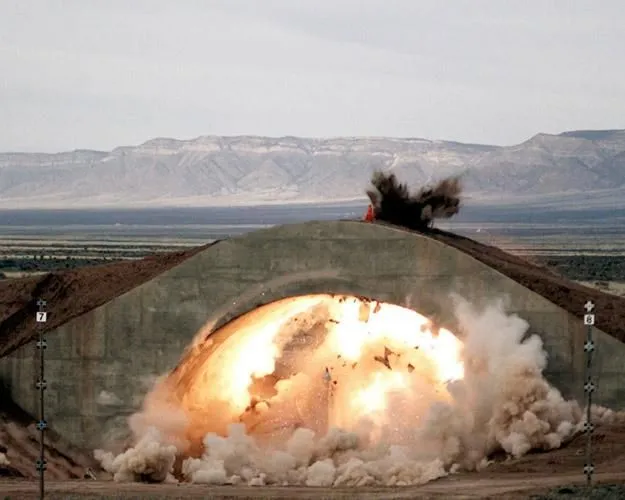
How Strong Is Iran’s Concrete?
When the U.S. launched Operation Midnight Hammer, targeting Iran’s Fordow, Natanz, and Isfahan nuclear sites, the expectation was that bunker-busting bombs would cripple Tehran’s underground facilities. Yet, early intelligence suggests the damage may be far less severe than anticipated. One possible explanation? Iran’s advanced UHPC concrete technology.
What Makes UHPC Concrete Different?
Traditional high-strength concrete typically withstands 5,000–10,000 psi (pounds per square inch). But Ultra-High Performance Concrete (UHPC) is in another league, with some variants enduring 40,000 psi or more.
How? UHPC incorporates steel or polymer fibers, turning concrete into a composite material that resists cracking.
“Instead of getting a few large cracks in a concrete panel, you get lots of smaller cracks. The fibers give it more fracture energy,” explains Dr. Stephanie Barnett, a concrete technology expert at the University of Portsmouth.
Past Failures of Bunker-Busters Against UHPC
This isn’t the first time Iran’s concrete has stumped military strategists. In the late 2000s, a bunker-buster bomb reportedly got stuck in an Iranian bunker’s surface without detonating. A disposal team had to remove it—an embarrassing failure that hinted at Iran’s advancements in fortified construction.
A Chinese study comparing traditional reinforced concrete to UHPC found that while standard bunkers were easily penetrated, UHPC structures only suffered minor cracks, with projectiles either bouncing off or embedding without full penetration.
Can Even the “Mother of All Bombs” Break UHPC?
The U.S. military’s Massive Ordnance Penetrator (MOP)—a 30,000-pound behemoth—was designed to destroy deeply buried targets. But experts question whether even this bomb can defeat UHPC-reinforced bunkers.
- Gregory Vartanov of Advanced Materials Development Corp argued in a 2021 defense journal that modern penetrator bombs cannot breach UHPC bunkers due to their extreme durability.
- The U.S. Air Force previously studied UHPC’s resilience and reportedly concluded that even 21,000-pound bombs (like the GBU-57 MOP) might fail against it.
Why This Matters for Iran’s Nuclear Program
If Iran’s nuclear sites are indeed shielded by UHPC, it means:
✔ Delayed, not destroyed: U.S. strikes may have set back Iran’s nuclear timeline by months, not years.
✔ Future-proof bunkers: Even heavier bombs may struggle to fully neutralize underground facilities.
✔ A new arms race: Countries may now prioritize bunker resilience as much as bomb potency.
What’s Next?
While the Pentagon assesses the damage, Iran insists its nuclear program is unscathed. If UHPC is the reason, it could force a rethink of bunker-busting strategies worldwide.
For now, one thing is clear: Iran’s concrete may be tougher than the bombs meant to destroy it.
The U.S. recently deployed bunker-busting bombs against Iran’s underground nuclear facilities, but early intelligence suggests the damage may be minimal. Iran is believed to be a leader in Ultra-High Performance Concrete (UHPC), a material far stronger than traditional reinforced concrete. Reports indicate that even the 30,000-pound Massive Ordnance Penetrator (MOP) may struggle to penetrate UHPC-reinforced bunkers. If true, this could explain why Iran claims its nuclear program remains largely unaffected by the recent strikes.


