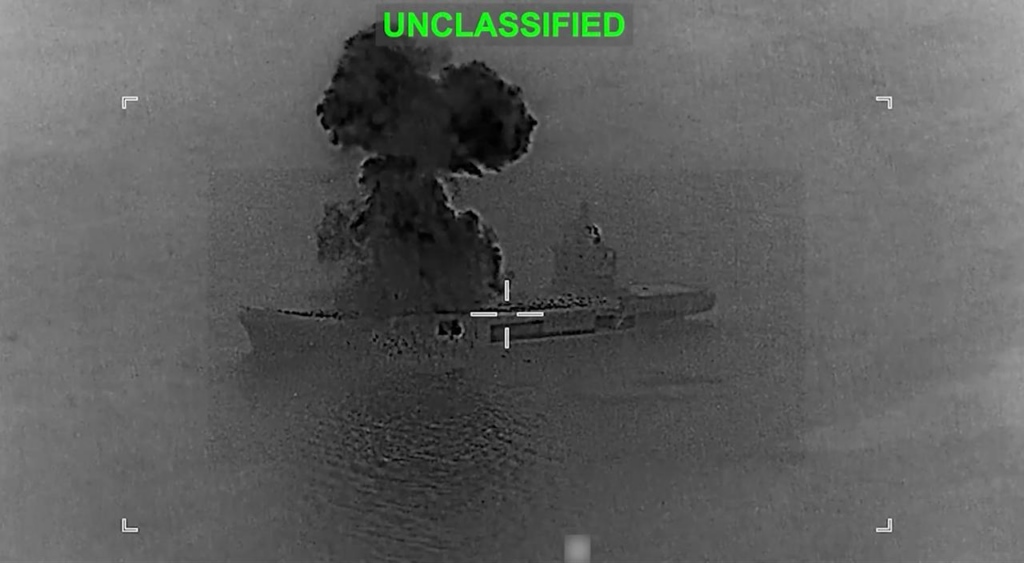
The United States military says it struck a massive Iranian drone carrier during the ongoing conflict with Tehran, releasing video footage that it claims shows the vessel engulfed in flames after the attack. The operation, carried out under the banner of Operation Epic Fury, marks another escalation in the rapidly intensifying confrontation between Washington and Iran.
According to the US military, the targeted ship was roughly the size of a World War II–era aircraft carrier. The strike was announced by the United States Central Command, which oversees American military operations across the Middle East.
The latest development comes as the war enters its sixth day and both sides signal that military operations could continue for weeks.
What does the CENTCOM video show?
CENTCOM shared footage on social media showing what it described as the aftermath of a US strike on an Iranian drone carrier.
In the clip, the vessel appears to be burning heavily following the attack. The military command said the strike was part of a broader campaign targeting Iranian naval capabilities.
Posting the video, CENTCOM wrote that US forces were “not holding back” in their mission and were working to neutralize Iran’s naval power.
The statement claimed that the drone carrier struck by US forces was roughly comparable in size to aircraft carriers used during World War II, underscoring the scale of the target.
At the time of publication, independent verification of the video had not been confirmed by third-party sources.
What is Operation Epic Fury?
Operation Epic Fury is the name used by the United States for the current military campaign against Iran. The operation began on February 28 with coordinated strikes carried out by US and Israeli forces.
Israel refers to its part of the campaign as Operation Lion’s Roar.
The opening phase of the strikes reportedly targeted senior Iranian leadership and military infrastructure. Among those killed was Ali Khamenei, Iran’s longtime supreme leader, whose death was confirmed on March 1.
His killing dramatically intensified the conflict and triggered vows of retaliation from Tehran.
What role is the USS Gerald R. Ford playing?
CENTCOM also highlighted the involvement of the USS Gerald R. Ford (CVN-78), the largest aircraft carrier in the world.
According to the command, the carrier is playing a central role in sustaining air operations during the campaign. The ship’s air wing is reportedly conducting around-the-clock sorties using carrier-based fighter jets.
CENTCOM said aircraft operating from the carrier include the Boeing F/A-18 Super Hornet, which are conducting strike missions across the theater.
Aircraft carriers like the USS Gerald R. Ford function as floating airbases, allowing the United States to project military power without relying on land bases inside the conflict zone.
Why aircraft carriers matter in modern warfare
Aircraft carriers offer several strategic advantages:
• Mobility across international waters
• Rapid deployment of air power
• Continuous air operations far from home territory
• Command and control hubs for naval strike groups
The Gerald R. Ford class represents the newest generation of US carriers and is designed to support higher sortie rates and advanced radar systems.
How has Iran responded to the strikes?
Iran has launched retaliatory attacks across the region following the initial US and Israeli strikes.
According to regional reports, Iranian forces and allied groups have targeted US military facilities and Israeli positions across several countries, including:
• Bahrain
• Kuwait
• United Arab Emirates
• Qatar
• Saudi Arabia
• Jordan
Tehran has warned that US military installations across the Middle East would be treated as legitimate targets if the attacks continue.
Iran-aligned groups in the region have also joined the fighting, expanding the risk of a broader regional war.
Why the drone carrier matters
Iran has increasingly invested in unconventional naval capabilities over the past decade.
Instead of relying on traditional large warships, Tehran has focused on asymmetric naval strategies that include:
• Drone carriers
• Fast attack boats
• Naval drones
• Anti-ship missile platforms
Drone carriers allow Iran to launch surveillance and attack drones at sea, extending its reach across strategic waterways such as the Persian Gulf and the Gulf of Oman.
Military analysts say disabling such platforms could significantly weaken Iran’s maritime surveillance and strike capabilities.
Growing international concern
The rapidly escalating conflict has triggered global concern about the possibility of a wider war.
Several governments in the Gulf have called for restraint and urged diplomatic efforts to prevent further escalation. At the same time, many NATO members have voiced support for Washington’s actions.
International leaders have warned that prolonged fighting could disrupt global energy markets and destabilize shipping routes in the region.
The Persian Gulf remains one of the most strategically important maritime corridors in the world, carrying a significant share of global oil exports.
What happens next?
US officials have signaled that military operations could continue for an extended period as they attempt to degrade Iran’s military infrastructure.
Iran, meanwhile, has pledged strong retaliation for the killing of its leadership and attacks on its naval assets.
Key developments to watch include:
• Further strikes on Iranian naval infrastructure
• Possible expansion of attacks on US regional bases
• Involvement of additional regional militias
• Diplomatic efforts aimed at de-escalation
As the conflict unfolds, the accuracy of battlefield claims from all sides remains difficult to independently verify. Analysts caution that information warfare and propaganda often accompany major military confrontations.
TL;DR
US Central Command says American forces struck a large Iranian drone carrier during Operation Epic Fury, releasing video footage showing the vessel on fire. The strike comes as the US-Iran conflict enters its sixth day, with Iran launching retaliatory attacks across the region and international leaders urging restraint.