
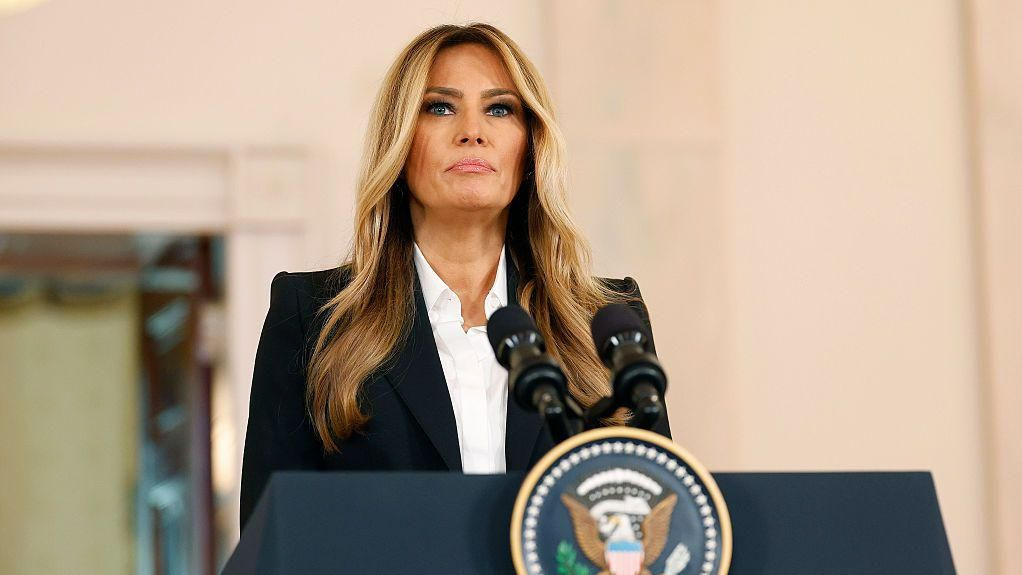
In a rare display of humanitarian cooperation amid an ongoing geopolitical standoff, First Lady Melania Trump revealed that she and Russian President Vladimir Putin have established a direct line of communication focused on reuniting Ukrainian children separated from their families during the Russia-Ukraine conflict.
Speaking from the Grand Foyer of the White House on Friday, Melania Trump announced that eight children had already been successfully reunited with their families in the past 24 hours. The First Lady called the initiative a “shared purpose with lasting impact,” signaling a surprising development in U.S.–Russia relations at a time when tensions remain high over Moscow’s invasion of Ukraine and Vladimir Putin’s international standing.
Why Is the U.S. First Lady Working with Vladimir Putin?
Melania Trump’s involvement in this issue started with a personal appeal. Earlier this year, she penned a letter directly to President Putin, urging him to make the safety and reunification of displaced children a priority. The letter was hand-delivered by President Donald Trump during a rare in-person meeting with Putin in Alaska this past August.
While diplomacy between Washington and Moscow has remained frozen since the war began in 2022, the First Lady’s move to bypass traditional channels and appeal directly to Putin appears to have yielded results.
Putin responded with a letter of his own, agreeing to work with the First Lady’s office and sharing information on Ukrainian children currently living in Russia. This response triggered the formation of what Melania Trump described as an “open channel of communication” specifically focused on child reunification.
What Do We Know About the Reunited Children?
According to the First Lady, the eight children returned to their families include:
- Three who were displaced to Russia due to front-line fighting in eastern Ukraine.
- Five who were separated across borders during chaotic evacuations—including one girl who voluntarily crossed into Russia.
Melania Trump said she has received a “detailed report” about each of the children from Russian officials and that the information has been independently confirmed by U.S. government sources. This verification is crucial, especially given longstanding concerns about the accuracy of Russian accounts of wartime activities.
The First Lady also raised a new concern: what happens to displaced minors who have since turned 18. “Their safe return requires coordinated assistance,” she said, noting that Russia has agreed to work on facilitating their return “within a short period of time.”
How Significant Is This Amid Ongoing War Crimes Allegations?
This effort comes against a highly sensitive backdrop. In 2022, the International Criminal Court (ICC) issued an arrest warrant for Vladimir Putin, accusing him of war crimes related to the abduction and forced deportation of Ukrainian children. The warrant, which is still active, was based in part on documentation compiled by Associated Press reporters and Ukrainian officials.
The ICC’s findings alleged that Russia had unlawfully moved children from occupied regions of Ukraine to facilities in Russia—a charge Moscow denies, claiming the children were relocated for their own safety.
Melania Trump’s new channel with Putin does not negate these charges. But it adds a layer of complexity: cooperation is now happening even as Putin remains wanted by international law.
This makes the initiative politically delicate. It’s unclear how it aligns with broader U.S. policy, especially as Washington continues to support Ukraine militarily and diplomatically.
Why Does This Matter?
The reunification of even a handful of children may seem minor compared to the war’s wider devastation. But in humanitarian terms, this development is significant for a few key reasons:
1. A Shift in Diplomatic Tone
This is one of the first publicly acknowledged collaborations between the U.S. and Russia on any humanitarian issue since the invasion began in February 2022. It could mark a turning point—albeit a small one—toward limited cooperation.
2. Human Impact Over Politics
Melania Trump framed the initiative in emotional terms, stating: “A child’s soul knows no borders, no flags.” That language is striking—deliberately sidestepping political posturing to focus on the human cost of war.
3. A Test Case for Future Reunifications
This early success may serve as a proof of concept. If U.S. and Russian teams can verify identities, coordinate across borders, and prioritize safety in these cases, the same framework could potentially help hundreds—or even thousands—more.
What Comes Next?
The First Lady emphasized that this is “just the beginning” of her efforts. Her team, she said, will continue working with Russian counterparts to identify more children who can be safely returned to their families.
She also made a broader appeal for global unity in protecting children from conflict. “We must foster a future for our children which is rich with potential, security, and complete with free will—a world where dreams will be realized rather than faded by war.”
But with the ICC warrant still hanging over Putin and deep-rooted mistrust between Russia and the West, there are still open questions:
- Will Russia allow independent organizations (like the Red Cross or UNICEF) to verify future reunifications?
- Could this backchannel lead to broader humanitarian cooperation—or is it a one-off?
- And what happens if the effort stalls or becomes politicized?