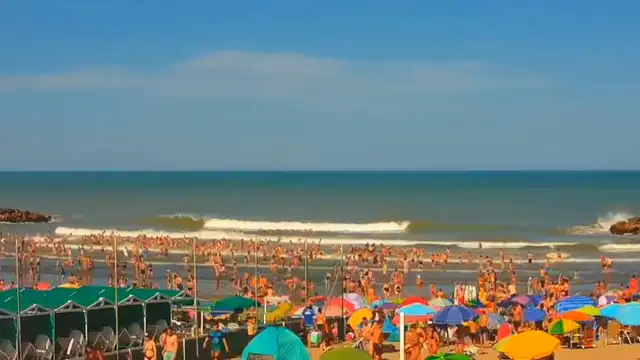
Beachgoers expecting a routine summer afternoon on Argentina’s Atlantic coast instead found themselves running for their lives. On Monday, a sudden and violent meteotsunami surged onto the shore in Santa Clara del Mar, killing one man, injuring several others, and leaving witnesses struggling to describe what they saw.
The rare event, often called a “mini tsunami,” struck without warning. Within moments, calm waters pulled back and then roared forward, transforming a crowded beach into a scene of chaos. Videos captured panic and confusion, even if the wave itself wasn’t caught on camera. What followed has raised urgent questions about how such events form, why they’re so hard to predict, and whether coastal communities are prepared for them.
What happened during the meteotsunami in Argentina?
According to local authorities and eyewitnesses, the sea changed abruptly in Santa Clara del Mar, a popular coastal town in Buenos Aires province. People swimming were suddenly dragged toward deeper water, while those on shore scrambled to escape as the surge rushed in.
Several beachgoers estimated the wave rose as high as 30 feet before crashing ashore. While that figure has not yet been independently verified, multiple witnesses described the same sequence: the water retreated unnaturally fast, then returned as a towering wall.
One victim, 29-year-old Yair Amir Manno Núñez, was vacationing with his girlfriend when he was swept away. Rescuers pulled him from the water and rushed him to a local hospital, but doctors said a severe blow to the head caused a fatal cardiorespiratory arrest.
Another man reportedly suffered a heart attack after being pulled into the sea, according to Argentine media outlet Diario de Cuyo. Lifeguards said the surge also ripped umbrellas, towels, and bags from the sand, scattering personal belongings across the beach.
“The waves reached unimaginable heights,” said Nahuel Nardone, head of the local lifeguard union. Another rescuer described seeing a “black whirlpool,” unlike anything he had encountered before.
🚨 🌊 🇦🇷 Argentina: Un meteotsunami "ola grande" de 4 metros sorprendio a turistas.
Una persona murió y al menos 35 resultaron heridas leves luego de que una ola impactara de manera sorpresiva pic.twitter.com/3ieYk5offq
#Argentina 🌊 Fenómeno histórico en la Costa Atlántica 📍 Santa Clara del Mar ⚠️ Una ola gigante, un “mini tsunami” que no ocurría desde 1954, golpeó la costa: 🔴 1 hombre murió al chocar contra las rocas 🟠 Más de 30 heridos pic.twitter.com/CGgIvIQr38
A meteotsunami is a wave that behaves like a tsunami but is not caused by an earthquake.
Instead of tectonic shifts, these events are driven by rapid changes in the atmosphere, particularly sudden drops in air pressure combined with strong winds. The result can be a powerful surge that amplifies as it moves into shallow coastal waters.
How is it different from a regular tsunami?
While the effects on shore can look similar, the causes are very different:
ADVERTISEMENT
Traditional tsunamis
Triggered by underwater earthquakes, landslides, or volcanic eruptions
Often detected by seismic monitoring systems
Can travel across entire oceans
Meteotsunamis
Triggered by atmospheric disturbances
Can form and strike within minutes
Are extremely hard to forecast
Because they don’t involve seismic activity, meteotsunamis usually arrive without official warnings, making them especially dangerous for swimmers and beachgoers.
Why are meteotsunamis so hard to predict?
Fabián García, head of Civil Defense for Buenos Aires province, said the phenomenon is rare in the region and notoriously difficult to forecast.
That unpredictability comes down to timing and scale.
Meteotsunamis form when a fast-moving atmospheric pressure disturbance travels at roughly the same speed as ocean waves. When those speeds align, the energy transfers efficiently into the water, causing waves to grow rapidly, sometimes within a single bay or stretch of coastline.
Unlike hurricanes or major storms, the atmospheric triggers can be brief and localized, making them easy to miss with conventional forecasting tools.
What warning signs should beachgoers watch for?
Even without sirens or alerts, meteotsunamis often show subtle but critical warning signs.
Common red flags include:
The sea pulls back suddenly, exposing more shoreline than usual
A rapid change in wind direction or intensity
Dark, fast-moving clouds overhead
Unusual roaring or rushing sounds from the ocean
Several witnesses in Santa Clara del Mar reported seeing the water withdraw just before the surge returned “like a wall.”
Experts say if you notice the sea behaving strangely, get out of the water immediately and move inland or to higher ground.
Where else do meteotsunamis occur?
While rare, meteotsunamis are not unique to Argentina. Scientists have documented them in multiple parts of the world, including:
The Great Lakes in the United States
The Gulf of Mexico
The U.S. Atlantic Coast
The Mediterranean and Adriatic Seas
In 1954, a meteotsunami in Chicago reportedly produced waves over 10 feet high, killing seven people along Lake Michigan. More recently, similar events have been studied along the coasts of Spain, Croatia, and Italy.
Why this event matters beyond Argentina
The deadly meteotsunami in Santa Clara del Mar underscores a growing concern for coastal safety in an era of increasingly volatile weather patterns.
While scientists caution against linking any single event directly to climate change, there is broad agreement that atmospheric instability is increasing. More intense pressure swings and sudden storms could raise the likelihood of rare but dangerous phenomena like meteotsunamis.
For coastal towns dependent on tourism, the risks aren’t just physical, they’re economic. Beaches are often crowded, and a sudden surge leaves little time for evacuation.
Are authorities prepared for future meteotsunamis?
At present, most coastal warning systems are designed around earthquakes and storms, not atmospheric-driven waves. That gap leaves communities reliant on:
Trained lifeguards
Public education
Rapid emergency response
In Santa Clara del Mar, lifeguards rushed into action once the waves receded, but officials have acknowledged that warning was virtually impossible.
Researchers are now pushing for better integration between meteorological monitoring and coastal alert systems, a step that could provide precious minutes of warning in the future.
TL;DR
A meteotsunami struck Santa Clara del Mar, Argentina, killing one man and injuring others.
Unlike traditional tsunamis, meteotsunamis are caused by atmospheric pressure changes, not earthquakes.
They strike suddenly and are extremely hard to predict.
Warning signs include rapidly receding water and sudden weather shifts.
As weather patterns grow more volatile, experts say awareness and preparedness matter more than ever.