
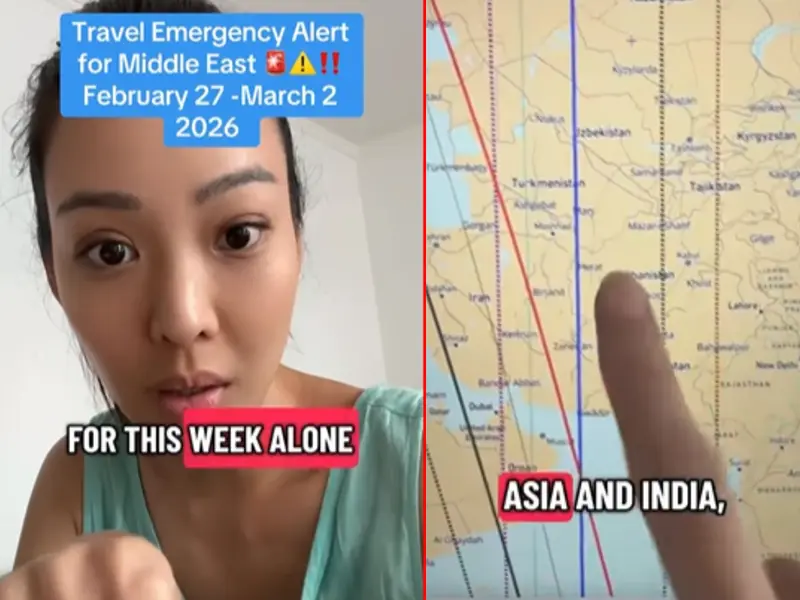
As geopolitical tensions dominate headlines, predictions from astrologers are once again circulating widely online. One such forecast has attracted attention after an astrologer who warned about instability in the Middle East days before the current crisis is now cautioning about potential turmoil in parts of South and Central Asia.
The astrologer, Natalia, who describes herself as an expert in astrocartography and locational astrology, claims planetary alignments later this year could bring “volatile energies” to regions including India, Pakistan, and Afghanistan. Her comments have gained traction on social media as people revisit earlier clips in which she advised travelers to avoid parts of the Middle East shortly before the latest escalation began.
While astrology predictions often go viral during periods of uncertainty, experts stress that such forecasts are not based on scientific evidence.
What Did the Astrologer Predict?
Natalia’s recent forecast focuses on planetary movements involving Mars and Uranus, which she says could create instability across parts of Central and South Asia in 2026.
In a video circulating online, she suggests that these planetary alignments could coincide with heightened tensions in several regions.
She identifies two key periods when volatility could peak:
- July 4, 2026
- December 5, 2026
According to her interpretation of planetary movements, the alignment of Mars and Uranus may correspond with unrest affecting areas across Central Asia and the Indian subcontinent.
In the video, she says the planetary configuration that recently coincided with turbulence in the Middle East will move eastward later this year.
“So around the 4th of July, Mars and Uranus, our favorite duo, which just caused a lot of havoc here, are going to move slightly to the east,” she said in the clip.
Regions Mentioned in the Forecast
The astrologer’s warning specifically references several locations across Central and South Asia.
These include:
- Uzbekistan
- Turkmenistan
- Afghanistan
- Pakistan
- India
- Oman
She suggests the July alignment could influence Central Asia first, while a similar planetary configuration in December could affect areas around Karachi and Afghanistan.
Natalia also links the planetary movements to modern forms of conflict, saying that with Uranus positioned in Gemini, potential tensions could involve technology or information-based warfare rather than traditional military battles.
Watch the video here
Why the Prediction Is Going Viral
The forecast is attracting attention primarily because of Natalia’s earlier warning about travel to parts of the Middle East.
Days before the current regional escalation, she posted a video advising travelers to be cautious when visiting countries such as the United Arab Emirates, Oman, and Iran.
In that post, she wrote:
“The Middle East is a hotbed for uncertainty this week; those travelling to the UAE, Oman, and Iran, especially, please be careful.”
Following the outbreak of conflict in the region, social media users began sharing the earlier clip, describing it as a “prediction” of the crisis.
However, such correlations are often interpreted differently depending on context, and many analysts note that geopolitical tensions in the Middle East had already been building before the latest escalation.
What Is Astrocartography?
Natalia says her predictions are based on astrocartography, a branch of astrology that claims planetary positions influence specific geographic regions.
Astrocartography attempts to map planetary alignments across Earth’s surface and interpret how these alignments might affect events in certain locations.
Supporters believe planetary configurations can influence:
- Travel outcomes
- Personal life events
- Political tensions in specific regions
However, scientists generally classify astrology and astrocartography as pseudoscience because their claims have not been supported by empirical evidence.
Why Astrology Often Gains Attention During Crises
Astrology predictions frequently trend online during periods of global uncertainty.
Researchers who study public behavior during crises note that people often turn to forecasts, prophecies, or predictions when geopolitical situations feel unpredictable.
Several factors contribute to the popularity of such content:
- Increased anxiety during global conflicts
- Social media amplification of viral clips
- Retrospective interpretation of predictions
- Cultural fascination with prophecy traditions
Historically, predictions from figures like Nostradamus have resurfaced during major global events for similar reasons.
Reality Check: Experts Urge Caution
While the predictions are generating attention online, experts emphasize that astrology cannot reliably forecast political or military events.
Conflicts between nations are influenced by complex factors, including:
- diplomatic relations
- military strategy
- economic interests
- historical rivalries
These developments are studied using political analysis, intelligence assessments, and historical context rather than planetary alignments.
Scientists and researchers note that astrology predictions often appear accurate in hindsight because their wording can be interpreted broadly.
The Bottom Line
The astrologer’s warning about “volatile energies” in India, Pakistan, and Central Asia is part of a broader wave of predictions circulating online during a time of heightened global tensions.
While the forecast highlights specific dates later in 2026, there is no scientific evidence linking planetary alignments to geopolitical events.
Still, the prediction illustrates how astrology continues to capture public attention during moments of uncertainty.
TL;DR
- An astrologer who warned about instability in the Middle East is now predicting volatility in Central and South Asia.
- She cites planetary alignments involving Mars and Uranus.
- Two dates mentioned in the forecast are July 4, 2026, and December 5, 2026.
- Regions referenced include India, Pakistan, Afghanistan, and parts of Central Asia.
- Experts say astrology predictions are not scientifically reliable indicators of geopolitical events.