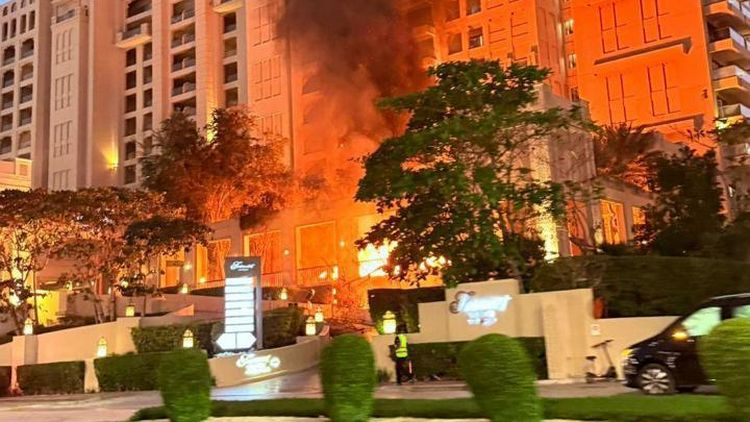
An Irish businessman who was staying at Dubai’s luxury beachfront resort has described the terrifying moment Iranian drones struck near his hotel, shaking his room and sending guests scrambling for safety.
The incident occurred at Fairmont The Palm in Dubai during a wave of retaliatory strikes launched by Iran across the Middle East. The attacks followed a major joint military operation by the United States and Israel that killed Iran’s Supreme Leader Ali Khamenei.
For travellers caught in the region, the strikes transformed what began as an ordinary weekend into a chaotic escape from a rapidly escalating conflict.
What Triggered the Iran Retaliation Attack?
The drone strikes came after the United States and Israel carried out coordinated military attacks on Iranian targets on February 28.
Washington reportedly called the operation Operation Epic Fury, while Israeli officials referred to it as Operation Lion’s Roar.
The strikes targeted senior Iranian leadership and reportedly killed Ali Khamenei along with several high-ranking officials. The operation occurred amid rising tensions between Tehran and Washington and ongoing negotiations surrounding Iran’s nuclear program.
Iran quickly responded with a sweeping regional retaliation. According to early reports, missiles and drones were launched toward:
- Israel
- U.S. military bases in Bahrain
- Kuwait
- The United Arab Emirates
- Qatar
- Saudi Arabia
- Jordan
The broad geographic scope of the strikes signalled a dramatic escalation, turning much of the Gulf region into a potential conflict zone.
Irish Tourist Describes “Nerve-Wracking” Moments During Drone Strike
Among those caught in the unfolding crisis was Stuart Carson, an Irish businessman visiting Dubai from Holywood in County Down.
Speaking later to BBC News NI, Carson described waking to loud explosions early Saturday morning.
At first, he assumed the noise came from nearby construction—common in a city constantly expanding its skyline.
But the situation quickly became far more alarming.
“It was very nerve-wracking,” Carson said. “The drone struck close to one of my friends’ rooms.”
Carson said he soon realised the sounds were not construction but the interception of Iranian missiles and drones overhead.
Shortly afterwards, a drone struck near the hotel, sending shockwaves through the building.
Inside the Fairmont The Palm During the Attack
Carson said he was inside his room when the drone detonated nearby.
“The whole room completely shook,” he recalled.
According to Carson, the blast occurred close to a room where a friend was staying with his son.
His friend immediately called him.
“He said, ‘We’ve been attacked in some way, shape, or form.’”
Videos circulating on social media later showed flames and smoke near sections of the hotel property, suggesting that part of the complex caught fire following the strike.
Chaos in the Lobby
When Carson went downstairs, the scene in the hotel lobby was chaotic.
He described:
- Damaged front doors
- Guests rushing toward exits
- Hotel staff assisting injured individuals
At one point, he saw a bellboy being pulled away from the entrance as people tried to assess what had happened.
“At that point, we just didn’t know what to do,” he said.
Guests Take Shelter as Situation Unfolds
Carson said he and other guests initially fled toward a nearby beach for safety.
Later that evening, they relocated to the hotel’s basement area, which offered more protection from potential further strikes.
The night was filled with uncertainty as authorities attempted to determine the scope of the attacks across the region.
For many tourists, it was the first time they had experienced a military strike zone firsthand.
Morning After: A Fragile Return to Normalcy
When dawn broke the following day, the situation appeared calmer.
Guests cautiously resumed normal activities.
Carson said people gathered in the hotel restaurant for breakfast while trying to process what had happened overnight.
“Once dawn broke, we started to feel a bit more comfortable,” he said.
But the sense of relief was temporary.
The group soon decided it was best to leave the area entirely.
Stranded by Flight Cancellations
The wider regional conflict quickly disrupted air travel across the Gulf.
Airlines began cancelling or rerouting flights due to safety concerns.
Carson’s original flight home with British Airways was among those cancelled.
Like many travellers caught in the disruption, he began searching for alternative routes out of the region.
“We were looking at all options,” he said.
His priority was simple: get as close to home as possible.
A Long Journey Back to Northern Ireland
After multiple booking attempts, Carson finally managed to secure a route back to Europe.
He ultimately landed at Belfast City Airport on Tuesday evening.
The relief, he said, came once the plane had been in the air long enough to leave the danger zone.
“When we were watching the map on the flight, we knew we were kind of out of it,” he explained.
After the first hour of the journey, passengers began to relax.
“That’s when the relief started to set in.”
Why the Dubai Attack Matters Globally
Dubai has long been viewed as one of the safest and most stable cities in the Middle East.
A strike near a major international hotel underscores how rapidly geopolitical conflicts can spill into civilian spaces—even those far from traditional battlefields.
Several factors make the incident particularly significant:
1. Expansion of Conflict Geography
Iran’s retaliation targeted multiple countries across the region, dramatically widening the conflict footprint.
2. Civilian Risk
The strike near a major tourist hotel highlights how civilian infrastructure can become collateral damage during military escalation.
3. Travel and Aviation Disruption
Airspace closures and flight cancellations across the Gulf region have immediate global ripple effects.
Airlines and aviation regulators typically respond quickly to military threats, sometimes shutting down entire flight corridors.
What Travelers Should Know During Regional Conflicts
Events like the Dubai drone strike highlight how quickly travel conditions can change during geopolitical crises.
Travel experts generally recommend:
- Registering with your country’s embassy when travelling abroad
- Monitoring airline updates and government advisories
- Keeping emergency cash and identification accessible
- Identifying safe areas within hotels or buildings
Tourists in high-traffic international hubs like Dubai often assume they are far removed from geopolitical tensions—but recent events suggest otherwise.
TL;DR
- An Iranian retaliatory drone strike occurred near Fairmont The Palm in Dubai.
- The attack followed U.S. and Israeli strikes that reportedly killed Ali Khamenei.
- Irish businessman Stuart Carson described his room shaking during the strike.
- Hotel guests took shelter overnight as chaos unfolded.
- Regional flight disruptions delayed Carson’s return home to Belfast City Airport.