
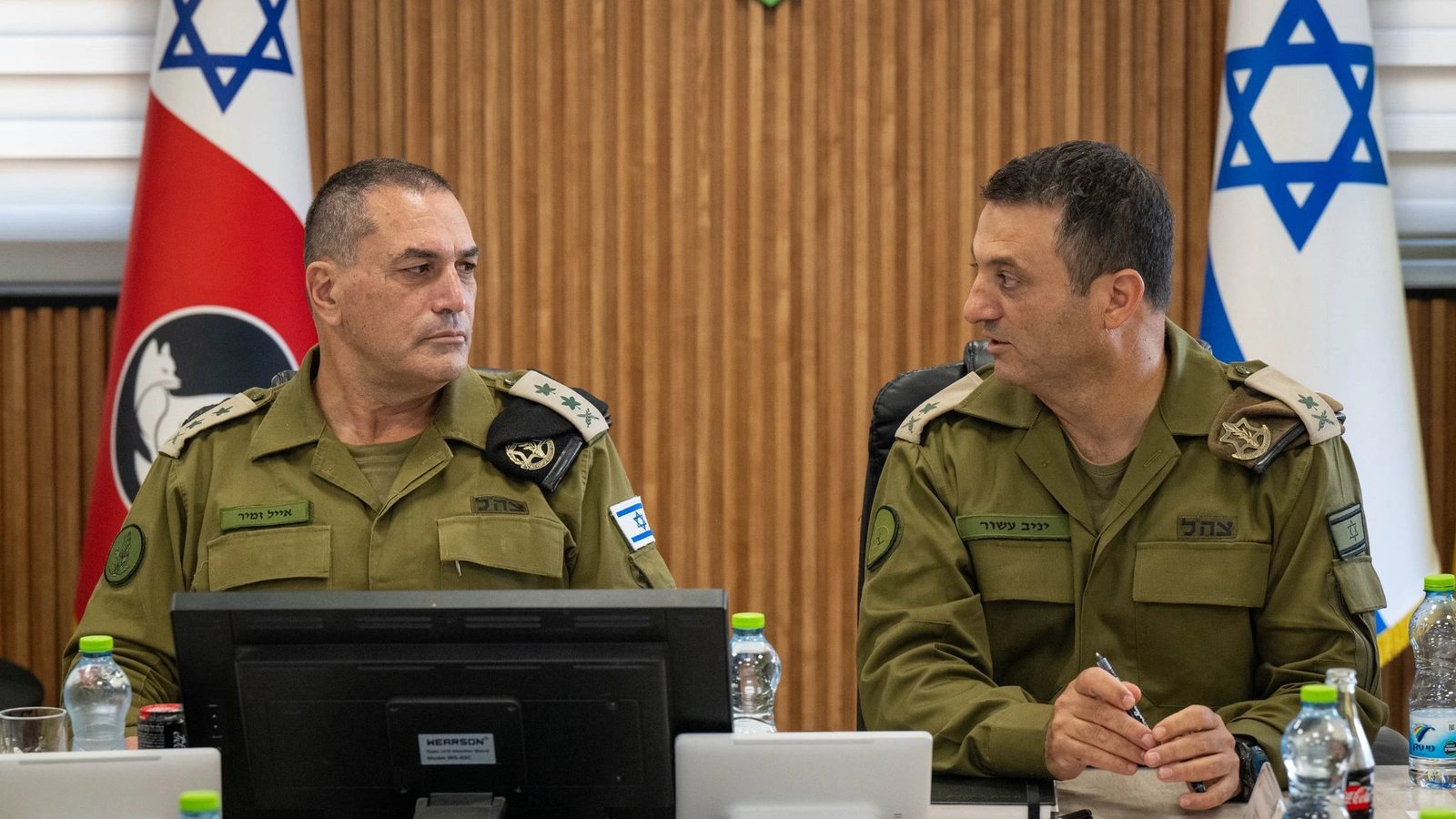

Israel’s Channel 12 reported late Sunday, Oct. 25, that army chief Lt. Gen. Eyal Zamir resisted an unspecified Iran-related directive from the political leadership. Citing unnamed sources, it said Zamir asked for a detailed discussion, legal guarantees and signatures before acting.
Prime Minister Benjamin Netanyahu, Defense Minister Israel Katz and the Israel Defense Forces all deny any rift. The report came less than 48 hours before Israelis vote on Tuesday, Oct. 27. Final polls showed neither bloc at 61 seats.
For Americans, the question is whether the US-Israeli war with Iran resumes, and when. President Donald Trump said on Oct. 8 that the US would not attack Iran before the Nov. 3 midterms. CNN reported on Monday that Zamir had also raised his concerns with the US military.
What Channel 12 and others reported
Channel 12 described a confrontation between Zamir and Netanyahu, according to CNN. It said Zamir feared a miscalculation that could start an immediate conflict with Iran.
The broadcaster did not say what the directive was. Its sources spoke of concern in the army “that the war might be exploited for political gain,” AFP reported.
Three other outlets have published similar accounts, all from unnamed officials. Army Radio cited two senior security officials on Monday morning, The Times of Israel reported. Haaretz military analyst Amos Harel wrote that the army’s top brass disagree with Netanyahu over whether an offensive is urgent.
CNN went further. Citing two US officials and an Israeli security source, it said Netanyahu pushed for a joint attack on Iran before the election. US officials asked him to wait.
The Israeli source told CNN that “Trump did not give a green light.” The source said one reason was Zamir’s warning to Gen. Dan Caine, chairman of the US Joint Chiefs. Zamir told Caine an attack “would harm the elections in Israel and lead to their postponement,” the source said.
None of these outlets named a source or described the operation. No outlet has published a document or recording.
What Netanyahu, Katz and the IDF said
Netanyahu called the Channel 12 report “rubbish” in a TV appearance, AFP reported. He said Israel’s army, military intelligence and Mossad chiefs had all said Iran is trying to harm the election.
Katz called the reports of disagreement “completely baseless and false.” He added: “I state unequivocally that Israel had no intention of initiating an attack on Iran before the elections in Israel,” The Times of Israel reported.
The IDF said it is focusing on its missions. “Any other discourse is misleading and irrelevant,” it said, according to The Times of Israel. Netanyahu’s office called the CNN account “fake news” and gave no details.
Opposition leader Yair Lapid wrote on X that Netanyahu “wants to set off an escalation and a confrontation with Iran, just to postpone the elections.” Gadi Eisenkot, a former army chief who leads the Yashar party, said: “Netanyahu, I’m watching you,” RTÉ reported.
Who is Eyal Zamir?
Zamir has led the army since March 5, 2025. He took over from Lt. Gen. Herzi Halevi, who resigned over the military’s failure to prevent the Hamas attack of Oct. 7, 2023. The cabinet confirmed Zamir as the IDF’s 24th chief of staff on Feb. 16, 2025, The Times of Israel reported.
Born in Eilat, he joined the army in 1984 as a tank officer. He commanded the 7th Armored Brigade in 2003 and the 36th Armored Division in 2009. He is the first chief of staff who began his service in the Armored Corps.
He served as Netanyahu’s military secretary from 2012 to 2015, then led Southern Command, which covers the Gaza border. He was deputy chief of staff from 2018 to 2021. He was a candidate for the top job in 2018 and 2022, when Aviv Kohavi and then Halevi got it, according to The Times of Israel.
After leaving the army, he spent 2021–22 as a visiting military fellow at the Washington Institute for Near East Policy. There he wrote a report on countering Iran’s regional strategy. He ran the Defense Ministry as director general from 2023 until Netanyahu and Katz picked him in February 2025.
How the Iran question reached election week
The US and Israel struck Iran on Feb. 28, 2026, killing its supreme leader. Fighting between Israel and Iran largely ended in April, The Times of Israel reported. Iran has since blocked the Strait of Hormuz, and the US has blockaded Iranian ports. We covered the latest flare-up when Iran said seven tankers were hit.
Zamir’s name came up earlier this month. On Oct. 8, Channel 12 reported that US officers told him to prepare for a large strike on Iran within three weeks. He warned it could postpone Israel’s election, The Times of Israel reported.
Trump wrote on Truth Social that day: “We will not be attacking Iran at any time prior to the Midterm Elections to be held in the United States on November 3rd.” CNN carried the post.
Netanyahu has said on the record that he told the IDF and Mossad to work toward toppling Iran’s government. Channel 12 did not establish whether that order and the directive it reported are linked, Anadolu Agency noted.
What happens after the vote
Polls are open from 7 a.m. to 10 p.m. Tuesday, Israel time, or 1 a.m. to 4 p.m. Eastern. Official results are due by Nov. 4. No Israeli party has ever won a majority alone, the Library of Congress notes, so a coalition must form. Netanyahu’s government stays on as a caretaker until then.
CNN’s sources expect any joint US-Israeli action against Iran to come after the US midterms on Nov. 3.