
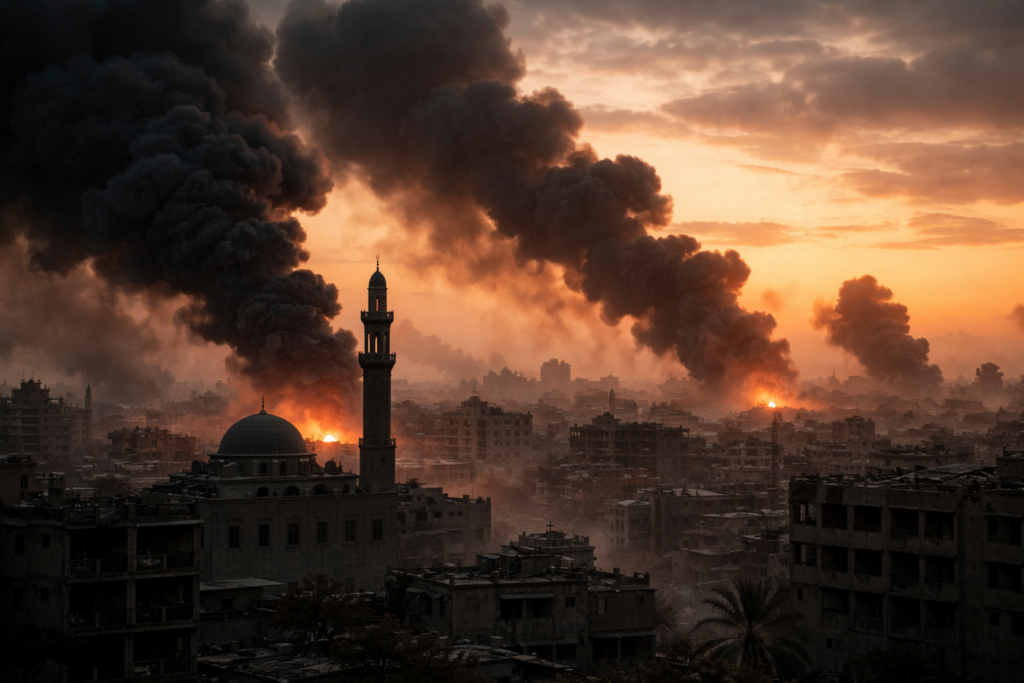
On day 17 of the U.S.-Israeli military campaign against Iran, the most significant development may not be a missile strike or a diplomatic breakthrough. It is a single sentence from Iran’s Foreign Minister Abbas Araghchi: “We never asked for a ceasefire, and we have never asked even for negotiation. ” That defiance is not bravado; it is a calculated bet that every passing day of war costs Washington and its allies more than it costs Tehran.
The Core Story: What Is Happening on Day 17?
As of Monday, March 17, Israeli forces launched a fresh wave of airstrikes on Tehran, with thick black smoke visible over the Iranian capital early in the morning, according to Al Jazeera and CNN. Iranian state media reported large booms across the city. The strikes targeted infrastructure sites, continuing a campaign that has now killed at least 1,444 people in Iran and injured more than 18,500, per Iranian government figures.
The U.S.-Israeli operation began on February 28 with coordinated strikes on Iranian nuclear and military facilities. Since then, Iran has retaliated with missile and drone barrages toward Israel and attacked neighboring Gulf states. The conflict has expanded into Lebanon, where at least 850 people have been killed, according to CNN.
President Trump told reporters on Sunday that the conflict may be “short-term,” while a Trump aide cited by Bloomberg indicated the Pentagon estimates the war could last up to six weeks. But Iran’s leadership is projecting a very different timeline.
Context & Global Impact: Why Tehran’s Silence on Talks Matters
- Oil is Iran’s weapon of attrition. The effective closure of the Strait of Hormuz has pushed Brent crude past $100 per barrel. Every week the Strait stays shut costs oil-importing economies billions.
- The U.S. is fighting on two fronts: military and economic. The Fed meets this week with GDP at 0.7% and inflation at 3.1%, both of which were worsened by the war.
- Iran’s conditions are maximalist by design. President Pezeshkian has demanded compensation and “firm” international guarantees against future attacks.
- Allied unity is cracking. Trump’s demand for a multinational naval coalition was met with near-unanimous refusal.
The Hidden Economic Calculus
Iran’s oil exports were already under heavy sanctions before the war. Tehran has comparatively less to lose from a prolonged Hormuz closure than countries like Japan, South Korea, and India. Iran is weaponizing a chokepoint that hurts its adversaries’ economies far more than its own.
What’s Next: Can Diplomacy Break Through?
Despite the public rejection of talks, Araghchi noted that Iran is “open to holding discussions with countries wanting to safely access the strait,” a narrow diplomatic opening that leaves room for intermediaries. The next 72 hours are critical.
Frequently Asked Questions
Has Iran asked for a ceasefire? No. Foreign Minister Araghchi explicitly stated Tehran has never asked for a ceasefire or negotiations.
How many casualties have there been? At least 1,444 people were killed in Iran, and over 18,500 people were injured. In Lebanon, at least 850 people were killed.
What are Iran’s conditions? Compensation for damages and firm international guarantees against future attacks.