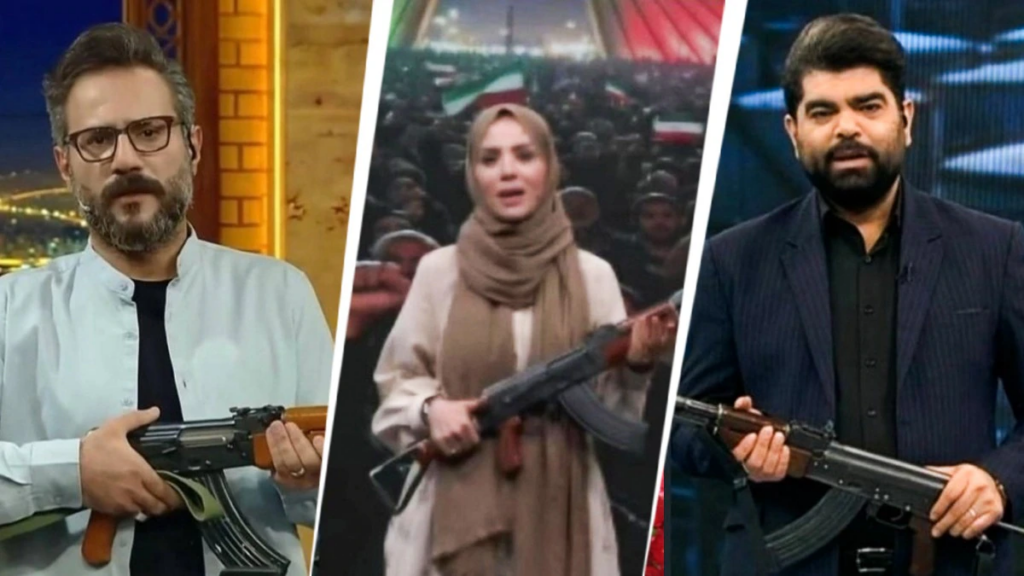
Iran’s state television has ignited controversy after broadcasting live firearms training segments featuring presenters handling AK-47-style rifles, including footage showing a host firing toward a UAE flag during an on-air demonstration.
The programming is part of a broader campaign reportedly called “Sacrifice Life for Iran,” which Iranian officials describe as a national defense preparedness initiative. Critics, however, see it as a highly theatrical show of militarization designed to rally public sentiment amid heightened tensions involving the United States and regional rivals.
Videos from the broadcasts have spread rapidly across social media, where clips of television presenters firing rifles in studio settings have drawn alarm, ridicule, and geopolitical scrutiny in equal measure.
What happened on Iranian state TV?
According to widely circulated footage, presenters on Iranian state television appeared alongside military instructors demonstrating how to:
- Load AK-47 rifles
- Unload and clear weapons
- Aim and fire assault rifles
- Handle firearms in combat-style scenarios
One clip that gained particular attention showed a presenter firing in the direction of a UAE flag displayed in the studio while imagery resembling a burning Dubai skyline appeared in the background.
The broadcast reportedly aired on a channel linked to Iran’s state media ecosystem and aligned with messaging associated with the country’s security establishment.
What is the ‘Sacrifice Life for Iran’ campaign?
Iranian officials have framed the campaign as a nationwide mobilization effort focused on defense education and civil preparedness.
Reports circulating in Iranian and regional media claim that:
- Weapons drills are being conducted in public spaces
- Civilians are participating in firearms familiarization sessions
- Teenagers have joined organized training events
- Millions of people allegedly registered support for the campaign
Footage reportedly emerged from locations including:
- Tehran
- Tajrish Square in Tehran
- Kermanshah
Images and videos from those events appear to show groups of men and women participating in open-air weapons exercises under instructor supervision.
Iranian state media has described some of the activities as part of a broader “presence in the field of power” initiative, language that emphasizes public readiness and resistance.
Why the UAE flag footage drew attention
The most controversial element of the broadcast was the apparent targeting of the United Arab Emirates flag during the live training segment.
The UAE has long maintained a complicated relationship with Iran, balancing economic ties with deep security concerns linked to regional conflicts, maritime disputes, and Iran’s relationships with armed proxy groups across the Middle East.
While the footage does not appear to represent an official military threat, analysts say the symbolism matters.
Televised imagery involving:
- National flags
- Burning city backdrops
- Firearms demonstrations
often serves a propaganda purpose aimed at projecting strength, defiance, or ideological unity.
The inclusion of Dubai-related imagery intensified reactions online because the city is viewed globally as both an economic hub and a symbol of Gulf stability.
What Iranian officials are saying
Mohsen Barmehni, identified in reports as a deputy head within Iran’s state broadcasting structure, defended the broadcasts.
According to his remarks, the programming was intended as:
- Educational training
- Cultural preparation
- Moral instruction
- Defense awareness
He reportedly said Iran was confronting “major powers and global oppression” and argued that citizens should develop a collective sense of readiness and responsibility.
Iranian officials frequently frame such messaging through concepts tied to:
- Resistance
- National defense
- Revolutionary identity
- Regional deterrence
That language has become more prominent during periods of heightened tension with the United States and Israel.
What rifle was reportedly used?
Some military observers online identified the firearm shown in the footage as an East German MPi-KMS variant, part of the broader AK-47 platform chambered in 7.62×39mm ammunition.
The AK-47 and its many variants remain among the world’s most recognizable military rifles because of their:
- Reliability
- Simplicity
- Widespread global use
- Symbolic association with insurgencies and armed movements
The weapon’s appearance on live television added to the dramatic nature of the broadcast and helped fuel its viral spread online.
Why this matters beyond Iran
The broadcasts arrive at a sensitive geopolitical moment.
Iran has recently been engaged in:
- Indirect diplomacy with the United States
- Ongoing regional tensions involving Israel
- Strategic competition with Gulf states
- Domestic efforts to project national unity
The televised drills also reflect a broader pattern seen globally where state media increasingly blends:
- Nationalist messaging
- Military imagery
- Social media virality
- Psychological signaling
Analysts say such broadcasts can serve multiple purposes simultaneously:
- Boost domestic morale
- Signal deterrence externally
- Reinforce ideological narratives
- Shape online discourse internationally
Critics argue the approach risks normalizing militarized rhetoric in civilian life, particularly when teenagers appear in public training footage.
Social media turns the broadcast into a global spectacle
The clips spread rapidly across platforms including X, where users debated whether the footage represented:
- Genuine defense preparation
- State propaganda
- Psychological warfare
- Political theater for domestic audiences
Part of the virality comes from the surreal contrast itself: television hosts switching from traditional studio presentation to assault-rifle demonstrations under dramatic visuals.
In the age of algorithm-driven media, highly visual state messaging can travel far beyond its intended domestic audience within minutes.
The larger message behind the campaign
The “Sacrifice Life for Iran” campaign appears designed to communicate a specific narrative: that ordinary citizens should view themselves as participants in national defense, not merely observers.
Whether the effort succeeds politically is another question.
To supporters inside Iran’s political establishment, the broadcasts may symbolize unity and preparedness. To critics abroad, they resemble a fusion of propaganda, intimidation, and spectacle television.
Either way, the campaign demonstrates how modern geopolitical messaging increasingly operates through viral clips, symbolic imagery, and emotionally charged broadcasts rather than formal speeches alone.
TL;DR
Iran’s state television aired controversial AK-47 training segments as part of a campaign called “Sacrifice Life for Iran.” Viral footage showed presenters handling rifles and appearing to fire toward a UAE flag during a televised demonstration. Iranian officials say the broadcasts are educational and tied to national defense readiness, while critics argue they promote militarization and propaganda during a period of heightened regional tensions.