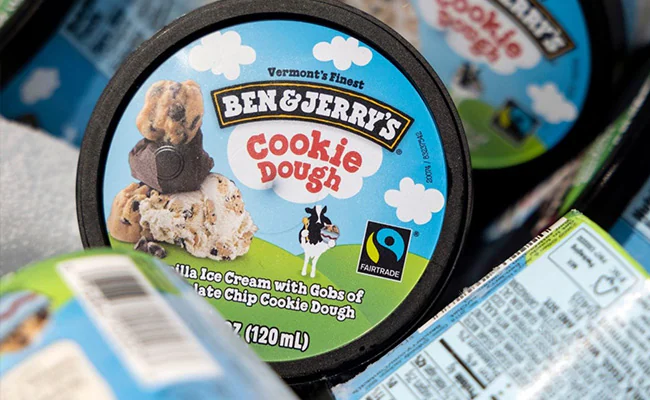
Israel’s decision to remove a social media post promoting a new Ben & Jerry’s flavor has turned what began as a marketing campaign into another flashpoint in the broader debate surrounding the Gaza war. The controversy erupted after critics online mocked the product with altered labels and accusations tied to the ongoing conflict, prompting the post’s removal and reigniting attention on Ben & Jerry’s complicated relationship with Israel.
The episode underscores how even seemingly routine corporate promotions can become politically charged in an era where brands, governments, and social media users collide in real time.
What happened with the deleted Ben & Jerry’s post?
Israel’s official account on X published a post promoting a new country-exclusive Ben & Jerry’s flavor called “Milk and Honey,” describing it as the nation’s “official ice cream.”
According to promotional materials, the flavor was created to support communities in southern Israel. Ingredients were sourced from multiple locations across the region:
- Milk and cream from dairy farms in Kibbutz Alumim
- Honey from Kibbutz Yad Mordechai
- Chocolate Star of David pieces produced in Beersheba
The campaign was intended to highlight local production and regional economic support. Instead, it quickly attracted criticism from users who linked the promotion to the humanitarian situation in Gaza.
Within days, the post disappeared from the platform.
Why did the campaign trigger backlash?
The strongest criticism came from social media users who argued that celebrating a new product while the Gaza conflict continues was insensitive.
Critics circulated edited versions of the ice cream packaging online. Some renamed the flavor “Genocidaires’ Delight,” while others posted comments claiming the product “tastes like genocide.”
The backlash spread rapidly across X and other social platforms, transforming a localized product launch into an international political controversy.
The incident illustrates a growing reality for governments and brands alike: online audiences increasingly interpret marketing messages through broader political and humanitarian contexts.
Social media’s role in amplifying controversies
The controversy gained momentum because it combined several highly visible elements:
- A globally recognized consumer brand
- An official government social media account
- An ongoing international conflict
- User-generated content designed for viral sharing
In many cases, altered images and satirical memes can travel faster than official messaging, reshaping public perception before organizations have an opportunity to respond.
How does the Gaza conflict factor into the reaction?
The backlash emerged amid renewed scrutiny of the Israel-Gaza war.
International organizations, human rights groups, and governments continue to debate the humanitarian consequences of the conflict. This week, additional attention focused on a United Nations commission report examining the impact of the war on Palestinian children.
Israel has repeatedly rejected allegations of genocide and war crimes, maintaining that its military actions are directed against security threats rather than civilians.
Regardless of where individuals stand politically, the conflict remains one of the most polarizing global issues, making any public-facing campaign connected to Israel especially vulnerable to political interpretation.
Why Ben & Jerry’s has a unique history with Israel
The controversy cannot be understood without examining Ben & Jerry’s long-running dispute over operations in Israel and the occupied Palestinian territories.
For years, the ice cream company has occupied a distinctive position among major consumer brands because of its willingness to engage in political and social issues.
The 2021 decision that sparked a corporate battle
In 2021, Ben & Jerry’s independent board announced that it would stop selling products in occupied Palestinian territories.
The company argued that continuing sales there conflicted with its stated social values.
The move generated intense debate and drew criticism from Israeli officials, pro-Israel organizations, and some investors.
Unilever’s intervention
At the time, Ben & Jerry’s was owned by consumer goods giant Unilever.
In 2022, Unilever reached an agreement with Israeli licensee Avi Zinger that allowed Ben & Jerry’s products to continue being sold across Israel and the West Bank.
The arrangement effectively bypassed the original policy announced by Ben & Jerry’s leadership and led to legal disputes between:
- Ben & Jerry’s independent board
- The company’s founders
- Unilever executives
- The Israeli license holder
The disagreement became one of the most visible examples of tensions between corporate ownership and brand activism.
A divided brand identity
The latest controversy highlights how Ben & Jerry’s remains caught between competing identities.
On one side is the company’s longstanding reputation for social activism. On the other is the reality of operating as part of a multinational corporation with business interests across politically sensitive regions.
Co-founders Ben Cohen and Jerry Greenfield have publicly expressed support for Palestinian rights and have criticized aspects of Israeli policy.
Their positions have occasionally diverged from actions taken by local franchise operators and corporate ownership structures.
As a result, different parts of the Ben & Jerry’s ecosystem often send different messages, creating confusion about who speaks for the brand.
Why this story matters beyond ice cream
At first glance, the controversy may appear to be a dispute over a product launch. In reality, it reflects broader trends shaping modern public discourse.
Brands are increasingly political
Consumers now expect companies to take positions on social and political issues, whether they want to or not.
A marketing campaign that once might have remained local can quickly become part of a global conversation.
Social media can redefine narratives
The original purpose of the campaign was to promote a locally sourced product. Yet public discussion rapidly shifted toward geopolitical questions.
This demonstrates how online communities can reshape the meaning of a campaign through commentary, parody, and viral content.
Corporate decisions face heightened scrutiny
Every aspect of a brand’s operations, from sourcing and partnerships to advertising and public statements, is now subject to intense public examination.
For companies operating in politically sensitive environments, even routine announcements can become controversial.
What happens next?
Neither Israel nor Ben & Jerry’s Israel has publicly indicated whether the promotional campaign will return in a modified form.
However, the episode is unlikely to be forgotten quickly.
The controversy arrives at a moment when public attention on the Israel-Gaza conflict remains high and when consumer brands increasingly find themselves drawn into geopolitical debates.
For Ben & Jerry’s, the incident is another reminder that its name carries significance far beyond the frozen dessert aisle. For governments and corporations alike, it demonstrates how quickly a marketing message can become a political battleground in the age of social media.
TL;DR
- Israel deleted a social media post promoting a new Ben & Jerry’s “Milk and Honey” flavor after widespread online criticism.
- Critics linked the campaign to the Gaza war and circulated mock labels such as “Genocidaires’ Delight.”
- The controversy reignited attention on Ben & Jerry’s long-running disputes over sales in Israel and the occupied Palestinian territories.
- The episode highlights the growing intersection of politics, branding, and social media.
- It also shows how quickly public perception can transform a marketing campaign into an international political debate.