
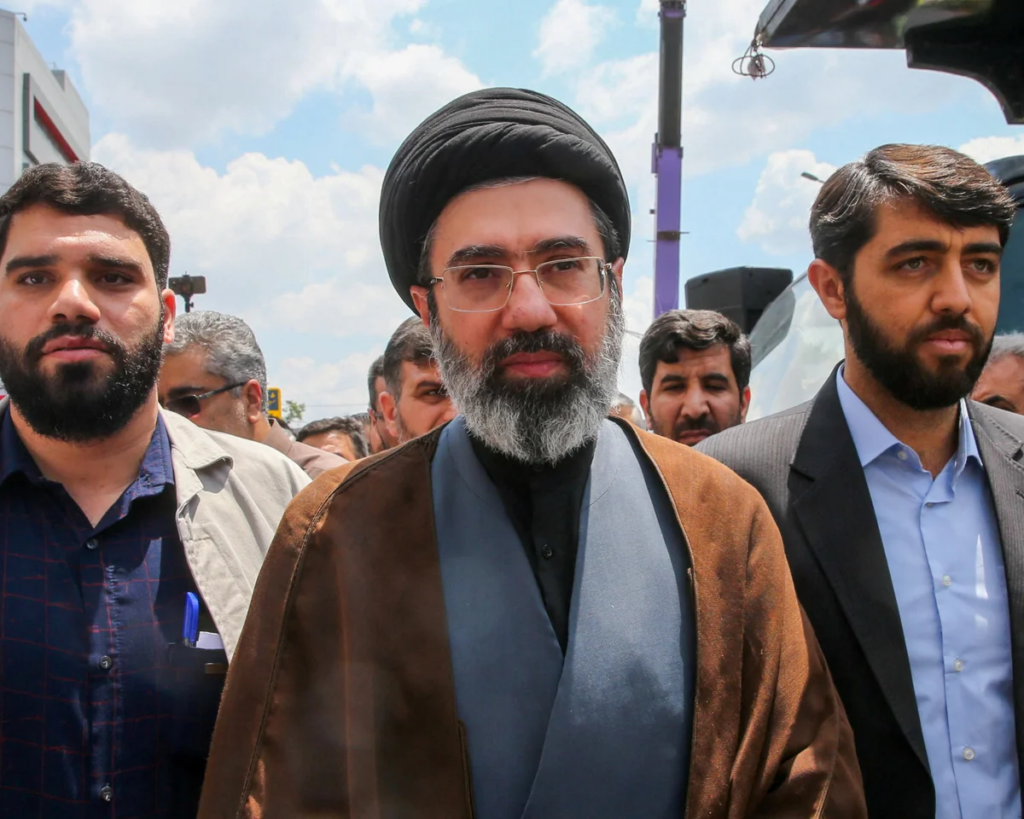
Iran’s newly appointed Supreme Leader, Mojtaba Khamenei, issued his first public statement on Thursday, signaling a hardline stance in the ongoing regional conflict and urging the continued closure of the strategic Strait of Hormuz to pressure Iran’s adversaries.
In remarks broadcast on Iranian state television, Khamenei warned that all U.S. military bases operating in the region should shut down immediately. He added that those installations could become targets if the conflict escalates further.
The statement marks the first official policy direction from Iran’s new leadership since it assumed the country’s highest political and religious authority.
What Mojtaba Khamenei said in his first address
During the televised statement, Khamenei framed Iran’s strategy as both defensive and retaliatory.
He declared that the closure of the Strait of Hormuz should continue as a strategic tool to pressure what he described as Iran’s “enemies.” The waterway is one of the most important energy routes in the world.
Khamenei also warned that U.S. military bases in the region must cease operations immediately.
According to the statement:
- Iran believes several attacks against it were launched from U.S. bases located in neighboring countries
- Tehran will focus retaliation on those facilities rather than on the countries hosting them
- Military action would continue if attacks against Iran persist
Despite the warnings, Khamenei stressed that Iran seeks to maintain friendly relations with neighboring nations in the region.
Why the Strait of Hormuz is central to the conflict
The Strait of Hormuz sits between the Persian Gulf and the Gulf of Oman and is widely considered one of the most strategically important maritime chokepoints in the world.
Roughly one-fifth of the world’s oil supply passes through this narrow waterway each day, according to energy analysts.
Any disruption to shipping in the Strait can trigger major consequences for global energy markets.
Why Iran views the Strait as leverage
Iran has long viewed the Strait of Hormuz as a powerful geopolitical bargaining chip.
By threatening to close or restrict access to the waterway, Tehran can exert pressure on countries that rely on Gulf oil exports.
Analysts say the strategy serves multiple purposes:
- Raising the economic cost of sanctions or military pressure
- Sending a warning to global energy markets
- Demonstrating Iran’s ability to disrupt maritime trade
Warning directed at U.S. military bases
Khamenei’s remarks also included direct warnings toward the United States.
The new leader said U.S. military bases across the Middle East must be shut down immediately, adding that they could be targeted if attacks on Iran continue.
Several American bases operate across the region, including in:
- Qatar
- Bahrain
- Kuwait
- United Arab Emirates
Iran’s leadership has frequently accused these facilities of enabling military operations against the country.
Khamenei said Tehran would focus retaliation on the bases themselves rather than the governments hosting them.
Call for unity inside Iran
Alongside the military messaging, Khamenei used the speech to call for unity among the Iranian population.
He urged citizens to participate in events tied to Quds Day, a major political and religious demonstration held in Iran and other countries.
The Supreme Leader praised the resilience of the Iranian people and said their “steadfastness and courage” had strengthened the country during a difficult period.
In a post shared on his newly launched social media account, he described the responsibility of leading Iran as a heavy task following the legacy of previous leaders.
How Mojtaba Khamenei came to power
Mojtaba Khamenei rose to the position of Supreme Leader following a vote by Iran’s powerful clerical body, the Assembly of Experts.
The council is responsible for selecting and supervising the country’s Supreme Leader.
In his statement, Khamenei referenced the legacy of both Ruhollah Khomeini and his father Ali Khamenei, describing the role as a difficult responsibility following two major figures in Iranian history.
His appointment comes at a time of heightened tensions across the Middle East and ongoing military exchanges involving Iran and its adversaries.
Why this statement matters for the wider region
The tone of Khamenei’s first address suggests that Iran’s leadership is unlikely to soften its position in the near future.
By emphasizing the closure of the Strait of Hormuz and threatening U.S. bases, the new leader signaled that Tehran intends to use both economic pressure and military deterrence during the conflict.
For the wider region, the implications are significant:
- Energy markets could face instability if shipping through the strait remains disrupted
- U.S. military assets in the Middle East could face heightened risk
- Neighboring countries may face increased diplomatic pressure from both sides
Experts say the coming weeks will determine whether the rhetoric translates into further military escalation or remains primarily strategic messaging.
TL;DR
Iran’s new Supreme Leader, Mojtaba Khamenei, used his first public statement to call for the continued closure of the Strait of Hormuz and warned that U.S. military bases in the region must shut down or face potential attacks. While emphasizing Iran’s desire for good relations with neighboring countries, he vowed that Tehran would continue retaliatory actions as the regional conflict intensifies.