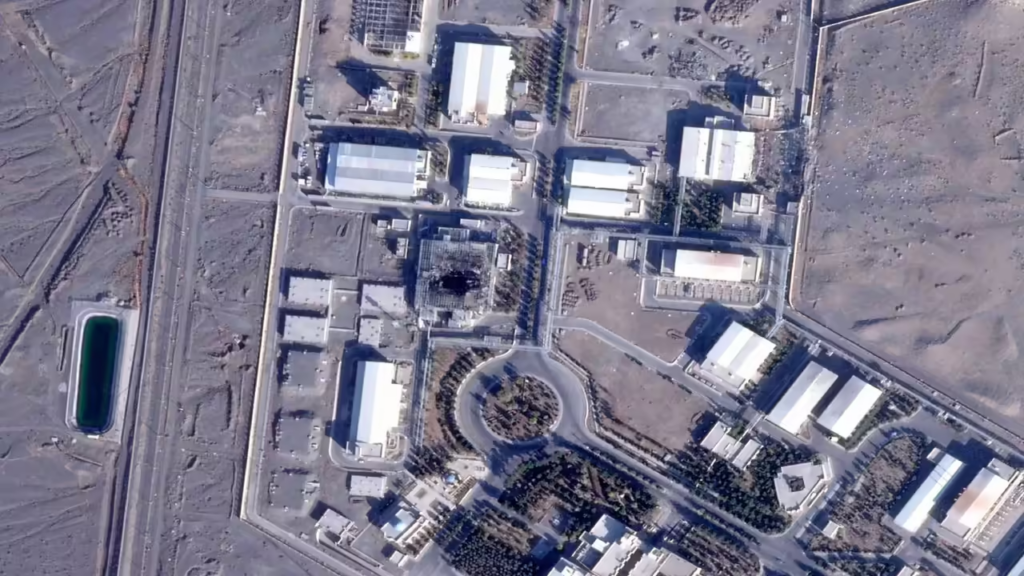
Iran says its Natanz nuclear facility was struck during joint U.S. and Israeli military operations on Sunday, dramatically escalating tensions over Tehran’s nuclear program. The claim was made by Iran’s ambassador to the International Atomic Energy Agency (IAEA), who accused Washington and Tel Aviv of targeting what he described as “peaceful, safeguarded nuclear facilities.”
If confirmed, a strike on Natanz would mark one of the most consequential escalations in the long-running shadow war over Iran’s nuclear ambitions.
Here’s what we know and why it matters.
What Happened at the Natanz Nuclear Facility?
During a meeting of the IAEA’s 35-nation Board of Governors in Vienna, Reza Najafi told reporters that the Natanz site had been attacked.
“Again they attacked Iran’s peaceful, safeguarded nuclear facilities yesterday,” he said, according to Reuters. When pressed on which site was hit, Najafi responded plainly: “Natanz.”
Iranian President Masoud Pezeshkian later vowed that Tehran would rebuild.
“Destroying buildings and factories will not create a problem for us; we will rebuild and with greater strength,” he said during a visit to Iran’s atomic energy organization, insisting the program is not aimed at nuclear weapons.
As of this writing, neither Washington nor Tel Aviv has publicly confirmed targeting Natanz. That makes independent verification essential.
Why Is the Natanz Nuclear Facility So Significant?
The Natanz Nuclear Facility is the centerpiece of Iran’s uranium enrichment program.
It houses advanced centrifuges
Natanz contains large cascades of centrifuges used to enrich uranium. Some sections are buried underground and reinforced, specifically designed to withstand airstrikes.
It has been at the center of past sabotage
The site has previously suffered cyberattacks and suspected covert sabotage operations. It has long been viewed by Western governments as critical to Iran’s nuclear breakout potential.
It’s under IAEA safeguards
Iran maintains that Natanz operates under IAEA monitoring and that its activities are civilian in nature. That distinction matters diplomatically: attacking a safeguarded nuclear facility carries serious international legal implications.
What Is the IAEA Saying?
Rafael Mariano Grossi, Director General of the International Atomic Energy Agency, expressed alarm.
Speaking at the Board of Governors meeting in Vienna, Grossi warned:
“We cannot rule out a possible radiological release with serious consequences, including the necessity to evacuate areas as large as or larger than major cities.”
That’s not a confirmation of radiation leakage, but it underscores the risk.
Why a radiological release matters
Even if a strike does not cause a nuclear explosion, damage to enrichment infrastructure can:
- Release radioactive material
- Contaminate surrounding areas
- Require mass evacuations
- Trigger long-term environmental cleanup
Radiological risks elevate this beyond a conventional military strike.
What About Isfahan and Other Nuclear Sites?
While Najafi specifically named Natanz, broader concern centers on multiple Iranian nuclear facilities, including the Isfahan Nuclear Technology Center.
Isfahan is critical because it:
- Converts uranium into feedstock for enrichment
- Hosts new enrichment infrastructure
- Stores uranium enriched to near weapons-grade levels, according to prior IAEA assessments
Satellite imagery in recent months has fueled speculation about expanded underground construction at several Iranian sites.
What Are the Strategic Risks of Hitting Natanz?
Striking a nuclear enrichment facility crosses a psychological and strategic threshold.
1. Escalation Risk
Iran has repeatedly warned that attacks on its nuclear infrastructure would prompt severe retaliation. That could mean:
- Missile strikes on regional U.S. bases
- Attacks on Israeli infrastructure
- Proxy action through allied militias
2. Nuclear Breakout Acceleration
Paradoxically, attacks may strengthen hardline voices inside Iran who argue that only a nuclear deterrent can prevent further strikes.
If Tehran abandons cooperation with inspectors, monitoring could collapse.
3. International Legal Fallout
Attacking safeguarded nuclear facilities raises complex legal questions under international law. Whether such a strike qualifies as self-defense depends on evidence of imminent threat — a claim that would require public intelligence justification.
How Has Iran Framed Its Nuclear Program?
President Pezeshkian emphasized that Iran does not seek nuclear weapons.
“It’s all intended for solving the problems of the people, for disease, for the health of the people,” he said, referring to nuclear applications in medicine and energy.
Iran has long argued its enrichment activities are peaceful and necessary for:
- Nuclear power generation
- Cancer treatment isotopes
- Scientific research
Western governments dispute that narrative, citing enrichment levels and stockpiles that exceed civilian needs.
Balanced coverage requires citing both IAEA technical reports and independent nuclear proliferation experts.
What Happens Next?
Several scenarios are now possible:
- IAEA emergency inspections: The agency may push for immediate access to assess damage.
- U.N. Security Council debate: Diplomatic fallout is likely.
- Further military escalation: If radiation is released or retaliation expands, the crisis could spiral.
Markets will also be watching. Any perception of broader war in the Gulf region can impact oil prices and shipping routes.
Why This Moment Matters
The Natanz nuclear facility has long symbolized the tension between Iran’s stated civilian nuclear ambitions and Western fears of weaponization.
If it has indeed been struck, the implications are not limited to Iran and Israel. This could reshape:
- Nuclear nonproliferation norms
- The credibility of IAEA safeguards
- Regional military doctrine
The next 72 hours will be critical — particularly regarding radiation assessments and official confirmation from the U.S. and Israel.
TL;DR
- Iran says the Natanz nuclear facility was struck in joint U.S.-Israeli operations.
- Iran’s ambassador to the IAEA identified Natanz as the site hit.
- President Pezeshkian vowed to rebuild nuclear infrastructure.
- IAEA chief Rafael Grossi warned of possible radiological release.
- A confirmed strike could escalate military and diplomatic tensions significantly.