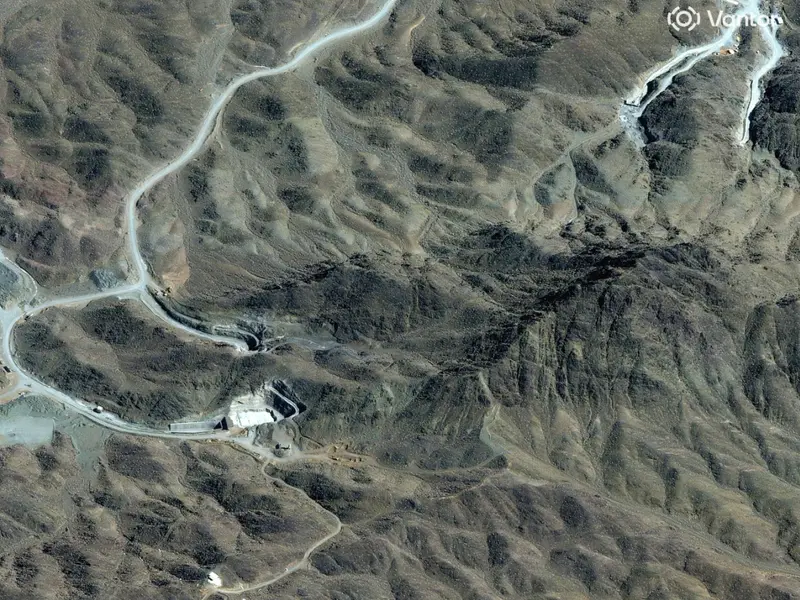
Fresh satellite imagery of a deeply buried Iranian tunnel complex near the Natanz nuclear facility is triggering renewed concern among nuclear analysts and Western security observers. The images appear to show deliberate efforts to restrict access to parts of the underground site, adding another layer of mystery to one of Iran’s most heavily scrutinized nuclear-linked locations.
The activity is centered around Mount Pickaxe, formally known as Kolang Gaz La Mountain, a fortified underground complex south of Iran’s main uranium enrichment site at Natanz. Analysts say recent changes visible from space suggest Tehran may be hardening the site against surveillance, sabotage, or possible future military strikes.
The timing is especially significant. The developments come amid heightened US-Iran tensions, ongoing military friction in the Strait of Hormuz, and growing uncertainty around Iran’s internal leadership structure.
What the satellite images show at the Iran nuclear-linked site
New imagery captured by Airbus Defence and Space and analyzed by the Institute for Science and International Security (ISIS) shows visible changes at the eastern entrances of the underground tunnel network near Natanz.
What changed between April 1 and April 22?
According to analysts:
- The eastern tunnel entrances were open on April 1
- By April 22, the same entrances appeared blocked with large amounts of soil or earth material
- The obstruction does not fully seal the tunnels
- Heavy machinery would likely be required to clear the entrances quickly
What makes the activity stand out is that the western tunnel entrances reportedly remain unaffected. That asymmetry suggests the move was intentional rather than routine construction or maintenance.
Security analysts believe the material may have been placed to:
- Slow vehicle movement
- Reduce vulnerability to airstrikes
- Conceal underground transfers
- Create blast barriers against attacks
Consider adding a side-by-side satellite comparison graphic here:
- April 1 imagery with open entrances
- April 22 imagery showing blocked eastern tunnels
Airbus Defence and Space imagery, if licensed, would provide strong visual authority for readers.
What is Mount Pickaxe, and why is it important?
Mount Pickaxe has become one of the most closely watched underground facilities connected to Iran’s nuclear infrastructure.
Built after the 2020 Natanz sabotage
Construction accelerated after a major 2020 explosion and fire at Natanz damaged a centrifuge assembly hall. Iranian officials later announced plans to build a more advanced facility “in the heart of the mountain” near Natanz.
That statement immediately drew international attention because underground mountain facilities are significantly harder to
- Destroy through airstrikes
- Monitor via satellites
- Penetrating with conventional bunker-busting weapons
Analysts from both ISIS and the Center for Strategic and International Studies (CSIS) have repeatedly assessed the site as a possible location for:
- Centrifuge production
- Uranium-related research
- Storage of sensitive nuclear equipment
- Advanced metallurgy operations
Why the site survived earlier strikes
One detail continues to raise questions among defense analysts: the site was reportedly not targeted during Operation Midnight Hammer in June 2025, even while other Iranian nuclear-linked facilities were hit.
That decision has become more notable as:
- Construction activity intensified afterward
- Tunnel reinforcement increased
- Satellite-observed concealment efforts expanded
Consider linking internally to:
- “What was Operation Midnight Hammer?”
- “How bunker-buster weapons target underground nuclear sites.”
What experts fear could be hidden inside
Analysts are careful not to overstate what satellite imagery alone can prove. Still, several warning signs have emerged.
A pattern of concealment
ISIS analysts noted that:
- Previous tunnel entrances had already been reinforced with concrete
- The new barriers appear strategic rather than temporary
- The site’s depth and fortification suggest high-value assets inside
Their concern centers less on what is visible and more on what Iran may be trying to keep invisible.
Possible nuclear relocation efforts
CSIS previously suggested Iran could be shifting sensitive nuclear work underground after earlier strikes damaged above-ground facilities.
One major concern involves uranium metallurgy, a highly sensitive process connected to nuclear fuel development and, potentially, weapons-related pathways.
If that work has indeed moved beneath Mount Pickaxe, it would represent the following:
- A major hardening of Iran’s nuclear infrastructure
- Increased difficulty for international monitoring
- Reduced the effectiveness of conventional military deterrence
Consider adding an infographic mapping:
- Natanz
- Fordow
- Isfahan
- Mount Pickaxe
Showing the relationships between these sites would help readers understand the broader nuclear infrastructure network.
Why the timing matters right now
The tunnel activity is unfolding during one of the most unstable periods in US-Iran relations in recent years.
Strait of Hormuz tensions remain volatile
Although a formal ceasefire framework exists, clashes and accusations continue in the Gulf region.
Recent developments reportedly include:
- Iranian accusations against US naval operations
- CENTCOM strikes on Iranian-linked military infrastructure
- Iranian retaliatory attacks involving naval assets and drones
Even limited military exchanges in the Strait of Hormuz carry enormous global implications because roughly one-fifth of the world’s oil supply passes through the region.
A strong internal link opportunity here:
- “What happens to oil prices if the Strait of Hormuz closes?”
Leadership uncertainty inside Iran adds another layer
Questions surrounding Iran’s leadership have further complicated the geopolitical picture.
Reports continue to circulate regarding the health and public absence of Mojtaba Khamenei following earlier attacks and political instability. Iranian officials insist national affairs remain under control, but prolonged absence from public view has fueled speculation about decision-making inside Tehran.
For nuclear analysts, uncertainty at the top of Iran’s political system increases concerns about:
- Strategic unpredictability
- Escalation risks
- Reduced diplomatic transparency
Why this development deserves attention
On its own, blocked tunnel entrances may sound like a technical construction detail. In the context of Iran’s nuclear program, they carry far greater significance.
The images fit a broader pattern seen since mid-2025:
- Accelerated underground construction
- Increased concealment measures
- Reduced transparency with inspectors
- Greater fortification of strategic sites
Whether Iran is protecting nuclear material, military infrastructure, or sensitive industrial equipment, the message appears clear: Tehran wants this site harder to observe, harder to access, and harder to destroy.
That alone is likely to keep Mount Pickaxe at the center of international intelligence monitoring in the months ahead.
TL;DR
- New satellite images show blocked eastern tunnel entrances at Iran’s Mount Pickaxe underground complex near Natanz
- Analysts say the changes appear deliberate and security-focused
- The facility was built after the 2020 sabotage at Natanz
- Experts fear sensitive nuclear-related work may have moved underground
- The developments come amid escalating US-Iran tensions and instability in the Strait of Hormuz