
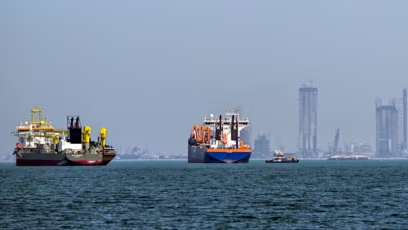
Amid a fragile ceasefire and escalating regional hostilities, new reports suggesting that Iran may have deployed sea mines in the Strait of Hormuz are raising serious concerns across global shipping, defence, and energy markets.
According to the Associated Press, semi-official Iranian outlets have published navigational charts indicating a potential “danger zone” in one of the world’s most critical maritime corridors.
What Do the Reports Say About Iran’s Mine Deployment?
The reports stem from charts released by Iranian media outlets, including ISNA and Tasnim News Agency.
Key Details From the Charts
- A clearly marked “danger zone” overlays the Traffic Separation Scheme (TSS), the primary route used by commercial vessels
- Ships have been advised to reroute northward
- Alternate paths bring vessels closer to Iran’s coastline, near Larak Island
Some vessels are already reportedly following these adjusted routes, signalling that the threat is being taken seriously by maritime operators.
Why this matters:
If confirmed, the placement of mines within a TSS is highly significant. These routes are designed to ensure safe and efficient passage of dense maritime traffic. Disrupting them increases both collision risks and operational costs.
Why Is the Strait of Hormuz So Critical?
The Strait of Hormuz is one of the most vital chokepoints in the global energy system.
A Lifeline for Global Oil Supply
- Roughly 20% of the world’s oil and gas passes through the strait
- It connects the Persian Gulf to international waters
- Major exporters like Saudi Arabia, Iraq, and the UAE rely on it
Even minor disruptions can send shockwaves through:
- Oil prices
- Global supply chains
- Energy security strategies
How Has the Conflict Escalated?
Rising Tensions Beyond the Strait
The reported mine deployment comes amid a broader escalation involving Iran, the United States, and Israel.
- Iran has reportedly closed the strait again following Israeli strikes targeting Hezbollah in Lebanon
- Drone and missile strikes have continued across Iran and Gulf regions
- Israel has intensified operations in Beirut, targeting both residential and commercial areas
In response, Hezbollah claims it has launched rockets toward Israel, accusing it of violating the ceasefire terms.
What Is the U.S. Position?
Donald Trump has signalled a hardline stance amid the unfolding crisis.
Key Statements
- U.S. forces will remain stationed near Iran
- Any breach of agreements could trigger “overwhelming military action.”
- Iran will not be allowed to develop nuclear weapons
- The Strait of Hormuz “will be open and safe.”
These remarks, shared via Truth Social, underscore Washington’s commitment to maintaining maritime security—but also raise the risk of further escalation.
Is the Ceasefire Still Holding?
A Truce Under Strain
Despite formal ceasefire terms, the situation on the ground suggests otherwise:
- Continued air and drone strikes
- Conflicting interpretations of the ceasefire scope
- Renewed maritime restrictions
Iran has warned of strong retaliation, while simultaneously taking steps such as closing the strait—moves that contradict earlier signals of de-escalation.
What Are Iran’s Political Leaders Saying?
Hardening Diplomatic Positions
Mohammad Bagher Qalibaf has dismissed planned negotiations as “unreasonable,” citing:
- Alleged U.S. violations of ceasefire conditions
- Israeli strikes in Lebanon
- Drone incursions into Iranian airspace
Meanwhile, Foreign Minister Abbas Araghchi has argued that the ceasefire framework extends to Lebanon—a claim rejected by both Israel and the U.S.
Deepening Divisions
This disagreement highlights a core issue:
- Iran views the conflict regionally (including Lebanon)
- Israel and the U.S. treat fronts separately
This gap complicates enforcement and increases the risk of miscalculation.
What Could Happen Next?
Risks to Watch
If the reports of sea mines are confirmed, several scenarios could unfold:
1. Maritime Disruption
- Increased insurance premiums for shipping
- Delays in oil shipments
- Potential rerouting through longer, costlier paths
2. Military Escalation
- U.S. or allied naval operations to clear mines
- Direct confrontation with Iranian forces
3. Market Volatility
- Immediate spikes in global oil prices
- Ripple effects across inflation and trade
Why This Moment Matters Globally
This is not just a regional issue—it’s a global one.
The combination of:
- A fragile ceasefire
- Strategic maritime threats
- Escalating proxy conflicts
creates a high-risk environment with worldwide implications.
TL;DR
- Reports suggest Iran may have deployed sea mines in the Strait of Hormuz.
- Charts from Iranian outlets show a “danger zone” in key shipping lanes.
- The strait handles about 20% of global oil trade, making any disruption critical.
- Donald Trump has warned of strong U.S. action if tensions escalate.
- Ongoing strikes and political disagreements are straining the ceasefire.