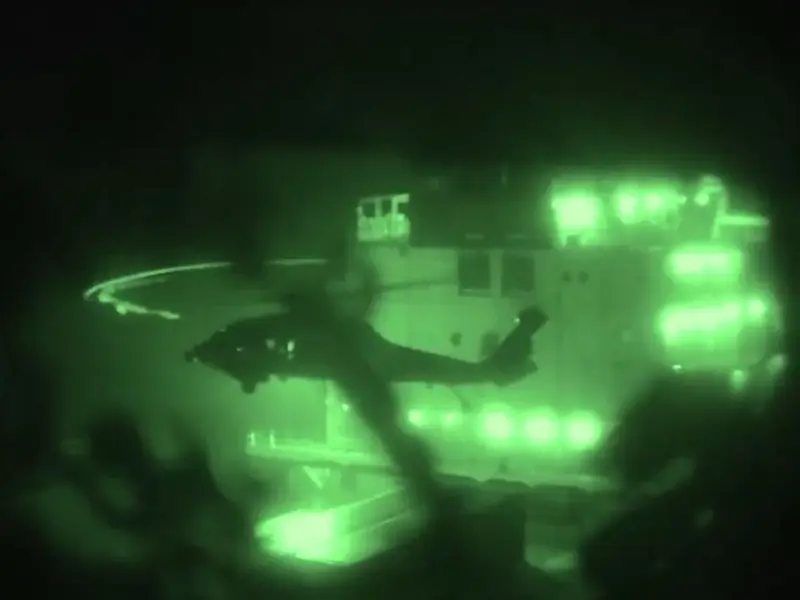
A newly released video from United States Central Command offers a rare, close-up look at a high-stakes maritime operation that is rapidly escalating tensions between Washington and Tehran. The footage shows United States Marine Corps forces boarding and seizing an Iranian-flagged cargo vessel after what US officials described as hours of ignored warnings.
The incident, which unfolded in the Sea of Oman, marks the first confirmed seizure under an ongoing US blockade targeting Iranian maritime activity. Iran has condemned the operation as “piracy” and warned of retaliation, raising fresh concerns about a broader regional conflict.
What does the CENTCOM video show?
The video released by United States Central Command captures a tightly coordinated military sequence that looks more like a precision drill than a spontaneous confrontation.
Key moments from the footage
- Marines deploy from the amphibious assault ship USS Tripoli (LHA-7) via helicopter
- Aerial insertion teams fast-rope onto the deck of the cargo vessel
- The targeted ship, identified as M/V Touska, appears immobilized before boarding
- Marines secure control of the vessel within minutes of landing
The choreography is deliberate. Every movement suggests a rehearsed protocol, designed to minimize resistance while asserting control quickly.
Why did the US seize the Iranian vessel?
According to US officials, the seizure followed repeated attempts to redirect the vessel, which they say was operating in violation of a declared blockade.
The US version of events
- The vessel ignored warnings for approximately six hours
- US forces instructed the crew to vacate the engine room
- The guided-missile destroyer USS Spruance (DDG-111) fired 5-inch MK 45 rounds
- The strike disabled the ship’s propulsion system
- Marines boarded after the vessel became non-operational
US authorities have framed the operation as “deliberate, professional, and proportional,” emphasizing that force was used only after prolonged non-compliance.
How has Iran responded?
Iran’s reaction was swift and sharply worded. Officials labeled the operation a violation of ceasefire conditions and described it as an act of “maritime piracy.”
Tehran’s position
Statements from Khatam al-Anbiya Central Headquarters accused the US of the following:
- Attacking a commercial vessel in international waters
- Deploying military personnel unlawfully
- Escalating tensions despite ongoing diplomatic efforts
Iran has warned that its armed forces will respond, though it has not specified how or when. That ambiguity adds to the uncertainty already surrounding the region.
Why the Sea of Oman matters strategically
The Sea of Oman is not just another stretch of water. It acts as a gateway to the Strait of Hormuz, one of the most critical النفط transit routes in the world.
What makes this region so sensitive?
- Roughly 20 percent of the global oil supply passes through nearby waters
- It connects the Persian Gulf to international shipping lanes
- Military presence from multiple nations is already high
Any escalation here risks disrupting global energy markets and shipping routes, making even isolated incidents globally significant.
Is this part of a larger US-Iran conflict?
This seizure doesn’t exist in isolation. It fits into a broader pattern of rising friction involving the United States, Iran, and regional allies.
Signals of a widening confrontation
- US enforcement of a maritime blockade on Iranian-linked shipping
- Increased naval deployments in the region
- Iran is scaling back cooperation in diplomatic channels
- Public rhetoric on both sides is growing more confrontational
What happens next?
The immediate future hinges on how both sides choose to interpret and respond to this incident. Maritime confrontations often operate in a gray zone, where legal interpretations differ, and escalation can be gradual rather than sudden.
Possible next steps
- Diplomatic protests or emergency talks
- Reciprocal actions by Iran targeting US or allied vessels
- Expanded enforcement of maritime restrictions
- Increased military patrols in the region
The risk is not just a single retaliation but a cycle of action and counteraction that becomes harder to control over time.
Why this incident matters beyond the region
Even for readers far from the Middle East, this event carries weight. Energy prices, shipping costs, and geopolitical stability are all tied to what happens in these waters.
An isolated boarding operation might seem tactical, but in a region this volatile, tactics can quickly become strategy.
TL;DR
- US Marines seized an Iranian-flagged cargo vessel in the Sea of Oman
- The operation followed six hours of ignored warnings, according to the US
- USS Spruance disabled the ship before boarding
- Iran called the move “maritime piracy” and vowed retaliation
- The incident raises tensions in a region critical to global oil supply