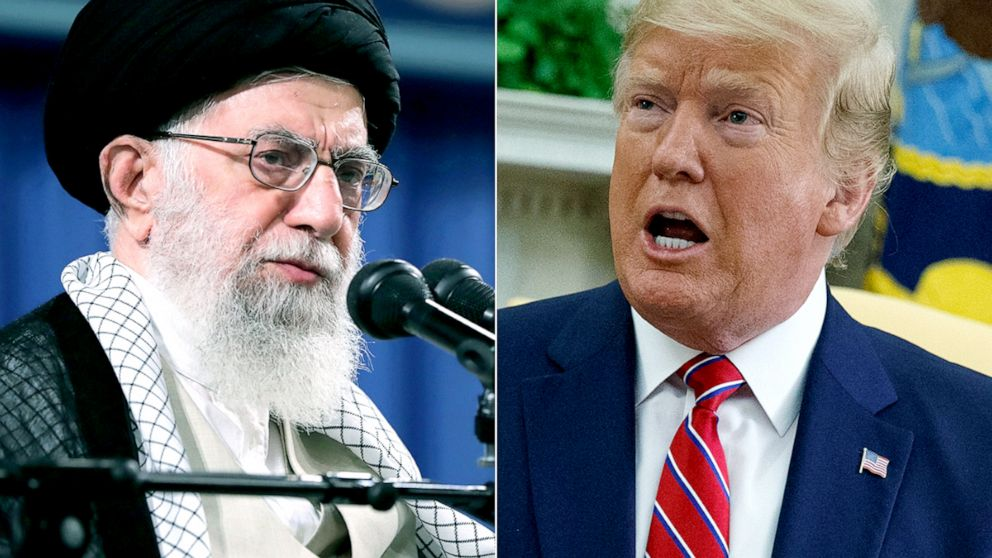
As Iran grapples with its most volatile wave of protests in years, speculation has swirled around an extraordinary question: has the country’s supreme leader, Ayatollah Ali Khamenei, fled the nation amid mounting unrest and a public warning from Donald Trump?
The rumors gained traction as images of burning streets, mass demonstrations, and internet blackouts flooded social media, coinciding with Trump’s threat that the United States would intervene if Iranian authorities violently suppressed peaceful protesters. But despite claims circulating online, Khamenei remains in Iran and has publicly addressed the nation.
Did Ayatollah Ali Khamenei leave Iran?
No, Khamenei has not left the country.
According to multiple reports, Ali Khamenei is still in Iran and addressed the nation following Friday prayers in Tehran, hours after Trump’s remarks escalated international attention on the crisis.
Speculation about his possible exit intensified after Trump suggested Iran’s leadership could face consequences if protesters were harmed and after unverified reports claimed Khamenei might seek refuge in Russia in the event of foreign intervention. Those claims, however, have not been substantiated.
Khamenei’s public appearance appears intended to project control and defiance at a moment when his authority is being openly challenged on the streets.
What did Khamenei say in response to Trump and the protests?
In his address after Friday prayers, Khamenei struck a confrontational tone.
He warned that the Islamic Republic would not tolerate ongoing protests and urged young Iranians to remain united against what he described as foreign-backed agitation. In a veiled but unmistakable message, he signaled that security forces were prepared to crack down on demonstrators.
Khamenei also directly attacked Donald Trump, accusing him of having his hands “stained with the blood of Iranians.” State television footage showed crowds responding with chants of “Death to America,” reinforcing the regime’s long-standing narrative of external دشمن enemies.
He dismissed protesters as individuals damaging their own cities to please the president of the United States, saying Trump should focus on the problems within his own country instead.
How Iran’s judiciary and state media are framing the unrest
Iran’s hardline response has not been limited to rhetoric.
The head of Iran’s judiciary, Gholamhossein Mohseni-Ejei, publicly vowed that punishment for protesters would be decisive, maximal, and without legal leniency. Such language has often preceded mass arrests and harsh sentencing in previous protest cycles.
State-aligned media outlets have repeatedly referred to demonstrators as terrorists, a framing that analysts say helps justify violent crackdowns. Similar narratives were used during earlier nationwide protests, which ended with hundreds killed and thousands detained.
Internet shutdowns and scenes from the streets
As unrest intensified, Iranian authorities once again resorted to one of their most powerful tools: cutting communication.
The government shut down internet access and international phone lines across large parts of the country. Despite this, short videos shared by activists showed protesters gathering around bonfires, chanting against the regime, and confronting security forces in Tehran and other cities well into Friday morning.
Debris-lined streets, burning objects, and nighttime demonstrations have become defining images of the current unrest, even as official state media has downplayed the scale of the protests.
Iranian outlets alleged that violence and fires were set by “terrorist agents” linked to the US and Israel, and acknowledged casualties without providing details.
Why Iran is facing nationwide protests again
The current unrest is rooted primarily in economic collapse.
Iran’s economy has been battered by sanctions, mismanagement, and the aftermath of a recent 12-day conflict, pushing the national currency into free fall. In December, the rial reportedly plummeted to around 1.4 million to the US dollar, erasing savings and eroding purchasing power.
Protests initially erupted after shopkeepers and traders reacted to the currency collapse but quickly expanded into broader demonstrations against Iran’s theocratic system. Chanting against the Islamic Republic itself has become increasingly common, signaling anger that goes beyond economic grievances.
Despite the scale of the unrest, it remains unclear why authorities have not yet launched a full-scale nationwide crackdown, as they have done in the past.
Trump’s warning and the international angle
Trump’s comments have added a volatile international dimension to the crisis.
Last week, he warned that if Tehran “violently kills peaceful protesters,” the United States would come to their rescue. Speaking in an interview with radio host Hugh Hewitt, Trump said Iran had been warned in powerful terms and would “pay hell” if mass violence occurred.
While Trump did not specify what form US intervention might take, his remarks have heightened tensions and fed speculation about regime stability, especially given Iran’s strained relations with Washington.
What this moment signals for Iran’s leadership
Khamenei’s decision to appear publicly rather than remain silent suggests concern about perception as much as security. Rumors of a leader fleeing, even if false, can be destabilizing in authoritarian systems that rely heavily on the image of absolute control.
At the same time, the language used by Iran’s leadership, judiciary, and state media points toward a familiar pattern: delegitimizing protesters, blaming foreign actors, and preparing the ground for force.
Whether this protest wave escalates into a broader confrontation or is suppressed like previous movements will likely depend on how security forces act in the coming days.
TL;DR
Rumors that Iran’s supreme leader, Ayatollah Ali Khamenei, had fled the country amid mass protests are false. Khamenei remains in Iran and addressed the nation after Friday prayers, issuing warnings to protesters and directly challenging Donald Trump, who has threatened US action if demonstrators are violently suppressed. As protests spread and the internet is shut down, Iran’s leadership appears to be bracing for a decisive showdown driven by economic collapse and political anger.