Teenage Remains Believed to Belong to Pre-Inca Chancay Culture
LIMA, PERU — Workers installing new gas pipelines in Peru’s capital made a remarkable discovery in June: a well-preserved 1,000-year-old mummy, buried less than two feet beneath the surface. The unexpected find occurred during excavation work overseen by the utility company Cálidda, which maintains archaeological supervision due to the region’s rich cultural history.
Adolescent Mummy Found in Sitting Position
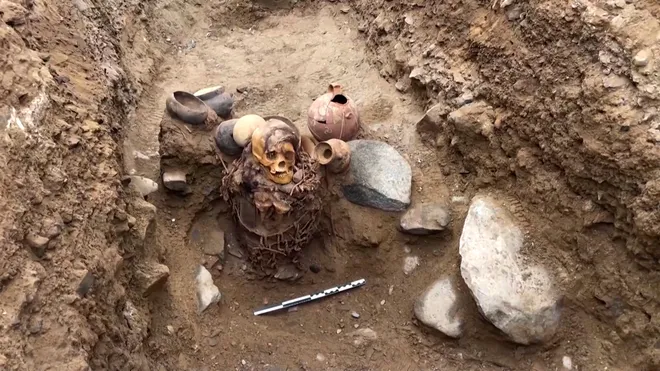
According to a report from the Associated Press, workers initially unearthed a makeshift tomb constructed from a huarango tree trunk, beneath which a child-sized mummy was found sitting upright, wrapped in cloth and surrounded by offerings including ceramics, food items, and rope.
Archaeologists believe the remains belong to an adolescent aged 10 to 15, part of the Chancay culture that predated the Inca Empire. Despite the centuries, the body retained dark hair and fragments of skin, a rare degree of preservation.
“This individual was likely buried between 1000 and 1200 CE,” said Jesús Bahamonde, scientific coordinator and archaeologist for Cálidda, in statements to both AP and Agence France-Presse (AFP).
Part of a Broader Archaeological Legacy
The discovery adds to more than 2,200 archaeological remains unearthed by Cálidda since beginning infrastructure work in the region. Because such finds are common in Peru, utility companies are required to employ archaeologists to monitor all excavations.
“Great stories aren’t just told: they’re lived, discovered, and shared,” Bahamonde wrote in a post on LinkedIn. “This is a new story added to the many millennia-old testimonies that lie beneath our streets, waiting to be interpreted with respect and returned to the collective memory.”
The Chancay civilization, which thrived along the Peruvian coast between 1000 and 1470 CE, is renowned for its distinct ceramics, fine textiles, and burial customs. Before being absorbed into the Inca Empire, the Chancay people established sophisticated urban centers and complex social structures.
According to the University of Missouri’s Museum of Art and Archaeology, the Chancay are especially notable for their production of painted pottery and woven goods, often found in burial contexts such as the one recently uncovered.