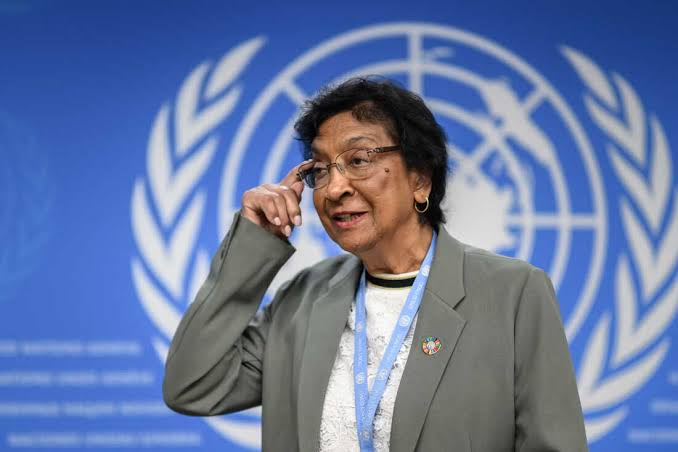
South African jurist of Indian Tamil origin Navanethem “Navi” Pillay has won the 2026 Nobel Peace Prize, recognizing her decades-long work defending human rights, strengthening international law and holding powerful individuals and governments accountable.
The Norwegian Nobel Committee announced the award in Oslo on Friday, October 9, honoring Pillay for her contributions to promoting peace and international justice.
The committee highlighted a consistent theme throughout her career, from representing people who opposed apartheid in South Africa to serving as a judge in major international criminal proceedings.
“A common thread runs from her early work defending Nelson Mandela and others who stood up against apartheid to her service as a judge in some of the key international court cases of our time,” the committee said.
Pillay, 85, previously served as the United Nations High Commissioner for Human Rights and has held senior judicial positions in international courts. Her work has helped shape legal recognition of sexual violence during conflicts and the prosecution of crimes against humanity.
The award comes as international legal institutions face mounting political pressure and armed conflicts continue across several regions.
Why did Navi Pillay win the Nobel Peace Prize?
The Nobel Committee recognized Pillay for her efforts to promote peace and international law.
Its decision places particular emphasis on the role of legal institutions in preventing violence, holding perpetrators accountable and providing justice to victims of war and persecution.
Pillay’s career has spanned several different stages of international justice. She began as a lawyer defending people targeted by South Africa’s apartheid government, later became a judge in the country’s High Court and went on to serve at international criminal tribunals.
Her work also included leadership at the United Nations, where she advocated for the protection of human rights across countries experiencing conflict, discrimination and political repression.
The Nobel Committee said her career demonstrated the importance of a strong moral compass when confronting powerful political interests.
The committee’s decision also sends a broader message about the relationship between peace and accountability. Its announcement emphasized that resolving conflicts without force depends on an international legal system capable of holding those responsible for serious abuses to account.
Who is Navi Pillay?
Navanethem Pillay was born on September 23, 1941, in Clairwood, Durban, in South Africa’s KwaZulu-Natal region. Her parents were of Indian Tamil origin.
She grew up during apartheid, a system of racial segregation and discrimination that restricted the rights of South Africa’s non-white population.
Despite the barriers facing people of Indian origin and other communities under apartheid, Pillay pursued a legal career that eventually took her from local courts to some of the world’s most prominent international institutions.
She studied at the University of Natal, earning a bachelor’s degree in 1963 and a law degree in 1965. She later pursued postgraduate studies in the United States, obtaining a Master of Laws degree and a Doctor of Juridical Science from Harvard University.
Her academic training provided the foundation for a career that combined courtroom advocacy, judicial work and international human rights leadership.
How did Pillay challenge apartheid?
Pillay began practising law in 1967 and became the first woman to establish her own law practice in Natal. She was also the first Black woman to serve as a judge on South Africa’s High Court.
During apartheid, she represented political activists detained by the government and challenged practices that denied prisoners basic legal protections.
Her work exposed abuses involving torture and solitary confinement and helped establish the right of political prisoners to access legal counsel.
These cases were significant because apartheid-era authorities frequently used security legislation to restrict political opposition and detain activists.
Pillay’s legal work demonstrated how courts and lawyers could challenge state power even when the broader political system was deeply unequal.
Her role in defending people targeted by apartheid became the starting point for a career focused on individual rights, equal treatment under the law and accountability for abuses committed by authorities.
The landmark Rwanda genocide tribunal cases
One of the most consequential stages of Pillay’s career came when she joined the International Criminal Tribunal for Rwanda in 1995.
The tribunal was established by the United Nations to prosecute those responsible for genocide and other serious crimes committed during the 1994 Rwandan genocide.
Pillay served as a judge for eight years, including four years as the tribunal’s president from 1999 to 2003.
She played an important role in legal developments surrounding sexual violence during armed conflict.
A landmark case was the prosecution of Jean-Paul Akayesu, a former Rwandan local government official convicted of genocide and crimes against humanity.
The tribunal’s judgment established that rape and sexual violence could constitute acts of genocide when committed with the required intent to destroy a protected group.
The ruling was a major development in international criminal law. It helped establish that sexual violence during conflict should not be treated as an incidental consequence of war but could form part of a deliberate campaign of persecution and destruction.
The judgment continues to influence international efforts to prosecute sexual violence and other abuses committed during armed conflicts.
Her role at the International Criminal Court
Pillay was elected to the International Criminal Court in 2003 and served as a judge until 2008, when she left to take up her United Nations role.
The ICC prosecutes individuals accused of the most serious international crimes, including genocide, crimes against humanity and war crimes, within the limits of its jurisdiction.
Her appointment reflected the growing importance of international judicial institutions in addressing abuses that national courts may be unwilling or unable to prosecute.
Pillay’s experience in South Africa and Rwanda gave her a perspective shaped by both political repression and the challenges of establishing accountability after mass atrocities.
Her work across these institutions helped strengthen the role of international law in protecting civilians and seeking justice for victims.
How did Pillay change the United Nations human rights office?
In 2008, Pillay became the United Nations High Commissioner for Human Rights, serving until 2014.
The position placed her at the center of the UN’s efforts to monitor human rights violations, support international investigations and encourage governments to comply with their legal obligations.
During her tenure, the office dealt with serious crises involving armed conflicts, political repression and allegations of widespread abuses.
Pillay repeatedly stressed that human rights protections must apply regardless of a person’s nationality, political affiliation or the influence of the government responsible for alleged violations.
The role also required her to navigate tensions between the UN’s human rights mandate and governments that resisted outside scrutiny.
Her work attracted criticism from some political leaders, but she maintained that investigating alleged abuses was central to the international community’s responsibility to protect human dignity.
Pillay’s work on Gaza and the occupied Palestinian territories
Pillay has also remained involved in international human rights investigations after leaving her UN leadership role.
She chaired the United Nations Independent International Commission of Inquiry on the Occupied Palestinian Territory, including East Jerusalem, and Israel.
In 2025, the commission concluded that Israel had committed genocide in Gaza. Israel rejected the finding as false and politically motivated.
The commission’s conclusion formed part of a wider international dispute over the conduct of the Gaza war and the application of international humanitarian law.
It is important to distinguish the commission’s findings from a final judgment by an international court. A commission of inquiry investigates allegations and publishes conclusions, while judicial determinations depend on the jurisdiction and proceedings of the relevant court.
Pillay’s involvement in the inquiry reflects her continuing role in international efforts to document alleged violations and apply established legal standards to conflicts.
Why does international law matter for peace?
The Nobel Committee’s decision highlights a central argument in Pillay’s career: peace is more sustainable when political and military power is constrained by law.
International law establishes rules governing the conduct of war, the protection of civilians, the treatment of prisoners and the prosecution of crimes such as genocide and crimes against humanity.
Without credible systems of accountability, victims may have little recourse when powerful actors commit serious abuses.
Pillay’s career has focused on building and applying mechanisms intended to prevent impunity.
Her work also illustrates the limits of those mechanisms. International courts and human rights bodies rely on states to cooperate, provide evidence and implement decisions, and they can face intense political resistance when their investigations implicate influential leaders.
The Nobel award therefore recognizes not only an individual career but also the importance of maintaining institutions capable of applying international law consistently.
How much is the 2026 Nobel Peace Prize worth?
The 2026 Nobel Peace Prize carries an award of 12 million Swedish kronor, equivalent to approximately $1.2 million.
The formal Nobel ceremony is scheduled for December 10 in Oslo, marking the anniversary of the death of Alfred Nobel, the Swedish inventor and philanthropist whose will established the prizes.
This year’s Peace Prize follows the 2025 award to Venezuelan opposition leader María Corina Machado.
Pillay’s award also comes during the Nobel Prize’s 125th anniversary year. The Peace Prize has recognized both individuals and organizations working across areas including peace negotiations, human rights, disarmament and humanitarian protection.
What does Pillay’s Nobel win mean?
Pillay’s selection arrives at a time when international courts and human rights organizations face growing scrutiny.
Conflicts in several regions have intensified debates about accountability, the application of international law, and whether powerful states can be held to the same standards as smaller countries.
The Nobel Committee has emphasized that the international legal system is essential to resolving disputes without violence and ensuring that victims of serious abuses receive justice.
Pillay’s career offers a concrete example of how those principles can be pursued through legal advocacy, judicial decisions, and international institutions.
From defending activists under apartheid to helping establish legal precedents on sexual violence in genocide, she has spent decades working to ensure that legal protections apply even when confronting powerful political interests.
Her Nobel Peace Prize is recognition of that work and a reminder that the pursuit of peace includes more than ending active fighting.
It also requires institutions that protect rights, investigate abuses, and establish accountability when the law is violated.