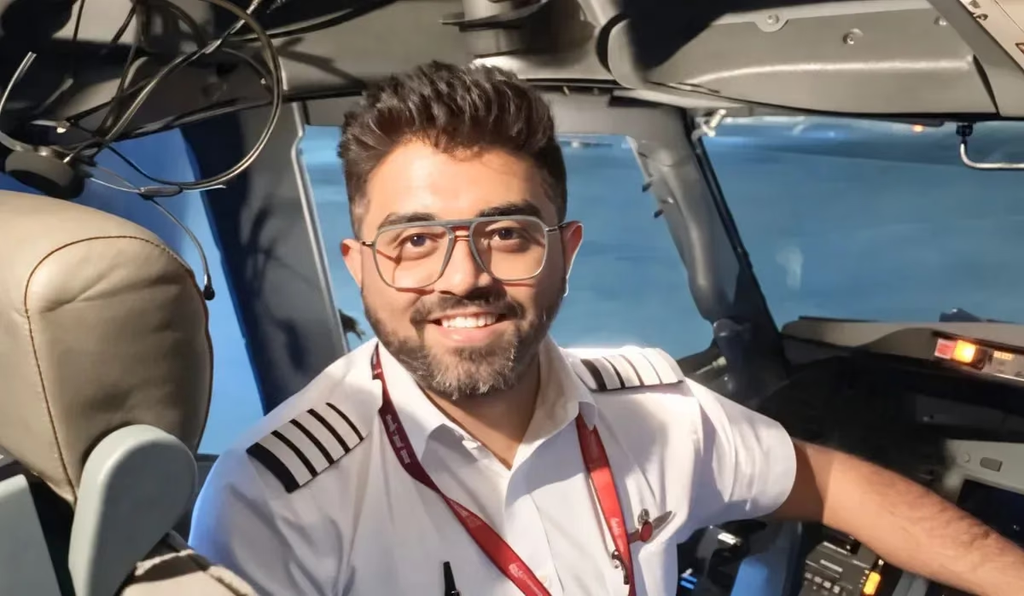
When Captain Smit Machchhar reported for duty aboard Flydubai flight FZ1073, he was preparing for another routine trip from Dubai to Tel Aviv.
Within minutes, the flight descended thousands of feet, an emergency unfolded inside the cockpit and the Boeing 737 MAX was forced to divert to Saudi Arabia.
At the center of the extraordinary incident was Machchhar, an Indian pilot from Mumbai who was seriously injured during an alleged attack by his co-pilot.
Israeli officials say the co-pilot stabbed Machchhar and attempted to crash the aircraft. Despite his injuries, Machchhar managed to open the cockpit door, allowing passengers and crew to intervene and overpower the attacker. A second pair of Flydubai pilots who were traveling as passengers then helped bring the aircraft safely to the ground in Tabuk.
The flight carried 174 people.
Indian Prime Minister Narendra Modi and Israeli Prime Minister Benjamin Netanyahu have since praised Machchhar for his actions, with both leaders describing him as a hero.
But before his name became associated with a mid-air emergency, Machchhar had spent more than a decade building a career in commercial aviation.
Who is Smit Machchhar?
Smit Machchhar is a Mumbai-born commercial pilot who has worked for Flydubai since 2022.
According to his LinkedIn profile, he has logged nearly 9,750 flying hours on Boeing 737 aircraft over a career spanning roughly 15 years. His aviation experience includes both the Boeing 737-800 and Boeing 737 MAX 8.
Before moving to Flydubai, he spent more than 11 years with India’s SpiceJet, where he worked his way up to senior command positions and eventually became a line training captain.
That role was particularly important because a line training captain does more than fly scheduled routes. Such pilots can also mentor and assess other pilots as they gain operational experience.
The background helps explain why Machchhar had accumulated extensive experience operating the same broad family of aircraft involved in the September 30 emergency.
Aviation was not his childhood dream
Machchhar’s route into the cockpit was far from conventional.
In a 2025 interview that resurfaced after the Flydubai incident, he said aviation was not something he had dreamed about as a child.
His original plan was to pursue textile engineering and eventually join his family’s textile business.
While studying management at Mumbai’s Welingkar Institute of Management, he attended an aviation seminar.
That was where his career plans changed.
“I came along much later in my life,” Machchhar said in the interview, describing how the experience sparked his interest in flying.
His mother was initially worried about the career choice.
Machchhar later trained in New Zealand before returning to India and beginning his commercial flying career with SpiceJet.
What started as an unexpected career change eventually became a profession involving thousands of hours in the air.
From SpiceJet to Flydubai
Smit Machchhar spent about 11 years with SpiceJet.
During that period, he progressed from a commercial pilot to senior command positions and eventually became a line training captain.
Reuters reported that he later joined Flydubai in 2022 as a direct-entry captain. The airline’s profile of him indicates substantial experience as a pilot-in-command before that move.
The supplied profile states that Machchhar had more than 6,400 hours as a pilot-in-command during his SpiceJet career and that he had served as a captain on Flydubai’s Boeing 737 fleet since June 2022.
That means the pilot who found himself facing the September 30 emergency was not a newcomer in the cockpit.
He was an experienced captain who had spent years operating commercial jets and training other pilots.
What happened to Machchhar aboard FZ1073?
Flight FZ1073 left Dubai for Tel Aviv on September 30.
During the flight, Israeli officials said the co-pilot attacked Machchhar inside the cockpit.
The aircraft then plunged nearly 14,000 feet in less than 30 seconds, according to Israeli authorities cited by Reuters.
Machchhar was seriously injured and, according to a spokesman for Netanyahu, was lying on the cockpit floor covered in blood when he activated the release that opened the cockpit door.
That action proved critical.
Passengers and crew members rushed toward the cockpit and overpowered the co-pilot, while two Flydubai pilots who were traveling as passengers helped take control and land the aircraft in Tabuk.
The precise circumstances surrounding the confrontation and its motive remain under investigation.
Flydubai has cautioned against premature speculation and said the underlying reasons for the incident were not yet known.
How Smit Machchhar helped prevent a catastrophe
The most consequential moment may have occurred after the captain was already badly injured.
According to Israeli officials, opening the cockpit door allowed people inside the passenger cabin to enter the flight deck.
Passengers then helped restrain the attacker.
That gave the additional Flydubai pilots aboard the aircraft the opportunity to help regain control.
The aircraft landed safely in Tabuk, Saudi Arabia.
Israeli Prime Minister Benjamin Netanyahu said the wounded captain’s actions helped save the lives of all 174 people aboard the flight.
Indian Prime Minister Narendra Modi made a similar assessment, praising Machchhar’s “courage” and “unwavering resolve” after the incident.
These statements are why Machchhar has been widely described as the key figure in the response to the emergency.
His condition after the attack
Smit Machchhar survived the incident but suffered serious injuries.
He underwent surgery in Saudi Arabia and remained in stable condition, according to India’s embassy in Saudi Arabia and reporting by Hindustan Times.
The Indian diplomatic authorities said they were in contact with Machchhar’s family and Saudi officials and were arranging assistance.
His medical treatment is taking place in Tabuk, where the flight was forced to land.
The other pilot was arrested by Saudi authorities and is being questioned as investigators attempt to determine what led to the cockpit attack. Israeli officials have identified him as an Omani national, although the wider circumstances remain under investigation.
Modi and Netanyahu call him a hero
Machchhar’s actions have drawn unusually strong praise from leaders in both India and Israel.
Modi wrote on X that Machchhar had acted with courage despite being seriously injured and credited him with helping prevent a major tragedy.
Netanyahu separately called him a “true hero” and said his actions helped save 174 people.
The praise is notable because the incident involved passengers from multiple nationalities rather than an exclusively Israeli group.
The Flydubai aircraft was traveling from the United Arab Emirates to Israel, and most of those aboard were Israeli citizens.
Machchhar’s own words reveal how he approached flying
An old interview with Machchhar has acquired new significance following the incident.
Speaking in 2025, he discussed the way he approached emergencies and delays in commercial aviation.
His philosophy was strikingly simple: getting passengers safely off the aircraft mattered more than maintaining a perfect schedule.
“Delay is not my problem. As long as you’re walking out of the aircraft is what I want,” he said in the interview.
That attitude appears throughout the interview.
He described having to divert flights because of medical emergencies and delaying departures over apparently minor technical issues.
His emphasis was on completing the flight safely rather than rushing to maintain a timetable.
That philosophy has taken on a striking new context following the FZ1073 incident.
He also kept his professional life separate from his personal life
Smit Machchhar told the same interviewer that he preferred not to spend his time away from work discussing aviation.
He described the cockpit as a place where professionalism and discipline mattered, while his life outside the aircraft was reserved for family and other interests.
“When I wear the uniform, then no nonsense and just do your job, finish the job,” he said.
That perspective offers a glimpse into how he viewed his profession before the September 30 emergency thrust him into international headlines.
He had spent years building expertise without seeking the kind of public profile that accompanies celebrity.
The attention came only after an extraordinary event in which he was forced to use that experience under extreme circumstances.
Why his training background matters
Commercial aviation depends heavily on procedures and repetition.
Pilots train for situations that they hope never occur, ranging from mechanical emergencies to rapid decompression and loss of normal cockpit conditions.
Machchhar’s experience as a line training captain at SpiceJet meant he had also spent time mentoring pilots and assessing their operational performance.
His experience therefore extended beyond accumulating flight hours.
He had experience in command and in helping other pilots develop their operational skills.
That does not allow investigators or observers to predict exactly how a pilot will respond to an unprecedented event.
But it does explain why his professional background has become a major part of the story following the Flydubai incident.
The flight’s emergency response involved more than one pilot
One detail that can easily get lost in the dramatic accounts is that Machchhar was not ultimately responsible for landing the aircraft after the cockpit confrontation.
According to Israeli officials cited by Reuters, two other Flydubai pilots were traveling as passengers on the flight.
After the passengers and crew overpowered the attacker, those pilots helped take control of the aircraft and brought it safely to Tabuk. (reuters.com)
That means the successful outcome involved several layers of response.
Machchhar was able to open the cockpit.
Passengers and crew entered and restrained the attacker.
Additional qualified pilots aboard the flight helped restore control.
And the aircraft was diverted to a suitable emergency airport.
It was a collective response to an extraordinary situation, even as Machchhar’s actions became the focal point of the story.
The motive remains the biggest unanswered question
While Israeli authorities have described the event as an apparent attempt to crash the aircraft, the motive remains unclear.
Flydubai has explicitly warned against premature speculation.
Authorities are also investigating the circumstances surrounding the co-pilot and why the confrontation began.
That means claims about terrorism, ideology, mental state or political motivation should not be treated as established unless investigators produce supporting evidence.
For now, officials have confirmed the physical attack and emergency but have not publicly provided a final explanation for why it occurred.
What happens next?
Smit Machchhar is recovering in Saudi Arabia while the wider investigation continues.
Israeli authorities have begun tightening checks on pilots flying into the country following the incident, according to Reuters.
The United Arab Emirates is also investigating because Flydubai is based in Dubai and the flight originated there.
The passengers have returned safely to Israel, but the investigation into what happened in the cockpit is continuing across several jurisdictions.
Investigators will need to establish the full sequence of events using cockpit recordings, flight-data records, crew and passenger testimony and other evidence.
From aspiring businessman to international headlines
There is an unusual symmetry to Machchhar’s career.
He did not grow up dreaming of flying.
At 19, he discovered aviation almost by chance at a seminar.
He left behind plans connected to his family’s textile business, trained overseas and eventually accumulated nearly 9,750 hours in the cockpit.
After more than a decade with SpiceJet, he moved to Flydubai and became a Boeing 737 captain.
On September 30, 2026, that experience was tested in an extraordinary situation that investigators are still reconstructing.
The story of Smit Machchhar is therefore not only about a dramatic flight.
It is also about the long, largely invisible career that preceded it.
Years of training.
Thousands of hours in the air.
Experience commanding aircraft.
Experience training other pilots.
And, in one terrifying moment, the need to apply that preparation under circumstances no routine checklist could fully anticipate.
That is why an Indian commercial pilot who once planned to work in textiles is now being remembered around the world for what happened in a cockpit at cruising altitude.