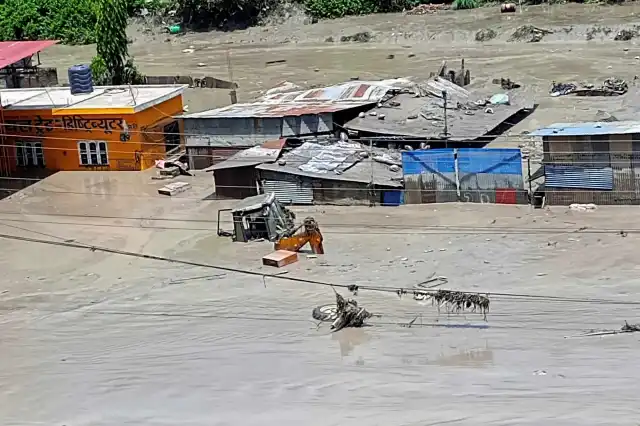
A massive Nepal flash flood tore through the Himalayan border district of Rasuwa on Wednesday, August 26, sweeping away settlements, bridges, roads and critical infrastructure along the Bhote Koshi River and leaving a rapidly changing toll of dead and missing.
By Wednesday afternoon, Nepalese authorities had confirmed at least seven deaths, while dozens of people remained missing or out of contact. Later reports put the confirmed death toll at eight or nine, underscoring how quickly the scale of the disaster was changing as rescue teams reached previously inaccessible areas.
The disaster struck around the areas of Timure and Syapru Besi, close to Nepal’s border with Tibet. The flooding also moved downstream through the Bhote Koshi and Trishuli river systems, prompting alerts in several districts.
Authorities have not yet definitively established what caused the sudden surge. A glacial lake outburst flood, landslide or another sudden release of water upstream remain among the possibilities under investigation.
What happened in Nepal’s Rasuwa district?
The flood struck the Bhote Koshi River early Wednesday morning, sending an unusually large volume of water downstream with little warning.
Timure, Syapru Besi and other settlements along the river were among the hardest-hit areas. Bridges, roads, buildings, vehicles and hydropower infrastructure were damaged or swept away. The flooding also disrupted communications and access routes, making it difficult for emergency teams to determine the full extent of the destruction.
At least 25 people had been rescued by Wednesday afternoon, according to Nepalese Army officials, while helicopters and security forces were being deployed to search affected areas.
The situation was particularly difficult because the disaster damaged the very infrastructure needed to respond to it.
How many people are dead or missing?
The casualty figures remained fluid throughout Wednesday as search-and-rescue teams moved into affected areas.
An initial report put the death toll at seven, with more than 40 security personnel missing. Subsequent official and media reports produced different figures as authorities reconciled missing-person reports and recovered bodies. Radio Nepal reported that 26 police personnel were out of contact, while other security personnel were also reported missing.
The Nepal Tourism Board also said that 384 travelers were initially listed as missing, including 105 Indian nationals, although these figures represent people whose whereabouts had not yet been confirmed rather than a confirmed death toll.
That distinction is important. In a disaster where roads and communications have been cut, people can temporarily appear missing simply because rescue teams cannot reach them or communication networks are down.
The confirmed toll is therefore likely to change as authorities gain access to isolated communities and verify reports.
Why was the flood so destructive?
Flash floods are different from the slower river flooding that can develop over hours or days.
A sudden release of water in a steep Himalayan valley can move extremely quickly. It can also pick up enormous quantities of rock, mud, trees and other debris, turning the flood into a powerful debris-laden flow.
That combination makes bridges, roads and buildings particularly vulnerable.
The Bhote Koshi also follows a steep mountain corridor. Communities and infrastructure located close to the river can have very little time to react when water levels rise suddenly.
In Rasuwa, the destruction of roads and bridges has compounded the emergency by restricting access for rescuers.
Did a glacial lake outburst cause the Nepal flash flood?
It is possible, but authorities have not yet confirmed it.
Officials are investigating whether a sudden release of water occurred upstream in Tibet. A landslide blocking a river and then releasing a large volume of water has also been discussed as a possible explanation.
A glacial lake outburst flood, or GLOF, occurs when water stored in a glacier-fed lake is suddenly released.
These lakes can form as glaciers retreat and meltwater collects behind natural barriers made of ice, rock or glacial debris. If the barrier fails, the stored water can escape rapidly.
Possible triggers include:
- Rock or ice avalanches falling into a lake
- Landslides
- Heavy rainfall
- Erosion of a natural dam
- Rapid changes in glacier or permafrost conditions
- Instability within a moraine dam
The resulting flood can travel far beyond the lake itself. Communities downstream may receive a destructive surge even if there is little or no rainfall where the damage occurs.
Why are officials looking upstream toward Tibet?
The Bhote Koshi originates on the Tibetan side of the Himalayas before flowing into Nepal and eventually joining the Trishuli River system.
That means an event in a remote high-altitude area can produce a major flood downstream in Nepal.
Reports on Wednesday indicated that the flood appeared to have originated from the Tibetan side, while authorities and hydrological experts were working to establish the precise source. Satellite imagery and information from across the border could be critical in determining whether a glacial lake, landslide or another event triggered the surge.
This is one reason GLOFs are particularly challenging to monitor. The trigger can occur in an inaccessible area many kilometers upstream, while the first visible evidence of the disaster may appear much farther down the valley.
Has Rasuwa experienced a similar flood before?
Yes. The latest disaster is strikingly similar to a deadly flood that hit the same river system in July 2025.
On July 8, 2025, a major flood swept down the Bhote Koshi from the Tibet side into Rasuwa. At least nine people were killed and more than two dozen were reported missing.
The flood destroyed the Friendship Bridge linking Nepal and China and damaged the Rasuwagadhi hydropower project and other infrastructure.
Subsequent satellite analysis found evidence that the drainage of a supraglacial lake in Tibet triggered the 2025 event. Nepalese hydrological authorities and ICIMOD researchers identified a substantial change in the lake before and after the flood.
That history makes the current investigation particularly significant.
A similar-looking flood occurring in the same river basin only a year later raises questions about the vulnerability of downstream communities and infrastructure to sudden high-altitude water releases.
Nepal has experienced other devastating GLOFs
Rasuwa is not the only Himalayan location to have experienced this kind of disaster.
Thame, Nepal — August 2024
On August 16, 2024, a glacial lake outburst flood struck the village of Thame in Nepal’s Everest region.
ICIMOD confirmed that the flood originated from the Thyanbo glacial lake. Fourteen properties were initially reported destroyed, including homes, hotels, a school and a health post.
A later ICIMOD study found that the event was more complicated than a simple lake breach. A rock avalanche triggered a displacement wave that caused one glacial lake to breach and contributed to the failure of another.
The chain reaction released an estimated 459,000 cubic meters of water and debris, which traveled roughly 80 kilometers downstream.
The lesson is important: a GLOF does not necessarily have a single trigger. An avalanche can cause a wave, the wave can breach a lake, and the resulting flood can trigger landslides and further debris flows.
Sikkim, India — October 2023
A similar catastrophe occurred at South Lhonak Lake in India’s Sikkim Himalaya in October 2023.
Research later published with ICIMOD’s involvement found that a massive collapse of moraine material into the lake generated a roughly 20-meter-high wave. The resulting outburst released about 50 million cubic meters of water and triggered additional landslides downstream.
The event caused extensive damage across the Teesta Valley, including to bridges, roads, settlements and hydropower infrastructure.
Why do glacial floods pose a growing risk in the Himalayas?
The danger is not simply that glaciers are melting.
As glaciers retreat, new lakes can form or existing lakes can expand. At the same time, warming can alter the stability of ice, rock, slopes and permafrost around those lakes.
This creates a landscape where several hazards can interact.
A rockfall can trigger an avalanche. An avalanche can displace water in a glacial lake. The resulting wave can overtop a natural dam. The flood can then destabilize slopes farther downstream.
ICIMOD’s regional research has documented more than 700 GLOF events in High Mountain Asia and found that more than half of recorded events were triggered by mass movements such as avalanches, rockfalls and landslides.
That does not mean every Himalayan flood is caused by climate change or by a GLOF. Rainfall, landslides, river blockages and other natural processes can produce similar disasters.
For the August 26 Rasuwa flood, the cause remains an open question.
Why does the disaster matter beyond Rasuwa?
The immediate concern is rescuing people and preventing additional deaths.
But the disaster also exposes the vulnerability of infrastructure built in narrow Himalayan valleys.
Roads, bridges and hydropower projects are often concentrated along river corridors because those routes provide the most practical access through mountainous terrain.
That creates a difficult trade-off: the same rivers that provide transportation routes and hydropower can also become channels for catastrophic flood flows.
The latest Rasuwa flood has already damaged energy infrastructure, with Reuters reporting that disruptions affected hundreds of megawatts of hydropower capacity.
The flood also has potential consequences downstream because the Bhote Koshi feeds into the wider Trishuli river system.
Nepalese authorities have urged people living near rivers to move to safer ground, while downstream districts have been placed on alert as floodwaters move through the river network.
What happens next?
The immediate priorities are straightforward:
- Locate people who remain missing.
- Reach communities cut off by damaged roads and bridges.
- Recover and identify victims.
- Provide medical assistance and temporary shelter.
- Monitor river levels downstream.
- Determine the source and trigger of the flood.
- Assess damage to roads, bridges and hydropower facilities.
- Use satellite imagery and field investigations to identify potential upstream hazards.
The cause will matter because it determines what can be done to reduce the risk of another disaster.
If investigators confirm a GLOF, authorities will need to assess potentially dangerous glacial lakes and improve monitoring and early-warning systems. If a landslide or rainfall event caused the flood, different forms of hazard mapping and river monitoring will become more important.
Either way, the August 26 disaster demonstrates the narrow window communities can have to respond to sudden Himalayan floods.
The bigger warning from the Nepal flash flood
The most important question is no longer simply how much damage the flood caused.
It is whether communities downstream of high-altitude lakes, glaciers and unstable slopes can receive enough warning before the next sudden release of water.
Nepal’s recent experience offers a clear pattern: a flood can begin in an isolated high-altitude landscape and, within a short time, become a disaster for people living many kilometers downstream.
The 2025 Rasuwa flood, the 2024 Thame GLOF and the 2023 South Lhonak disaster all demonstrate how a relatively remote mountain hazard can destroy infrastructure and threaten communities far from its origin.
But the August 26 flood should not be labeled a GLOF until investigators establish that link.
For now, the facts are stark enough without speculation: a sudden flood tore through Rasuwa, people were killed, many remained missing, critical infrastructure was destroyed and rescue teams were racing against difficult terrain and damaged access routes.
The final toll — and the explanation for what unleashed the water — may take time to emerge.
TL;DR
A massive flash flood struck Nepal’s Rasuwa district on August 26, 2026, along the Bhote Koshi River near the Tibet border.
- At least seven deaths were initially confirmed, with later reports putting the toll at eight or nine.
- Dozens of people, including security personnel, were reported missing or out of contact.
- The Nepal Tourism Board separately listed 384 travelers as missing, including 105 Indian nationals, although these figures were preliminary.
- Timure and Syapru Besi were among the worst-hit areas.
- Roads, bridges, settlements and hydropower infrastructure were damaged.
- Authorities have not confirmed the cause.
- A glacial lake outburst, landslide or sudden upstream water release are among the possibilities being investigated.
- Rasuwa experienced a similar deadly flood in 2025 that was later linked to the drainage of a supraglacial lake in Tibet.
- Experts have documented a growing risk from interacting glacier, avalanche, landslide and flood hazards across the Himalayas.