
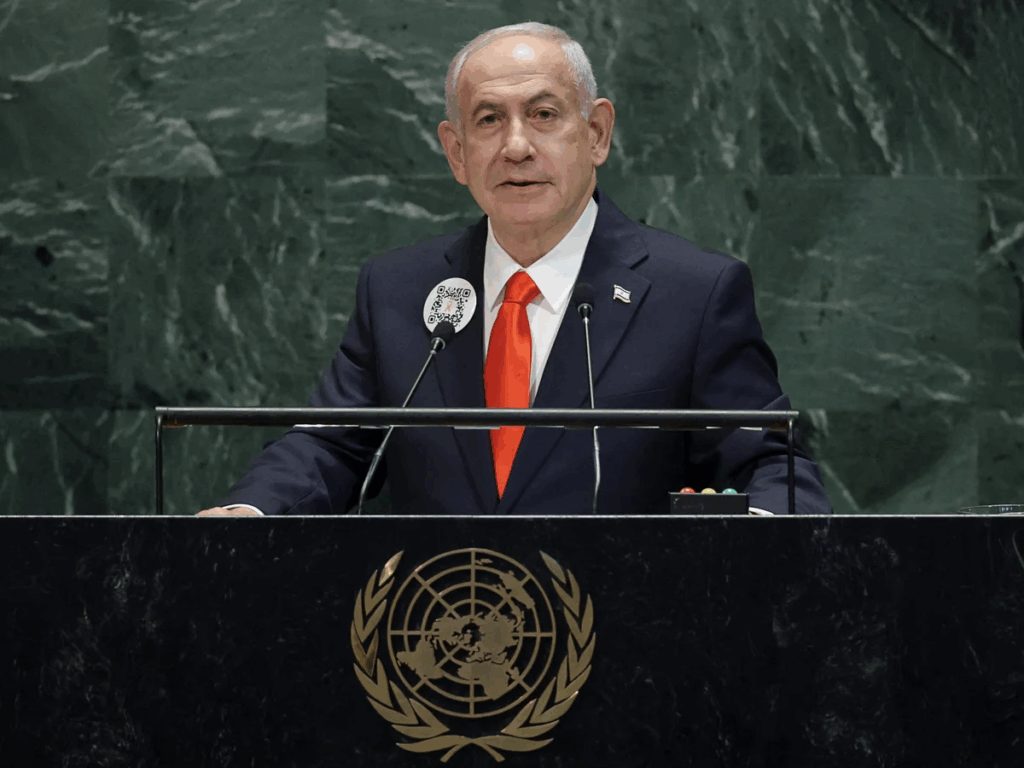
Israeli Prime Minister Benjamin Netanyahu turned his address at the United Nations General Assembly (UNGA) into a dual broadcast on Friday, simultaneously speaking to world leaders and to Israeli hostages held in Gaza. In a rare move, his remarks were transmitted via loudspeakers across parts of the Strip, to signal both reassurance to captives and defiance toward Hamas.
What did Netanyahu say to the hostages?
Speaking first in Hebrew and then in English, Netanyahu sought to comfort the 48 hostages believed to be in Hamas captivity.
“Our brave heroes, this is Prime Minister Netanyahu, speaking to you live from the United Nations. We have not forgotten you, not even for a second. The people of Israel are with you,” he declared.
He emphasized Israel’s commitment to securing their release:
- “We will not falter, we will not rest, until we bring all of you home.”
The Israeli leader framed the message as a direct lifeline to those trapped inside Gaza, while also appealing to Israeli citizens watching from home.
How was the speech broadcast in Gaza?
To amplify his words beyond the UN chamber, Netanyahu ordered the Israel Defense Forces (IDF) to set up loudspeakers across the Gaza Strip. This was part of what some military officials described as psychological warfare against both Hamas and Gaza residents.
- Challenges to the plan: IDF commanders reportedly objected, warning that soldiers would face heightened risks by entering exposed areas to install the equipment.
- Execution: Despite concerns, Israeli media reported that preparations were underway to carry out the order, following the Prime Minister’s directive.
Netanyahu also claimed that his speech was streamed directly onto Gazan cell phones, crediting Israeli intelligence with making that possible. If true, it would mark a novel form of digital information warfare designed to bypass Hamas-controlled media channels.
What was Netanyahu’s message to Hamas?
In his address, Netanyahu shifted tone from reassurance to warning:
- Ultimatum: “Lay down your arms, free the hostages now. Let my people go. Free the hostages — all of them, the whole 48. If you do, you live. If not, Israel will hunt you down.”
- Conditional ceasefire: He suggested that the war could end immediately if Hamas complied, a message that framed the release of hostages as a precondition for peace.
This rhetoric underscores Netanyahu’s strategy of leveraging international platforms like the UNGA to deliver sharp, symbolic blows to Hamas’s legitimacy while appealing to global audiences.
How did Netanyahu respond to genocide accusations?
The Prime Minister used part of his speech to reject charges of genocide in Gaza, accusations that have gained traction in international courts and civil society debates.
- He called the allegations “baseless,” arguing that Israel views each civilian death as a tragedy, while Hamas treats it as a strategy.
- Netanyahu claimed that shortages of food in Gaza were not the result of Israeli blockades but of Hamas diverting supplies. “What a joke,” he remarked.
This defense reflects Israel’s broader diplomatic strategy: shifting blame to Hamas and framing itself as both victim and reluctant combatant.
Why did Netanyahu avoid French and Spanish airspace?
Netanyahu’s journey to New York drew attention before he even took the UN stage.
- His plane took an unusual route, skirting French and Spanish skies, both countries that have reportedly issued arrest warrants against him for alleged war crimes.
- Flight-tracking data showed the aircraft briefly flying over Greece and Italy before crossing the Atlantic.
- Reports suggested his entourage was kept smaller than usual, with some journalists excluded, either to save fuel for the longer detour or due to security arrangements.
This maneuver illustrates the growing international legal and diplomatic challenges Netanyahu faces abroad, even as he seeks to project strength at home and on the world stage.
Why does this matter?
Netanyahu’s decision to merge his UNGA address with a psychological operation in Gaza reveals several key dynamics in Israel’s ongoing conflict:
- Symbolic reassurance: By directly addressing hostages, Netanyahu sought to demonstrate leadership and empathy to Israeli families pressing for answers.
- Psychological warfare: Broadcasting across Gaza was not just about communication, but about undermining Hamas’s narrative control.
- Global audience: Delivering these messages at the UN magnified their reach, forcing the international community to weigh Israel’s framing of the conflict.
- Personal stakes: Netanyahu’s avoidance of European airspace highlighted the precarious balance he faces between global scrutiny and domestic expectations.
TL;DR
Netanyahu used his UNGA address to send a direct message to hostages in Gaza via loudspeakers, promising their return and warning Hamas to release them or face relentless pursuit. He dismissed genocide accusations as “baseless” and defended Israel’s conduct in Gaza. His flight to the US notably avoided French and Spanish airspace due to legal risks, underscoring his growing diplomatic isolation even as he sought to project strength internationally.