
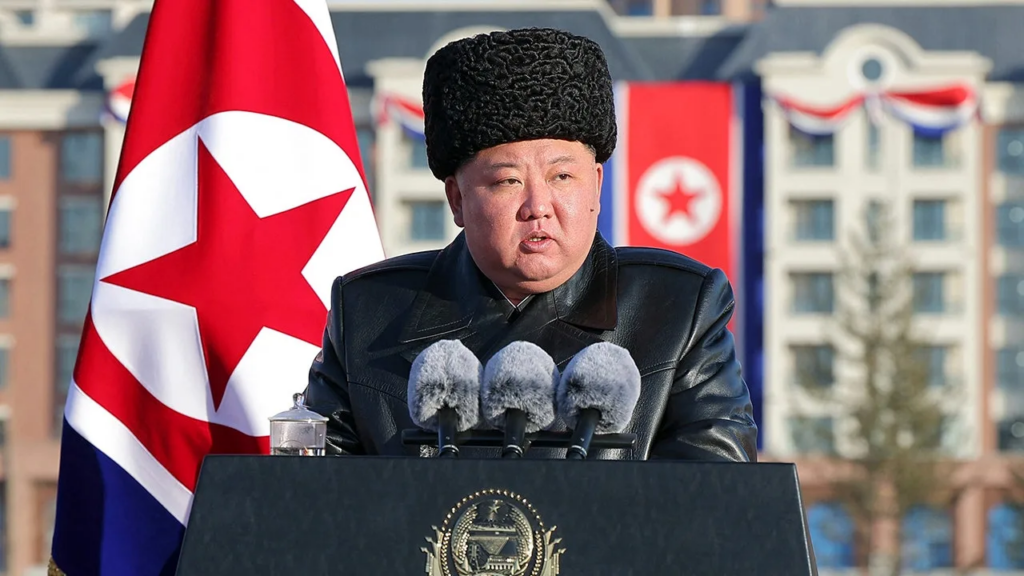
North Korea has reportedly updated its constitution to authorize an automatic nuclear response if leader Kim Jong Un is assassinated or the country’s nuclear command structure is disabled.
The reported change marks one of the clearest signals yet that Pyongyang is preparing for a “decapitation strike” scenario, military terminology for an attempt to eliminate a country’s leadership during conflict.
According to reports citing South Korea’s intelligence services, the revised constitutional language states that if North Korea’s nuclear command-and-control system is threatened by hostile forces, a retaliatory nuclear strike would be launched “automatically and immediately.”
The development is intensifying concerns among security analysts who already view North Korea’s nuclear posture as increasingly aggressive and less predictable.
Why North Korea Is Changing Its Nuclear Policy Now
The reported constitutional update comes during a period of heightened geopolitical instability.
Pyongyang has spent the past several years expanding both its nuclear arsenal and the legal framework governing when those weapons could be used.
In 2022, North Korea formally adopted a law allowing preemptive nuclear use under certain conditions. The latest constitutional revision appears to go even further by codifying an automatic retaliation mechanism tied directly to the survival of the regime.
Analysts say the move reflects two major fears inside North Korea:
- A targeted strike against Kim Jong Un
- Disruption of military leadership during wartime
By embedding automatic retaliation into state doctrine, North Korea may be trying to strengthen deterrence by signaling that killing its leader would not prevent nuclear escalation.
What “Automatic Nuclear Retaliation” Actually Means
The most alarming aspect of the reported change is the idea of launch authority being triggered automatically rather than through direct human command.
In nuclear strategy, command-and-control systems are designed to ensure weapons are used only under tightly controlled conditions. Any move toward automatic launch mechanisms raises the risk of:
- Miscalculation
- Technical malfunction
- Escalation during crises
- Reduced diplomatic response time
Security experts often compare such systems to Cold War-era “dead hand” concepts, where a country ensures retaliation even if its leadership is wiped out.
The Soviet Union famously developed a semi-automated nuclear retaliation system during the Cold War to preserve deterrence in the event of a surprise attack.
Why Pyongyang Is Focused on Leadership Survival
North Korea has long viewed leadership protection as central to regime survival.
Both the United States and South Korea have previously discussed “decapitation strike” capabilities aimed at disabling North Korea’s leadership during conflict.
South Korea’s military strategy has at times included plans designed to target key command facilities in Pyongyang if war appeared imminent.
North Korea routinely cites those discussions as justification for expanding its nuclear arsenal.
By making automatic retaliation part of its constitutional framework, Pyongyang appears to be telling adversaries that eliminating Kim Jong Un would not stop a nuclear response.
The Constitutional Change Reflects a Broader Strategic Shift
The latest revision is part of a broader effort by Kim Jong Un to redefine North Korea’s national identity and military doctrine.
Recent constitutional changes have included:
- Defining South Korea as a separate hostile state
- Removing language about Korean reunification
- Expanding references to nuclear defense
- Hardening anti-US rhetoric
These moves mark a major departure from decades of official messaging that at least nominally supported eventual reunification of the Korean Peninsula.
Instead, North Korea increasingly portrays inter-Korean relations as permanent hostility between two separate states.
Could the New Policy Increase Nuclear Risk?
Many arms-control experts believe it could.
Automatic retaliation systems are considered especially dangerous because they reduce the time available for verification and political decision-making during a crisis.
Critics worry the doctrine could:
- Encourage faster escalation during military conflict
- Increase risks from false alarms
- Make diplomatic de-escalation harder
- Lower the threshold for nuclear use
Even if the system is not fully automated technologically, the rhetoric itself changes how adversaries interpret North Korea’s nuclear posture.
That can influence military planning in Washington, Seoul, and Tokyo.
How the US and Allies May Respond
The United States and its regional allies are likely to view the reported policy change as further evidence that North Korea is moving toward a more aggressive nuclear strategy.
Possible responses could include:
- Expanded joint military exercises
- Stronger missile defense deployments
- Increased surveillance of North Korean launch systems
- Additional sanctions or diplomatic pressure
At the same time, analysts warn that pressure campaigns alone have historically failed to stop Pyongyang’s weapons development.
North Korea continues to frame its nuclear arsenal as essential for regime survival.
Why This Matters Beyond the Korean Peninsula
North Korea’s evolving doctrine is being closely watched worldwide because it reflects a broader trend in modern nuclear strategy: the weakening of traditional safeguards against escalation.
As geopolitical tensions rise globally, more countries are emphasizing rapid-response deterrence, survivable launch systems, and hardened command structures.
The concern among arms-control experts is that doctrines built around automatic retaliation leave less room for diplomacy, verification, or human judgment during moments of crisis.
And in nuclear strategy, even a few minutes can matter enormously.