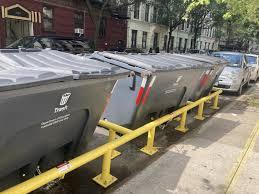
New York City’s plan to curb its rat problem by forcing smaller residential buildings to use official trash containers is colliding with a basic logistical failure: many New Yorkers can’t actually buy the bins they’re being required to use.
Starting this summer, every building with one to nine residential units must put trash out in the city-mandated “NYC Bin” or face fines. City Hall says the rule is essential to containerize garbage and reduce vermin. Homeowners say it feels like a setup—because the bins are out of stock, back-ordered, or stuck in bureaucratic limbo.
The result is growing frustration, finger-pointing between the city and its vendor, and a question that keeps coming up on stoops across the five boroughs: How can the city fine people for not using bins they can’t get?
What is the NYC garbage bin mandate?
The NYC garbage bin mandate requires owners of smaller residential buildings—defined as one- to nine-unit properties—to use standardized, lidded containers for trash pickup.
The basics residents need to know
- Who it applies to: Buildings with 1–9 units
- What’s required: Official, NYC-branded garbage bins
- When enforcement begins: June (this summer)
- Penalties:
- $50 minimum fine
- Up to $200 for repeat violations
The rule replaces the current system, which allows trash to be set out in any 55-gallon lidded container. Once the switch happens, only the official NYC bins will be allowed.
Why is the city pushing standardized garbage bins?
City officials argue that containerization is one of the most effective ways to fight rats. Loose trash bags, especially overnight, provide easy food access for rodents.
The “War on Rats” strategy
Former Mayor Eric Adams made rat mitigation a signature policy goal, even creating a dedicated Office of Rodent Mitigation. Containerized trash is central to that effort.
The logic is straightforward:
- Fewer exposed trash bags
- Less food for rats
- Cleaner sidewalks
Many other U.S. cities already use standardized bins with success. The problem, critics say, isn’t the idea—it’s the execution.
Why can’t New Yorkers find the bins?
This is where the plan breaks down.
The Department of Sanitation’s own website currently warns residents that online ordering and the call center are unavailable. The city directs people to Home Depot locations instead.
But multiple residents told local media they went to Home Depot only to find the bins out of stock.
City vs. vendor: who’s responsible?
- The city blames Otto Environmental Systems, the outside manufacturer.
- Otto says it’s working to restore delivery and also tells customers to check Home Depot.
- Home Depot, in many cases, has no bins to sell.
It’s a circular answer that leaves residents stuck in the middle.
How residents are being affected right now
Orders placed, bins never delivered
Michael Monopoli, a 76-year-old Staten Island homeowner, ordered a bin back in October. It never arrived.
When he tried to follow up:
- The sanitation phone lines were down
- The website was unusable
His takeaway was blunt: “I never got the pail. And when I went to call you, the Department of Sanitation, you closed down your phone and your website.”
Fear of fines without proof
Sanitation officials say homeowners won’t be fined if they’ve ordered a bin and are waiting for delivery. But residents say that’s easier said than done.
“How do you prove that?” one Brooklyn homeowner asked. “You’re going to spend months fighting a ticket.”
Are sanitation workers struggling with the bins, too?
Even residents who managed to get the bins say the rollout has been rocky.
One Brooklyn resident, Brad, said sanitation workers appear slowed down by the new containers.
How trash pickup has changed
- Workers must drag the bin to the truck
- Open the latch
- Remove bags manually
- Return the bin to the curb
Before, crews could grab bags quickly and move on. Now, every stop takes longer.
“It’s a whole extra step,” Brad said. “It’s a lot.”
That raises another concern: if pickups slow down, will trash pile up anyway?
Is this about public health or revenue?
Some New Yorkers believe the mandate feels less like rat control and more like a cash grab.
Why critics are skeptical
- Bins cost around $50 upfront
- Fines start at $50
- Supply shortages make compliance harder
“If they’re going to make rules like that, they need to provide the bins,” said Bushwick resident Tom Pratt. “It’s a money grab.”
The City Council did pass legislation to reimburse middle-class homeowners for the cost of the bins, but reimbursement doesn’t help if the product can’t be purchased in the first place.
Why this rollout feels uniquely New York
Standardized garbage bins are not a novel idea. Cities across the country use them successfully.
What frustrates residents is that New York managed to turn a relatively simple policy into a logistical mess.
“It seems like only in New York can you try to match a standard idea from across the country and struggle so much to accomplish it,” one Brooklyn homeowner said.
That sentiment captures the broader issue: the policy goal may be sound, but the execution is undermining public trust.
What happens next?
Unless supply issues are resolved quickly, the city risks enforcing a rule many residents physically cannot comply with.
Key questions still unanswered:
- When will online ordering be restored?
- Will enforcement be delayed if shortages continue?
- How will residents prove they tried to comply?
Without clear answers, the NYC garbage bin mandate could become less about fighting rats—and more about fighting City Hall.
TL;DR
- NYC is requiring 1–9 unit buildings to use official garbage bins starting this summer.
- The bins are difficult or impossible to buy due to supply and ordering issues.
- Residents fear fines despite good-faith attempts to comply.
- The city blames the vendor; the vendor points residents to stores without stock.
- What was meant to be an anti-rat solution is turning into a credibility problem.