
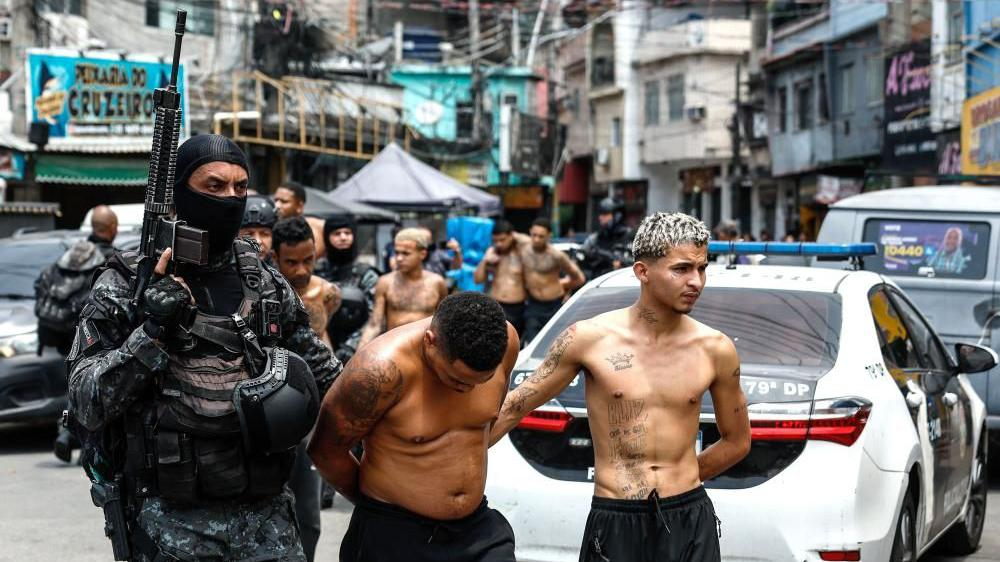
More than 119 people have been killed in what is now considered the deadliest police operation in Brazil’s history. The massive raid in Rio de Janeiro’s favelas, aimed at dismantling the notorious Comando Vermelho (Red Command), has triggered shockwaves across Brazil, reigniting debates about police violence, organized crime, and state accountability.
As details continue to emerge, here’s what we know, and don’t yet know, about the unprecedented crackdown.
What triggered Brazil’s deadliest police operation?
The multi-day raid, officially codenamed Operation Containment, was launched to target the Comando Vermelho, one of Brazil’s oldest and most powerful criminal syndicates. Founded in the 1970s, the gang grew from within Rio’s prisons and now controls vast sections of the city’s underbelly, from drug trafficking and extortion to utilities like electricity and transport in certain favelas.
According to Rio’s state security officials, the operation involved 2,500 police officers, supported by armored vehicles, helicopters, and drones, and focused on two of the gang’s strongholds: Alemao and Penha. Both are densely populated favelas known for decades of violent clashes between traffickers and law enforcement.
Officials say the goal was to “reclaim control of critical areas dominated by organized crime,” but human rights observers argue the operation’s sheer scale and civilian toll suggest otherwise.
How many people were killed or arrested?
The official death toll currently stands at 119, including four police officers. However, Brazil’s Public Defender’s Office and several NGOs estimate the number may exceed 130.
Authorities confirmed 113 arrests, among them 10 minors, and the seizure of 91 high-caliber rifles along with an unspecified quantity of drugs and cash.
Rio’s Civil Police described the operation as a “strategic victory against organized crime.” Still, human rights organizations have questioned whether such extreme force was necessary, and whether all those killed were truly gang members.
How does this compare to previous deadly raids
Operation Containment surpassed the 1992 Carandiru prison massacre, where 111 inmates were killed, marking the highest death toll in any police action in Brazil’s history.
For context:
- Jacarezinho raid (2021): 28 killed
- Vila Cruzeiro raid (2022): 23 killed
- Carandiru massacre (1992): 111 killed
- Operation Containment (2025): 119+ killed
This escalation underscores a growing pattern of militarized policing in Brazil’s urban centers, a strategy that critics say prioritizes lethal force over long-term social intervention.
Political tension over the raid
The raid has also deepened a political rift between Brazil’s federal and state governments.
The operation was planned solely by Rio’s state government, led by Governor Claudio Castro, a conservative and vocal ally of former president Jair Bolsonaro. The federal government, including Justice Minister Ricardo Lewandowski, stated it had no prior knowledge of the raid.
The timing has further fueled controversy. Just days before the operation, President Luiz Inácio Lula da Silva, speaking in Indonesia, said that “drug traffickers are also victims of drug users,” a comment widely criticized as lenient. Lula later clarified that his administration remains committed to dismantling criminal networks.
Observers say the incident has become a symbol of Brazil’s polarized debate over how to tackle crime, between hardline enforcement and socio-economic reform.
Unanswered questions: Who were the victims?
One of the most pressing questions is who the victims were. Authorities have not released a full list of the deceased, and journalists report that many families in the affected favelas still don’t know whether their relatives are alive or detained.
Local residents and human rights groups allege that extrajudicial killings occurred, with several witnesses describing unarmed men being shot at close range. The Public Prosecutor’s Office has since opened a formal inquiry.
Among the arrested is Thiago do Nascimento Mendes, believed to be a top lieutenant in the Red Command. However, it remains unclear how many of the others detained or killed were actually linked to the gang’s leadership structure.
The United Nations Secretary-General António Guterres has urged Brazil to conduct a transparent investigation, emphasizing that “public security must never come at the cost of human rights.”
Why Brazil’s police raids keep getting deadlier
Experts argue that such operations reflect deeper systemic failures within Brazil’s policing and judicial systems.
Three key factors contribute to the rising lethality:
- Militarization of police forces: Brazil’s military police operate under wartime logic rather than community protection models.
- Lack of accountability: Convictions of officers involved in fatal raids remain rare, reinforcing a culture of impunity.
- Socio-economic neglect: Favelas, where most raids occur, remain economically marginalized and heavily surveilled, fueling resentment and mistrust.
Human rights watchdog Human Rights Watch (HRW) has long warned that “Brazil’s war on drugs has become a war on its own citizens.” Analysts say that unless reforms shift from force-first to prevention-first strategies, similar tragedies are inevitable.
What happens next?
Brazil’s Attorney General’s Office has requested a federal inquiry into the legality and proportionality of Operation Containment. Advocacy groups are calling for independent forensic analysis to determine whether victims were shot in combat or executed post-surrender.
Meanwhile, residents of Alemao and Penha are mourning their dead amid blackouts, infrastructure damage, and a pervasive sense of fear.
The outcome of the investigation, and whether the Brazilian government allows true transparency, could define the country’s human rights trajectory for years to come.
TL;DR: Key takeaways
- Operation Containment targeted Rio’s Comando Vermelho gang.
- 119+ people died, making it Brazil’s deadliest police raid ever.
- Federal authorities say they were not informed beforehand.
- UN and human rights groups have called for an independent probe.
- The event reignites debate over militarized policing and accountability in Brazil.