
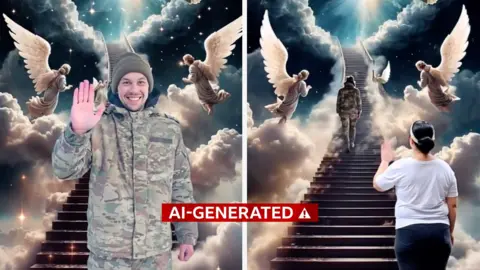
Artificial intelligence is giving grieving families new ways to remember loved ones, but it is also raising difficult ethical questions. In Russia, a growing number of families of soldiers killed or missing in the Ukraine war are paying creators to produce AI-generated photos and videos that imagine emotional reunions, heavenly farewells, or homecomings that never happened.
The trend has become a profitable online business, with creators charging anywhere from a few hundred to several thousand roubles for customized videos. Supporters say the content offers comfort to grieving families, while critics argue it risks exploiting loss, distorting reality, and turning war into emotionally charged digital propaganda.
What are these AI-generated memorial videos?
The videos are typically short, highly emotional clips created using generative AI tools.
Many portray deceased or missing Russian soldiers:
- Walking back through the front door to embrace family members.
- Holding children or spouses in imagined reunions.
- Wearing military uniforms with angel wings.
- Climbing stairways into heaven.
- Appearing on fictional welcome-home billboards.
Some videos feature soldiers who are officially missing in action rather than confirmed dead, imagining their safe return after the war.
One widely shared example reportedly came from Russian blogger Katya Jin, whose husband has been missing while serving in what Russian authorities continue to call the “special military operation.” Her AI-generated video depicting a soldier returning home inspired many others to commission similar tributes.
Why are families paying for AI recreations?
These photos and videos are being posted by the relatives of soldiers who have either died or have disappeared, and have left Ukrainians appalled, the BBC reported. For many grieving relatives, these videos serve as digital memorials rather than attempts to deceive viewers.
Traditional mourning rituals often include photographs, memorial videos, or recorded messages. AI tools now allow families to create scenes that were never possible in real life, offering a symbolic goodbye or an imagined reunion.
Supporters argue these creations can:
- Help process grief.
- Preserve memories in a personalized way.
- Provide emotional comfort after a sudden loss.
- Honor military service.
The phenomenon reflects a broader global trend, sometimes described as the “digital afterlife,” in which artificial intelligence is increasingly used to recreate the appearance, voice, or likeness of deceased individuals.
A growing business built around digital grief
The emotional demand has also created a new commercial market.
According to reports, creators charge between the following:
- 200 roubles for simple AI edits.
- 10,000 roubles for more elaborate, customized videos.
Successful creators reportedly earn up to 200,000 roubles per month, significantly exceeding Russia’s average monthly wage.
That profitability has fueled criticism that some creators may be monetizing grief during an ongoing conflict.
The debate mirrors broader concerns surrounding AI-generated memorial services, digital avatars of deceased loved ones, and commercial deepfake technologies emerging worldwide.
Why has the trend become controversial?
The controversy extends well beyond the use of artificial intelligence itself.
Questions about consent
Many of the deceased never agreed to have AI recreate their likeness after death.
Ethicists have increasingly questioned whether families alone should decide how someone’s digital identity is used once they are gone.
Emotional manipulation
Critics argue that hyper-realistic videos can blur the line between memory and fiction.
While many viewers understand these videos are AI-generated, emotionally powerful imagery may still influence how people process grief.
Wartime messaging
Another major criticism concerns the broader narrative surrounding the Ukraine war.
Many AI memorials portray fallen soldiers as patriotic heroes making noble sacrifices for their country.
Critics argue that these portrayals can reinforce official wartime messaging while drawing attention away from the human cost of the conflict.
Some Ukrainian observers have reportedly described the trend as unsettling, particularly given the ongoing violence and loss experienced on both sides.
How does this relate to the broader debate over AI and deepfakes?
The Russian memorial trend is part of a much larger conversation about generative AI.
As AI image and video tools become increasingly realistic, societies around the world are confronting difficult questions, including:
- Who owns a person’s digital likeness after death?
- Should AI recreations require prior consent?
- Can synthetic memorials help people grieve without misleading others?
- Where should platforms draw the line between remembrance and manipulation?
These issues extend beyond wartime and affect entertainment, advertising, education, and historical preservation.
Several technology companies have already introduced policies governing AI-generated media, while lawmakers in multiple countries are considering regulations addressing deepfakes, identity rights, and synthetic content.
Russia’s handling of wartime casualties
Independent estimates suggest Russia has suffered substantial military losses since the full-scale invasion of Ukraine began in 2022, although exact casualty figures remain disputed.
Moscow rarely publishes detailed official casualty data, and reporting on military losses remains tightly controlled.
Within this environment, AI-generated memorials have become one way families publicly honor relatives whose deaths or disappearances may receive little official attention.
At the same time, the imagery often emphasizes sacrifice, patriotism, and remembrance rather than the broader realities of the conflict.
Could AI change how societies mourn?
The technology behind these videos is evolving rapidly.
AI can now generate:
- Photorealistic portraits.
- Talking avatars.
- Voice recreations.
- Animated family photographs.
- Personalized memorial videos.
Some psychologists believe these tools may eventually become part of modern grieving rituals, much like photographs or home videos once did.
Others caution that replacing genuine memories with fictional interactions could complicate the grieving process for some individuals.
Researchers continue to study whether AI-generated memorials provide lasting comfort or create emotional dependence.
The bigger picture
Artificial intelligence is transforming far more than workplaces and entertainment. It is also changing how people remember, mourn, and preserve the lives of those they have lost.
For some Russian families, AI-generated memorial videos represent a deeply personal tribute to loved ones who never returned home. For others, they raise uncomfortable questions about consent, commercialization, and the role of technology in shaping public memory during wartime.
As generative AI becomes more accessible, debates over digital remembrance are likely to intensify, forcing societies to balance compassion, ethics, and authenticity in an era where technology can recreate almost any image, voice, or moment.
TL;DR
- Families of Russian soldiers are commissioning AI-generated memorial videos and images.
- The content often depicts deceased soldiers reuniting with loved ones or ascending to heaven.
- Creators charge between 200 and 10,000 roubles per video, with some earning well above Russia’s average monthly wage.
- The trend has ignited debate over grief, ethics, AI-generated deepfakes, and wartime narratives.
- Experts warn that AI memorials raise questions about consent, authenticity, and emotional manipulation.