
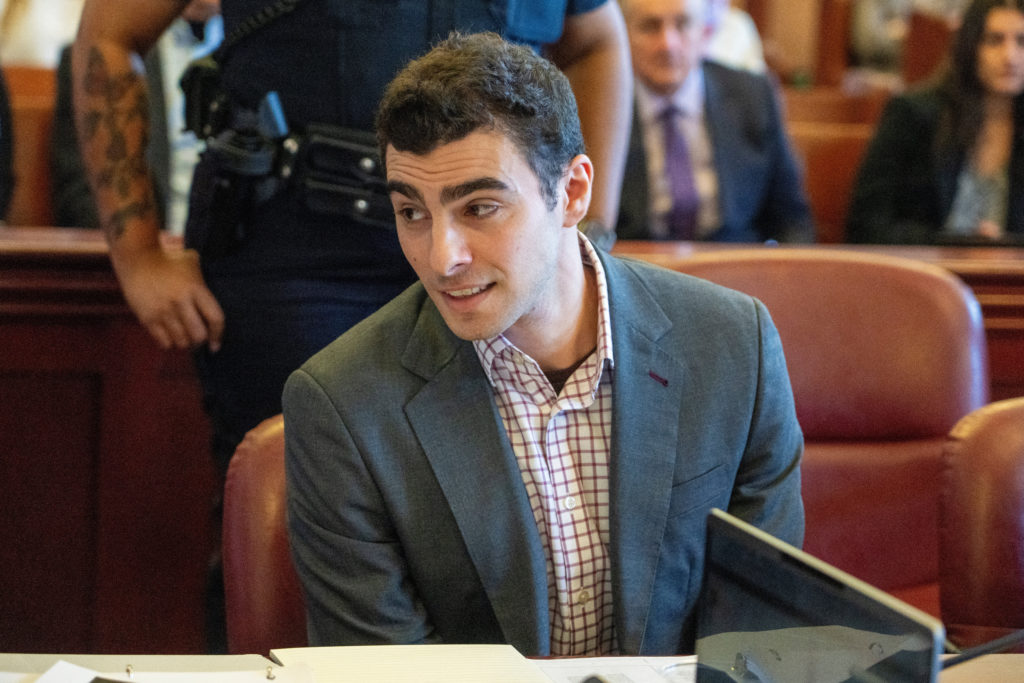
Luigi Mangione pleaded guilty Friday to federal stalking charges tied to the killing of UnitedHealthcare CEO Brian Thompson, bringing a major turn in one of the most closely watched criminal cases in the United States.
During a federal court hearing in Manhattan, Mangione admitted that he tracked Thompson to an investor conference in December 2024 and shot him outside a New York City hotel. He pleaded guilty to two federal counts of stalking resulting in death.
The 28-year-old’s guilty plea does not automatically end the broader criminal case. Mangione still faces a separate murder prosecution in New York state court, creating a complicated legal question over whether that trial can proceed after the federal conviction.
What did Luigi Mangione admit in federal court?
Mangione gave the court a detailed account of how he targeted Thompson.
He acknowledged that he learned UnitedHealthcare was holding its annual investor conference in New York on December 4, 2024. He said he contacted the company while posing as an investor to obtain information about the event.
Mangione then traveled to New York and tracked Thompson to the conference. He admitted shooting the executive outside a Manhattan hotel.
His plea represents a significant departure from his earlier position. Mangione had previously pleaded not guilty to the federal charges.
The federal case centered on stalking-related offenses rather than a standalone federal murder conviction after the federal murder charge was dismissed. His guilty plea therefore resolves the federal stalking counts while leaving the state murder prosecution as a separate legal matter.
What federal charges did Mangione plead guilty to?
Mangione pleaded guilty to two federal stalking counts involving death.
The charges were based on the allegation that he traveled across state lines and used interstate communications while stalking Thompson, ultimately resulting in the executive’s death.
Each federal count carries a potential maximum sentence of life imprisonment. US District Judge Margaret Garnett scheduled Mangione’s federal sentencing for December 18. Prosecutors have indicated they will seek a life sentence.
The guilty plea means there will be no federal trial on those charges.
That is a substantial change from earlier proceedings, when Mangione faced the possibility of a federal trial alongside a separate state prosecution.
Why is Mangione still facing a state murder case?
The federal guilty plea does not automatically erase the murder case brought by Manhattan prosecutors.
Mangione is separately charged in New York state court with killing Thompson. That case is currently scheduled to proceed, with jury selection expected to begin September 8.
Mangione’s lawyers have moved to dismiss the state charges, arguing that continuing the prosecution after the federal case would violate constitutional protections against double jeopardy.
The argument is now one of the most consequential legal questions surrounding the case.
Whether the state prosecution can continue will depend on how New York courts interpret the relationship between the federal charges to which Mangione pleaded guilty and the state murder charges.
What is double jeopardy and why does it matter here?
The Double Jeopardy Clause of the Fifth Amendment generally protects defendants from being prosecuted twice for the same offense after jeopardy has attached.
But the legal issue is more complicated when federal and state governments bring separate prosecutions arising from the same conduct.
The United States and individual states operate as separate sovereigns, and the dual-sovereignty doctrine can allow successive federal and state prosecutions under certain circumstances.
That means Mangione’s guilty plea does not by itself guarantee that the New York murder case will be dismissed.
His lawyers are nevertheless seeking dismissal, arguing that the federal and state proceedings arise from the same underlying killing. The state prosecution has indicated it intends to continue pursuing the case.
What sentence could Luigi Mangione receive?
Mangione faces a maximum possible sentence of life imprisonment on each of the two federal stalking counts, although the exact sentence will be determined by the federal court.
His sentencing is scheduled for December 18.
The guilty plea also means Mangione avoids a federal trial, but it does not necessarily eliminate the possibility of additional consequences from the state case.
If the New York prosecution survives his dismissal motion, Mangione could still have to defend himself against the state’s murder charges.
The final legal outcome could therefore depend heavily on what happens in the state court over the coming weeks.
Why did the killing become such a major national story?
Thompson’s killing quickly became much larger than a conventional homicide case because of the public debate surrounding America’s health insurance industry.
Thompson was the CEO of UnitedHealthcare, one of the country’s largest health insurance companies. His killing prompted intense discussion about healthcare costs, insurance denials and public frustration with the US healthcare system.
Mangione’s alleged motive became part of that discussion after investigators found writings and other material indicating anger toward the healthcare industry.
That background also contributed to an unusual public reaction to the case. Some people online portrayed Mangione as a symbol of frustration with the insurance system, while Thompson’s family and others emphasized that the debate over healthcare cannot justify the killing of an individual.
The guilty plea does not resolve that wider debate.
It does, however, establish Mangione’s criminal responsibility for the conduct covered by the federal charges to which he pleaded guilty.
How did investigators identify Mangione?
The killing triggered a massive investigation and a days-long manhunt.
Thompson was shot on December 4, 2024, outside a Manhattan hotel as he was heading toward UnitedHealth Group’s annual investor conference.
Five days later, Mangione was arrested at a McDonald’s in Altoona, Pennsylvania, after an employee recognized him from media coverage and contacted authorities.
A New York court’s 2026 decision recounts that police recovered a 9mm handgun, a silencer, ammunition and other items from Mangione’s backpack following his arrest.
The arrest ended the immediate manhunt but began a complex series of federal and state legal proceedings.
What happens to the federal case now?
The federal prosecution moves toward sentencing rather than trial.
Mangione’s guilty plea means the court no longer needs to determine whether he committed the conduct covered by the two federal stalking counts. The next major federal proceeding will be his sentencing hearing on December 18.
The federal sentence could also become strategically important in the state proceedings.
Mangione’s attorneys are attempting to use the federal resolution as part of their argument that the New York murder case should be dismissed. The state prosecution, however, remains active unless and until a court rules otherwise.
What happens next in the New York case?
The immediate battle is likely to shift to the state court.
Mangione’s lawyers have filed a motion seeking dismissal of the murder charges on double-jeopardy grounds. The Manhattan District Attorney’s Office is expected to oppose that effort.
If the state case survives, the scheduled September trial could become the next major chapter in the prosecution.
If the state charges are dismissed, the federal sentencing would become the central remaining criminal proceeding.
Either way, Mangione’s guilty plea has dramatically changed the legal landscape surrounding the case.
Why the guilty plea matters
Mangione’s decision closes one major avenue of litigation while opening another.
The federal government no longer needs to prove the stalking charges at trial. Mangione has admitted guilt, and the court will determine his sentence in December.
At the same time, his lawyers are trying to use that federal conviction to prevent what they characterize as a second prosecution arising from the same killing.
The result is an unusual legal crossroads: a defendant has admitted in federal court that he shot Thompson, yet a separate state court may still have to decide whether prosecutors can put him on trial for murder.
The next few months will determine whether Mangione’s guilty plea effectively brings the criminal proceedings toward an end or simply shifts the fight from a federal courtroom to a state one.
Key facts at a glance
- Luigi Mangione pleaded guilty to two federal stalking counts on August 14, 2026.
- The charges stem from the December 2024 killing of UnitedHealthcare CEO Brian Thompson.
- Mangione admitted in court that he tracked Thompson and shot him in Manhattan.
- He faces a potential maximum sentence of life imprisonment on each federal count.
- Federal sentencing is scheduled for December 18.
- Mangione still faces a separate murder case in New York state court.
- His attorneys are seeking dismissal of that case on double-jeopardy grounds.
- Jury selection in the state case is currently scheduled for September 8.
- The federal guilty plea eliminates the need for a federal trial on the stalking charges.