
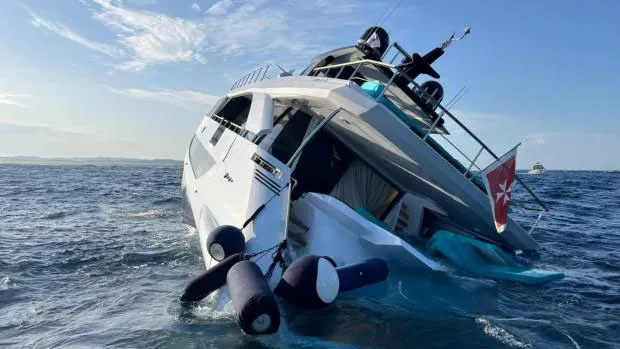
A luxury superyacht worth about $9.1 million has sunk off the coast of Sardinia only four days after it was handed over to a new owner, after an apparent engine failure was followed by a fire and water entering the vessel.
The 98-foot Amer F100 Angiola II went down near Porto Cervo on August 11, according to reports. Fourteen people were aboard when the yacht got into trouble, but all were rescued and no injuries were reported. Italian authorities are investigating what caused the incident.
The yacht eventually settled on the Mediterranean seabed at a depth of roughly 23 feet, or about 7 meters, between Cappuccini Island and Capo Ferro on Sardinia’s Costa Smeralda. Authorities have begun preparations for a major salvage operation.
What happened to the Angiola II?
The Angiola II was reportedly cruising off Sardinia when an apparent engine problem led to a fire. The blaze was brought under control, but the yacht subsequently began taking on water and lost buoyancy.
Footage from the incident reportedly showed the vessel listing heavily before eventually rolling onto its side and disappearing beneath the water. The Coast Guard responded to the scene, and everyone aboard was safely evacuated.
The exact sequence that caused the flooding has not yet been officially established.
Initial reports have suggested that the engine failure may have damaged seals, allowing seawater to enter the vessel. That explanation remains under investigation and should not be treated as a confirmed cause until Italian authorities complete their findings.
Why is the yacht’s timing so unusual?
The Angiola II had reportedly been delivered to its new owner only four days before it sank.
That makes the incident particularly striking because the yacht had recently undergone an extensive refurbishment before the handover. The vessel was built in 2020 by Italian shipbuilder Permare under its Amer Yachts brand.
The new owner has not been publicly identified. Reports describe the buyer as an Italian businessman and a longtime client of the brokerage involved in the sale.
The extremely short period between delivery and the sinking is likely to make questions about the yacht’s recent refit, maintenance and mechanical condition part of the investigation.
However, the timing alone does not establish that the refurbishment caused the failure.
How many people were aboard?
Fourteen people were on the yacht when the emergency unfolded.
According to reports, 12 people were rescued by another vessel, while the owner and another passenger were later taken ashore by a Coast Guard patrol boat. No injuries have been reported.
The successful evacuation is particularly important given how quickly a fire followed by flooding can change conditions aboard a yacht.
Once seawater begins entering a vessel, its stability can deteriorate rapidly. A list can become progressively worse as water moves through internal spaces, increasing the risk of capsizing.
What kind of yacht is the Angiola II?
The Angiola II is an Amer F100 motor yacht measuring about 98 feet, or roughly 30 meters.
The vessel was built in 2020 and is part of the Amer F100 series. It has five cabins and can accommodate up to 10 guests, with space for five crew members.
The yacht has four engines and can reach a reported top speed of 28 knots, or more than 32 mph.
Its relatively compact size compared with some of the world’s giant superyachts does not make the incident any less significant. A 30-meter vessel contains sophisticated propulsion, electrical, navigation and hotel systems, all of which must function reliably to keep the yacht safe.
Who owns the yacht now?
The new owner’s identity has not been disclosed publicly.
According to reports, the buyer is an Italian businessman, but no name has been released. That is not unusual in the luxury-yacht market, where ownership can sometimes be structured through companies or kept private for security and personal reasons.
The yacht had reportedly changed hands several times since being launched in 2020. Amer Yachts co-CEO Barbara Amerio said the company was monitoring the situation closely and was awaiting official findings.
Amerio also expressed relief that everyone aboard was safe.
How deep did the superyacht sink?
The Angiola II is resting roughly 7 meters below the surface, or about 23 feet.
The wreck was reportedly secured on the seabed to prevent it from moving while authorities organize its recovery. Containment booms were placed around the area as a precaution against fuel contamination.
Initial reports indicated that no fuel leak had been detected.
That is important because even a relatively small amount of fuel or other pollutants released from a sunken vessel can create an environmental problem in a coastal area.
How will authorities recover the yacht?
A major salvage operation is being prepared.
Reports say authorities are considering a large pontoon, with estimates ranging from about 200 to 220 tons, to help lift the yacht from the seabed.
The exact recovery method will depend on the vessel’s final position, its condition, the amount of water inside and the stability of the wreck.
A salvage operation involving a 30-meter yacht requires careful planning because attempting to move a damaged vessel too quickly can cause additional structural damage or release pollutants.
Keeping the wreck stable until the operation begins is therefore a priority.
Could an engine failure sink a superyacht?
An engine failure by itself does not normally cause a large yacht to sink.
The danger comes when a mechanical failure triggers another event, such as a fire, hull damage, flooding or loss of critical systems.
In the Angiola II case, reports suggest that an engine problem was followed by a fire and then water entering the vessel. If flooding reaches enough compartments or overwhelms the boat’s pumps and watertight protections, buoyancy can be lost.
That sequence can turn what begins as a mechanical problem into a serious maritime emergency.
The exact technical pathway in this case has not yet been confirmed.
Why does the recent refurbishment matter?
Because the yacht had been refurbished shortly before the sale, investigators will likely examine its maintenance and recent work as part of determining what happened.
That does not mean the refit was responsible.
A post-refit failure could result from a defective component, an unrelated mechanical problem, damage that developed after delivery or another cause entirely.
Investigators will need to establish whether the engine failure, fire and flooding were connected and whether any component failed unexpectedly.
The vessel’s maintenance records, engineering logs and recent inspection documents could therefore become important evidence.
What has the yacht builder said?
Amer Yachts co-CEO Barbara Amerio said the company was following the situation closely and was waiting for official findings.
She also said the company was relieved that the passengers and crew were safe.
That is a significant point because the immediate outcome could have been far worse. A fire and subsequent sinking in open water can quickly become life-threatening, particularly if evacuation takes place at night or far from nearby vessels.
In this case, the rescue operation succeeded without reported injuries.
What happens next?
The immediate priorities are environmental monitoring, securing the wreck and determining how best to recover it.
The Italian Coast Guard and other authorities are investigating the cause of the incident. Their findings will be important in determining whether the sinking resulted from a mechanical failure, fire-related damage, flooding, stability problems or a combination of factors.
The case may also draw attention from the yacht’s owner, insurers, brokers, shipyard and maintenance providers because of the unusually short period between delivery and the sinking.
For now, however, the cause remains unresolved.
The bigger story behind the sinking
The dramatic part of the Angiola II story is that a luxury yacht worth millions went from newly delivered to lying on the seabed in just four days.
But the most important part of the story is that all 14 people aboard survived.
The sinking also demonstrates how quickly a chain of events at sea can escalate. An apparent mechanical problem can lead to a fire; a fire can damage critical systems or seals; flooding can then destabilise an otherwise sophisticated vessel.
Until investigators complete their work, it would be premature to blame the recent refurbishment or any particular mechanical component.
For now, the Angiola II sits off Sardinia’s coast awaiting salvage, while authorities work to determine how a recently delivered luxury yacht ended up underwater so soon after changing hands.