
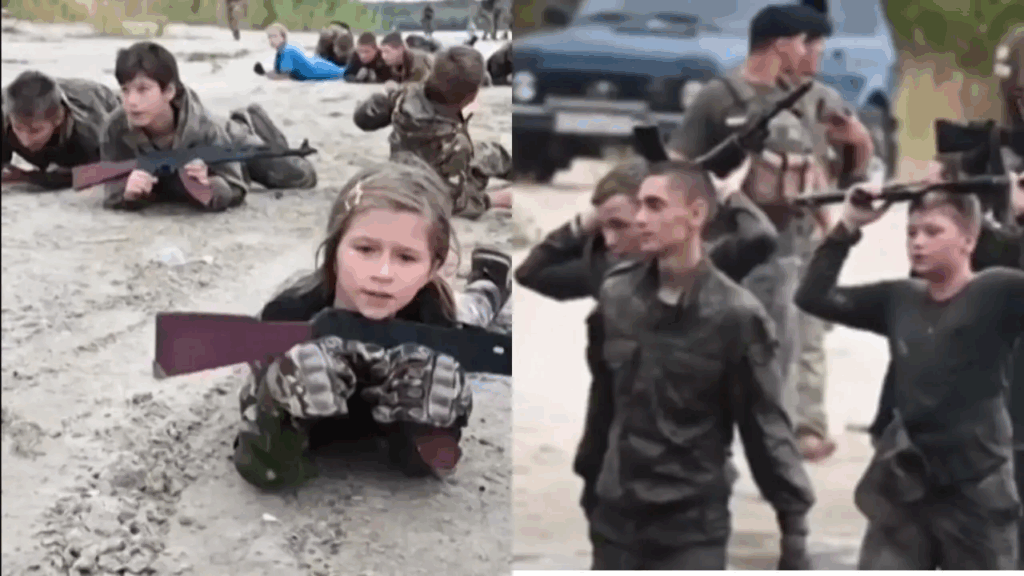
In Russia’s Rostov region, just miles from the Ukrainian border, children as young as eight are being put through military-style training. At a summer camp designed to look more like a battlefield than a playground, boys and girls marched in camouflage, hurled grenades, fired rifles, and crawled through sand under the watchful eye of combat veterans.
The program, which included 83 children aged 8 to 17, is raising serious questions: is this patriotism, discipline, or state-sanctioned indoctrination of the next generation of Vladimir Putin’s soldiers?
What happened at the Russian military camp?
The camp’s activities looked more like boot camp drills than summer recreation. According to local reports:
- Children practiced throwing grenades and firing dummy shots.
- They carried rifles—sometimes real, sometimes lifelike replicas.
- Campers participated in a grueling “route march” along the River Don, crawling through sand and shallow water.
- Classroom sessions included training in weapons handling and drone building.
Eight-year-old Ivan Glushchenko described the experience with excitement: “We threw hand grenades and fired dummy shots,” he said, adding that he was glad the camp welcomed both boys and girls.
For older teens, the message was about shaping identity. “Why I am here? It’s because I want to tie my future with military service. To serve my country and be loyal to my cause until the very end,” said Anton, one of the senior campers.
Why is Russia training children in combat drills?
The program appears to be part of a broader Kremlin-backed push to militarize Russian youth and reinforce patriotic values at a time when the country is deeply entrenched in its war with Ukraine.
Patriotic framing
Instructors at the camp argue that the activities keep children “disciplined” and give them a sense of purpose. “Patriotic training is very important. They don’t want to hang out in back alleyways. It’s much more fun for them here,” said instructor Vladimir Yanenko.
Another trainer, Alexander Shopin—himself wounded in Ukraine—oversaw drills while awaiting surgery. His presence underscored the program’s close link to the ongoing conflict.
Strategic intent
Analysts suggest such initiatives are meant to:
- Instill loyalty to the state and military from an early age.
- Normalize warfare as part of national identity.
- Ensure a steady flow of future recruits for Russia’s armed forces.
How are children reacting to the training?
While critics describe the program as dangerous indoctrination, many children reported enthusiasm.
- “I nearly died!” laughed one teenage girl, recalling a particularly tough exercise. Her friend added they had repeated the march “three times.”
- Another boy, David, said: “It allowed me to find out how strong my willpower is.”
The mix of exhaustion, pride, and excitement mirrors military initiation rituals—except here, the recruits are minors.
Why critics call this propaganda
Human rights groups and critics warn that the militarization of children is part of a state propaganda machine. Their concerns include:
- Psychological impact: Exposing children to simulated violence may normalize conflict and desensitize them to war.
- Loss of childhood: Instead of sports or arts, young Russians are trained to think like soldiers.
- Political indoctrination: Teaching combat skills under patriotic slogans blurs the line between civic education and preparation for war.
International law, including the Optional Protocol on the Involvement of Children in Armed Conflict, prohibits the recruitment of children under 15 into armed forces. While Russia frames these camps as “patriotic education,” the blurred lines raise ethical and legal questions.
The bigger picture: militarization of Russian youth
This camp is not an isolated experiment. It fits into a wider pattern of youth militarization programs in Russia:
- Yunarmiya (“Youth Army”): A Kremlin-sponsored movement launched in 2016 that now boasts hundreds of thousands of members, often trained in military basics.
- School reforms: Russian schools have expanded patriotic lessons and basic combat training since the war in Ukraine escalated.
- State funding: Camps like the one in Rostov often receive financial or logistical support from state or pro-Kremlin groups.
Together, these initiatives aim to create what critics call a “generation shaped for war.”
Why this matters
The images of children holding rifles in Russia are more than just a curiosity—they reflect a deliberate state strategy. At a time when Moscow is locked in a costly and prolonged conflict, ensuring the loyalty of its youngest citizens could be seen as an investment in the future of Russia’s military machine.
For the outside world, it raises difficult questions:
- Where is the line between patriotism and indoctrination?
- Should the international community treat this as cultural tradition, or as a violation of child rights?
- How will these children, trained to equate national duty with combat, see the world as adults?
TL;DR
At a camp in Russia’s Rostov region, children as young as eight trained with rifles and grenades under the guidance of Ukraine war veterans. While the Kremlin frames the initiative as “patriotic education,” critics argue it amounts to militarizing childhood and preparing the next generation for war.