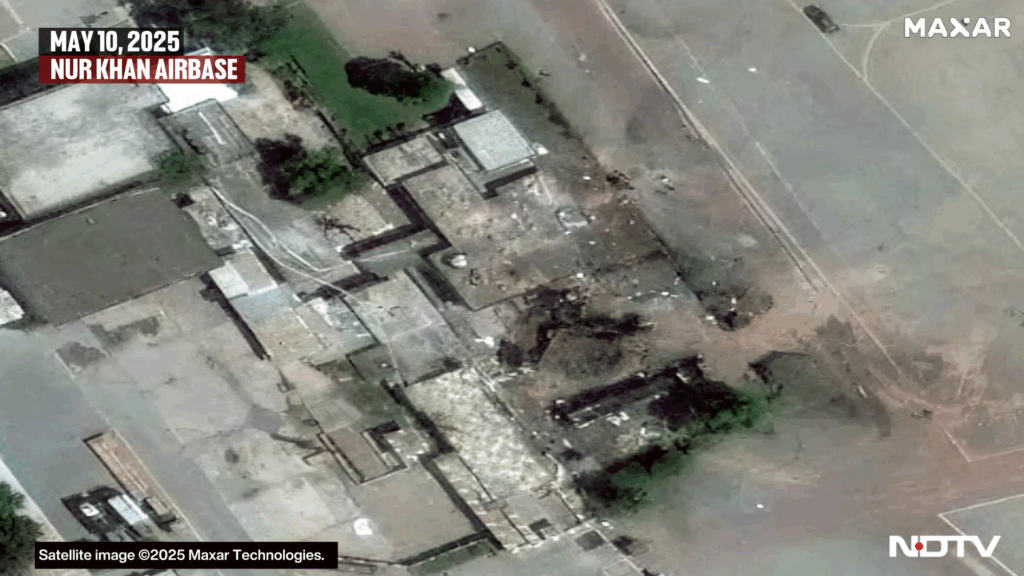
Newly released satellite imagery has provided the clearest evidence yet of significant damage inflicted on multiple Pakistani air bases during India’s recent military operation, showing destroyed hangars and cratered runways following precision strikes by Indian armed forces.
The high-resolution satellite photos, captured by US aerospace firm Maxar Technologies, document the aftermath of Operation Sindoor, which India launched in response to escalating border tensions following a deadly terror attack in Jammu and Kashmir last month.
Multiple strategic air bases targeted in precision strikes
The satellite imagery reveals considerable damage to key Pakistani Air Force (PAF) facilities, including the strategically important Nur Khan base in Rawalpindi, located less than 10 kilometers from Islamabad and adjacent to Pakistan’s military headquarters.
Other significantly damaged installations include Sukkur base in Sindh, Rahim Yar Khan in Pakistan’s Punjab, Mushaf in Sargodha, Shahbaz Jacobabad in northern Sindh, and Bholari in northern Thatta.
During an official press briefing on Operation Sindoor, Wing Commander Vyomika Singh confirmed that the Indian Armed Forces had conducted “precision attacks” targeting Pakistani military infrastructure.
“These included technical infrastructure, command and control centers, radar sites and weapon storage areas,” Wing Commander Singh stated, adding that Pakistan military targets at Rafiqui, Murid, Chaklala, Rahim Yar Khan, Sukkur, and Chunian were engaged using “air-launched precision weapons from the Indian Air Force fighter aircraft.”
The operation also targeted radar sites at Pasrur and Sialkot aviation base using precision munitions. “While carrying out these responses, India ensured minimum collateral damage,” Wing Commander Singh emphasized.
Operation launched in response to Pahalgam terror attack
Air Marshal AK Bharti, the Director General of Air Operations, provided further details at yesterday’s press conference, showing reporters footage of the Nur Khan air base engulfed in flames following a major explosion. He also presented video evidence of extensive runway damage at the Rahim Yar Khan air base.
“The Indian armed forces’ fight was against the terrorists, but the Pakistan military chose to support the terrorists, and widened the conflict,” Air Marshal Bharti stated.
India launched Operation Sindoor on May 7, striking nine terror sites in Pakistan and Pakistan-occupied Kashmir (PoK) in retaliation for the April 22 Pahalgam terror attack that claimed 26 lives, including one Nepali citizen. The operation reportedly destroyed multiple camps operated by terror groups including Lashkar-e-Taiba (LeT), Jaish-e-Mohammad (JeM), and Hizbul Mujahideen, with Indian officials claiming more than 100 terrorists were killed.
Tensions de-escalate following the ceasefire agreement
Following India’s initial operations, the Pakistani Army responded by launching drones and missiles at western parts of India, which were reportedly intercepted successfully. India subsequently targeted selected military installations deep within Pakistani territory.
The military exchange concluded when both countries reached a ceasefire agreement last Saturday to halt all military actions with immediate effect, ending four days of intense cross-border drone and missile strikes.
The satellite imagery now provides independent verification of India’s claims regarding the extent and precision of its military response during the operation.