
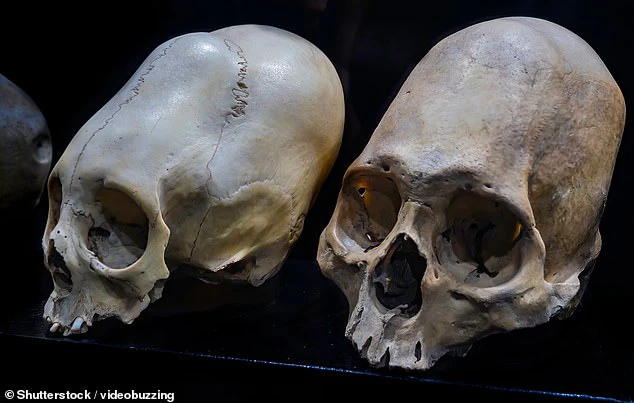
For nearly a century, the mysterious “conehead” mummies of Peru have fueled debate among archaeologists, geneticists, and alien enthusiasts alike. Now, a new DNA analysis has added another chapter to the mystery.
Scientists from Liberty University in Virginia, examining the elongated skulls known as the Paracas mummies, say they were unable to obtain enough genetic material to determine the individuals’ ancestry. While the findings do not prove extraterrestrial origins, they also fail to provide the definitive answers scientists have been seeking for decades.
The latest results have reignited public fascination with one of South America’s most enduring archaeological puzzles: who were the people behind the unusually shaped skulls discovered in Peru nearly 100 years ago?
What are the Peru conehead mummies?
The so-called Peru conehead mummies refer to a collection of ancient human remains discovered in the Paracas Peninsula of southern Peru during the 1920s.
The mummies are best known for their dramatically elongated skulls, which appear significantly different from typical human cranial shapes.
These remains are generally associated with the ancient Paracas culture, which flourished on Peru’s southern coast between approximately 800 BC and 100 BC.
The unusual skull shapes have inspired decades of theories ranging from accepted archaeological explanations to claims involving lost civilisations and extraterrestrial visitors.
Why do the skulls look so unusual?
Most mainstream archaeologists believe the elongated heads are the result of intentional cranial modification, a practice documented in numerous cultures throughout history.
What is cranial binding?
Cranial binding, also called artificial cranial deformation, involves gently shaping a child’s skull during infancy while the bones are still developing.
This was commonly achieved using:
- Cloth wrappings
- Wooden boards
- Specialized head-binding devices
- Sustained pressure applied over several years
The practice has been documented across ancient societies in South America, Central Asia, Europe, and parts of Africa.
Researchers believe elongated skulls often served as markers of social status, cultural identity, or elite lineage.
What did the latest DNA analysis find?
Scientists from Liberty University attempted a fresh genetic investigation using teeth recovered from the Paracas skulls.
The goal was straightforward: extract enough DNA to compare the remains with known human populations and potentially identify their genetic origins.
However, the effort ran into a familiar obstacle.
Ancient DNA is notoriously difficult to recover
DNA degrades over time due to:
- Heat exposure
- Humidity
- Soil chemistry
- Microbial activity
- Natural decomposition
The Peruvian remains are more than 2,000 years old, making genetic recovery particularly challenging.
Researchers tested two extraction methods.
The first involved carefully collecting powder from inside the tooth root. The second method required grinding an entire tooth to maximize DNA recovery.
Neither approach produced enough material for a complete genetic analysis.
Why scientists still cannot identify the mummies
According to the researchers, the extracted DNA quantities fell below the threshold required for definitive testing.
The gentler extraction method yielded only 2.3 units of DNA, while the more aggressive grinding process produced approximately 14.1 units.
Scientists estimated that the recovered material represented only a few thousand cells, short of the roughly 20 units considered necessary for robust analysis.
As a result, researchers were unable to draw reliable conclusions about ancestry, migration patterns, or genetic relationships.
Importantly, insufficient DNA is not evidence of non-human origins. It simply means there is not enough genetic information available to make a scientific determination.
Do the findings support extraterrestrial theories?
The short answer is no.
One of the most common misconceptions surrounding the Paracas skulls is that a failed DNA test somehow strengthens claims of alien ancestry.
In reality, scientific investigations work differently.
What the results actually mean
The latest study found:
- DNA extraction was incomplete
- The genetic sample size was insufficient
- No reliable ancestry conclusions could be drawn
- No evidence of extraterrestrial DNA was discovered
A lack of conclusive evidence is not the same as evidence supporting an extraordinary claim.
Scientists generally require extraordinary levels of proof before accepting claims that challenge established biological or archaeological understanding.
At present, no peer-reviewed study has demonstrated that the Paracas skulls belong to a non-human species.
Why the Peru conehead mummies continue to fascinate researchers
Despite decades of investigation, the Paracas skulls remain scientifically valuable.
The mystery is not necessarily whether they were aliens, but rather what they can reveal about ancient South American societies.
Questions researchers continue to explore include:
- Why was cranial modification practiced?
- Did it signify elite status?
- Were specific families selected for the practice?
- How widespread was the tradition?
- What genetic connections existed between Paracas populations and neighboring cultures?
These questions offer important insights into ancient social structures and cultural traditions.
What happens next?
Researchers are not giving up on the mystery.
The team plans to test a process known as demineralization, which may improve DNA recovery by breaking down hard tooth structures before extraction.
Scientists also intend to compare future genetic samples with DNA recovered from hair found alongside the mummified remains.
If successful, the next round of testing could provide a clearer picture of the individuals’ ancestry and help settle long-standing debates surrounding the Paracas skulls.
Why this story matters
The Peru conehead mummies sit at the intersection of archaeology, genetics, and popular culture.
They remind us that scientific mysteries do not always produce immediate answers. Sometimes the most important discovery is understanding how much remains unknown.
For researchers, the challenge is recovering enough evidence to reconstruct the lives of people who lived more than 2,000 years ago.
For the public, the mystery endures because it combines ancient history, unusual physical features, and unanswered questions that continue to spark curiosity around the world.
TL;DR
- The latest DNA analysis of Peru’s famous Paracas “conehead” mummies failed to recover enough genetic material for definitive testing.
- Researchers examined teeth from the ancient remains but obtained insufficient DNA for ancestry analysis.
- The findings do not prove extraterrestrial origins or non-human ancestry.
- Most archaeologists attribute the elongated skulls to intentional cranial modification, a documented cultural practice.
- Scientists plan to use new extraction methods in future attempts to recover better-quality DNA.
- The Paracas skulls remain one of archaeology’s most intriguing unresolved mysteries.