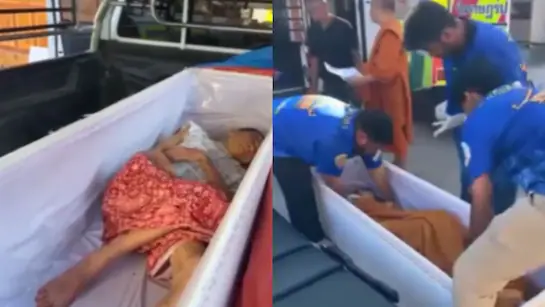
A Thai woman waking up inside her coffin moments before cremation has stunned social media and raised urgent questions about medical oversight, end-of-life assumptions, and how families interpret signs of death. This extraordinary incident at a temple outside Bangkok is far more than a strange headline; it highlights longstanding gaps in how certain communities verify death, especially when medical access is limited.
In this article, we examine what happened, why the family believed she had died, how the temple responded, and what similar global cases tell us about premature death assumptions.
What happened when the Thai woman woke up in her coffin?
Temple workers at Wat Rat Prakhong Tham in Nonthaburi were preparing for what they believed would be a routine cremation. The 65-year-old woman, visibly pale and unresponsive, had already been placed in a plain white coffin. Her family had completed their farewells.
Then the impossible happened.
According to the staff, the coffin began to move slightly. A faint knock came from inside. At first, the temple manager thought he had imagined it. When the sound repeated, he asked the family to open the lid. Inside, the woman slowly opened her eyes and continued knocking, indicating she had likely been conscious for some time.
A short video posted on the temple’s Facebook page shows staff scrambling in disbelief. The woman was rushed to a nearby hospital, and the temple’s abbot later offered to cover her medical expenses.
Why did the family believe she was dead?
Understanding her medical condition
The woman had reportedly been bedridden for two years. Her health had gradually declined until she stopped responding entirely. Her brother, who had driven more than 500 kilometers from Phitsanulok province, said she eventually appeared to stop breathing for nearly two days.
Without access to immediate medical verification, relatives assumed she had passed away.
Why the hospital refused to accept the body
Her brother initially planned to take her to a hospital in Bangkok because she had expressed a wish to donate her organs. However, without a formal death certificate, the hospital could not accept the body.
Why did the temple become the next option?
The family turned to the temple, which provides free cremation services for low-income families. But the temple, too, required official documentation before proceeding. While the staff was explaining the legal steps, the knock came from inside the coffin, altering everything.
How often do premature death assumptions happen?
Although rare, cases of people being mistakenly declared dead do occur worldwide, most often in situations where medical assessment is limited or vital signs are faint.
Global examples worth noting
- Newborns in several countries have been found alive after being pronounced dead due to shallow breathing.
- Elderly individuals with severe hypothermia or metabolic conditions have occasionally been mistaken for deceased.
- In 2023, a woman in Ecuador shocked mourners by waking up during her own wake, prompting government investigations into local healthcare standards.
What makes verifying death difficult in low-resource settings?
The challenge of shallow or intermittent breathing
Some medical conditions cause minimal respiratory movement that the untrained eye can miss. Prolonged immobility, decreased metabolism, or chronic illness can make signs of life almost imperceptible.
Lack of access to trained medical personnel
In rural or financially strained communities, families may rely on observation rather than medical confirmation. In such cases, a doctor or authorized official may not be immediately available to issue a death certificate.
Cultural practices that expedite cremation
In many Buddhist communities, funerals take place quickly, often within 24 hours. When combined with limited medical verification, the risk of misinterpretation increases.
Why this incident matters beyond the shock value
This case has revived discussions on whether clearer guidelines are needed for confirming death before religious ceremonies, especially as many temples offer free services to families who cannot afford hospital fees.
It exposes gaps in formal procedures
Even the temple required documentation, but the family had none. This suggests a broader systemic issue where low-income families may struggle to navigate the bureaucracy surrounding end-of-life processes.
It shows how quickly misinformation can spread
Viral stories about people “coming back from the dead” often lead to sensationalism. Clear reporting and medical explanations help prevent myths or superstitions from taking root.
It emphasizes the need for public education
Simple awareness campaigns could reduce the risk of misinterpreting unresponsiveness as death. Health ministries or NGOs could step in with community training on recognizing vital signs and when to seek medical confirmation.
What happens next for the woman and the investigation?
The woman is receiving medical treatment, though her long-term prognosis is unknown. Local authorities are expected to review the circumstances, and the temple has stated it will support the family through any inquiries.
Further reporting may reveal whether her near-burial was due to a rare medical condition, a mistaken observation, or a combination of both.
TL;DR
A 65-year-old Thai woman believed dead awakened inside her coffin just before cremation at a temple near Bangkok. Her family assumed she had died after two days without visible breathing, but without a death certificate, hospitals and cremation services required formal verification. While staff explained the paperwork, knocking was heard from inside the coffin. The incident highlights gaps in death-verification processes in low-resource settings and raises questions about medical access, cultural norms, and public education.