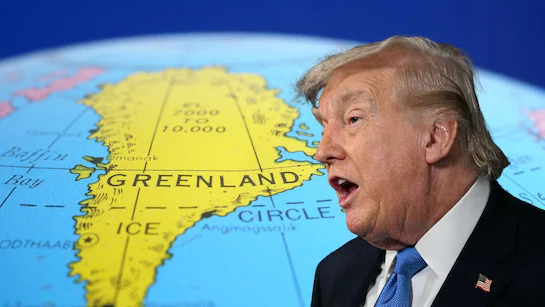
The Trump administration is once again testing the limits of geopolitics, this time with a proposal that sounds more like a stimulus program than a foreign policy strategy for Greenlanders. According to reporting by Reuters, US officials have discussed offering direct cash payments of $10,000 to $100,000 to every resident of Greenland as part of an effort to persuade the Arctic territory to break from Denmark and move closer to Washington.
The idea lands amid renewed rhetoric from President Donald Trump about acquiring Greenland, sharp warnings from Denmark, and long-running debates inside Greenland about independence, economic security, and identity. What’s new is the scale and bluntness of the approach and the risks it carries for all sides.
What is the $100,000-per-person plan?
At its core, the proposal under discussion would involve sending direct payments to Greenland’s roughly 57,000 residents, potentially totaling close to $6 billion if the upper range were adopted.
How the idea emerged
Reuters, citing sources familiar with internal White House deliberations, reports that US officials have floated lump-sum payments as a way to make separation from Denmark financially attractive. The talks are not new, but they have reportedly intensified in recent days, with higher figures now being seriously considered. The logic is straightforward: Greenland depends heavily on annual subsidies from Denmark; a one-time cash infusion could offset fears about the economic shock of independence; payments could be framed as a first step toward a closer political arrangement with the US. What remains unclear is almost everything else—how the money would be distributed, what legal commitments would be expected in return, and whether such payments would be tied to a referendum or a future agreement. Consider adding a simple chart here comparing Denmark’s annual subsidy to Greenland versus the proposed one-time US payout.
Why is Greenland so central to Trump’s strategy?
President Trump’s interest in Greenland predates his current term and has only grown more explicit.
Strategic value in the Arctic
Trump and his advisers argue that Greenland is critical for national security, given its location between North America and Europe, missile defense and early-warning systems; and access to rare earths and other minerals vital for advanced military and technological applications. From Washington’s perspective, the Arctic is no longer a frozen backwater but a competitive theater involving the US, Russia, and China. Greenland’s geography makes it a strategic prize.
A broader worldview
Trump has also framed Greenland within a wider belief that the Western Hemisphere should remain firmly under US influence. In recent remarks, he suggested Denmark lacks the capacity to secure the island’s strategic potential, reinforcing his argument that American control is both practical and necessary. For readers, consider linking internally to an explainer on Arctic geopolitics or US–China competition in the polar region.
How has Denmark responded?
Copenhagen’s reaction has been swift and unusually blunt.
“Shoot first” warning
A day before the Reuters report surfaced, Denmark’s defense ministry confirmed that long-standing rules of engagement allow Danish soldiers to open fire immediately if foreign forces invade Greenland, without waiting for orders from commanders. The directive, dating back to 1952, remains in force. The message was unmistakable: Greenland is Danish territory, and any attempt to seize it by force would be treated as an invasion.
Political red lines
Danish officials have repeatedly stated that Greenland is not for sale. While Denmark acknowledges Greenland’s right to self-determination, it rejects any external pressure aimed at coercing that choice—especially from an ally. This tension underscores a deeper concern in Europe: that transactional diplomacy could erode norms around sovereignty.
What do Greenlanders actually want?
This is where the cash plan runs into political reality.
Independence, with caveats
Polling consistently shows that most Greenlanders favor eventual independence from Denmark. However, support drops sharply when respondents are asked about the economic consequences. Key concerns include loss of Danish subsidies that support public services, limited economic diversification, and vulnerability to outside influence after independence. These worries have kept Greenlandic lawmakers from calling a full independence referendum.
Attitudes toward the US
Surveys suggest that while Greenlanders are open to redefining their relationship with Denmark, most do not want to become part of the United States. Direct payments, critics argue, risk appearing patronizing or even disrespectful to a population that has long debated its future on its own terms. A good place for an infographic would be a timeline of Greenland’s autonomy milestones and past independence debates.
Is a Compact of Free Association the real endgame?
Cash payments may be only one piece of a broader strategy.
What is a COFA?
A Compact of Free Association is a formal agreement that the US has with a small number of Pacific island nations, including Micronesia, the Marshall Islands, and Palau. Under these agreements, the US provides defense, economic assistance, and essential services; the US military gains broad operational access; and trade with the US is largely duty-free.
Why it matters for Greenland
White House officials have indicated that a COFA-style arrangement could be a model for Greenland—if it first becomes independent from Denmark. In theory, financial incentives could encourage voters to back independence and later approve such a pact. This approach would allow Washington to achieve many of its strategic goals without formal annexation, but it would still require Greenlanders to choose a path many remain skeptical of. For sourcing, consider linking externally to the US Department of the Interior or State Department pages explaining existing COFA agreements.
Why the plan is so controversial
The proposal has drawn criticism not just for its feasibility but for what it signals.
Transactional diplomacy risks backlash
Offering cash to an entire population blurs the line between assistance and inducement. Critics argue it reduces a complex question of identity and sovereignty to a financial calculation. There is also the risk of strengthening opposition within Greenland, uniting Danish and European allies against Washington, and setting a precedent that money can buy territorial realignment.
Military pressure complicates the message
The idea is being discussed alongside explicit statements from Trump that military force remains an option. That combination, cash incentives paired with coercive rhetoric, undercuts claims that the US prefers a purely diplomatic solution.
What happens next?
For now, the plan remains internal and exploratory. No formal proposal has been announced, and many logistical and legal hurdles remain. What is clear is that Greenland has reemerged as a focal point of Trump’s foreign policy, one where strategy, symbolism, and sovereignty collide. Whether money can move public opinion where history, culture, and caution have not remains an open question.
TL;DR
The Trump administration has discussed paying Greenlanders $10,000–$100,000 each to encourage independence from Denmark. The idea reflects Greenland’s strategic value but risks backlash for being overly transactional. Denmark has issued stark military warnings, reinforcing that Greenland is not for sale. Most Greenlanders favor independence in principle but oppose joining the US. A Compact of Free Association may be the longer-term objective, though it faces political hurdles.