
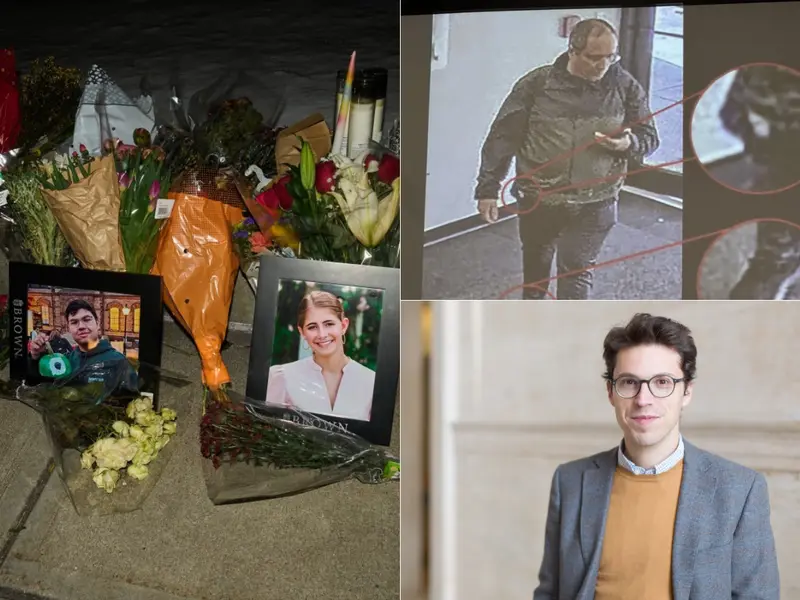
The Brown University shooting took a disturbing new turn on December 19, when law enforcement officials laid out fresh details in a long-awaited press conference. What initially appeared to be a tragic but isolated campus attack is now understood as part of a far more complex and unsettling sequence of events spanning multiple states, institutions, and years.
Investigators confirmed that the suspected gunman, Claudio Nevez Valenti, was found dead after a six-day manhunt. But the briefing went well beyond closure. It raised new questions about motive, missed warning signs, and how two elite academic communities—Brown University and MIT—became connected by violence.
Below are the five most shocking revelations from the Brown University shooting press conference, explained with context and clarity.
TL;DR
Police revealed that the Brown University shooting suspect, who died by suicide after evading authorities for six days, was also responsible for killing an MIT professor, had academic ties to the victim, used sophisticated methods to avoid tracking, and may have carried out both targeted and random attacks—leaving investigators with unanswered questions about motive and prevention.
What happened to the Brown University shooting suspect?
He was found dead after a six-day multi-state manhunt
The most immediate revelation was confirmation of the suspect’s death.
Authorities said Claudio Nevez Valenti, 48, was found dead inside a storage unit in Salem, New Hampshire, on December 18—six days after the Brown University shooting. Investigators believe he died from a self-inflicted gunshot wound.
Why this matters
This discovery effectively ended a manhunt that stretched across Rhode Island, Massachusetts, and New Hampshire, involving local police, state authorities, and federal agencies. It also confirmed that the suspect remained mobile—and dangerous—for nearly a week after the campus attack.
How is the Brown University shooting linked to the MIT professor’s murder?
Two crimes once thought unrelated are now officially connected
Perhaps the most startling announcement was that the Brown University shooting and the killing of an MIT professor were carried out by the same person.
Just days earlier, police had publicly stated that the two cases were unrelated. That assessment has now changed.
The victim in the second case was Nuno Loureiro, a 47-year-old MIT physicist who was shot at his home in Brookline, Massachusetts, on December 15. He later died from his injuries.
Why this matters
This revelation reframes the Brown University shooting as part of a broader pattern of violence, not a single spontaneous act. It also raises questions about why the connection was not established sooner—and whether earlier acknowledgment could have altered the manhunt.
What was the academic connection between the suspect and the MIT victim?
They studied physics together in Portugal
Investigators disclosed that Nevez Valenti and Loureiro attended the same academic program in Portugal, where both studied physics. Loureiro later built a distinguished career, becoming a prominent fusion scientist at MIT.
Authorities have not publicly stated whether the two maintained contact in later years or whether there was a specific conflict between them.
Why this matters
This academic overlap suggests the MIT killing may have been targeted, not random. It also introduces a deeply unsettling possibility: that grievances rooted in academic or professional history can resurface violently decades later.
How did Claudio Nevez Valenti avoid police for nearly a week?
Officials say he used “sophisticated” methods to stay hidden
During the press conference, Massachusetts U.S. Attorney Leah Foley described the suspect as “sophisticated in hiding his tracks.”
According to investigators, Nevez Valenti:
- Used a phone designed to obscure tracking
- Traveled across state lines
- Avoided patterns that typically help law enforcement narrow searches
Why this matters
This detail highlights a growing challenge for law enforcement: modern technology can be weaponized to evade capture, even after high-profile crimes. It also underscores why manhunts today often last longer, despite widespread surveillance infrastructure.
How were the Brown and MIT cases finally linked?
A rented car became the key piece of evidence
The breakthrough came through vehicle identification.
Police revealed that:
- A rented car used by the suspect was captured on CCTV near Brown University
- A witness helped confirm the vehicle after the campus shooting
- The same car was later spotted near the scene of the MIT professor’s killing in Brookline
Why this matters
This connection illustrates how traditional investigative tools, cameras, witnesses, and vehicle records, remain crucial, even as suspects adopt advanced methods to stay hidden.
Were the attacks targeted or random?
Investigators say the answer is both—and that’s troubling
Police now believe the two crimes may fall into different categories of violence.
- The killing of MIT professor Nuno Loureiro appears targeted, given the academic connection.
- The Brown University victims, Ella Cook and Mukhammad Aziz Umurzokov, had no known link to the suspect.
Why this matters
This duality complicates efforts to understand motive. It suggests the suspect may have acted with specific intent in one case and indiscriminate violence in another, a pattern that makes prevention significantly harder.
What questions remain unanswered?
Despite the detailed briefing, several critical questions remain open:
- What triggered the suspect’s actions after so many years?
- Were there warning signs missed by institutions or individuals?
- Could earlier coordination between agencies have changed the outcome?
Authorities emphasized that investigations into motive and background are ongoing, even though the suspect is deceased.
Why this press conference matters beyond Brown University
The Brown University shooting press conference did more than provide updates—it exposed vulnerabilities in campus security, inter-agency coordination, and early threat detection.
For universities across the U.S., the case serves as a grim reminder that:
- Violence can emerge from long-dormant personal histories
- Academic environments are not immune to targeted attacks
- Rapid information-sharing is critical during unfolding crises