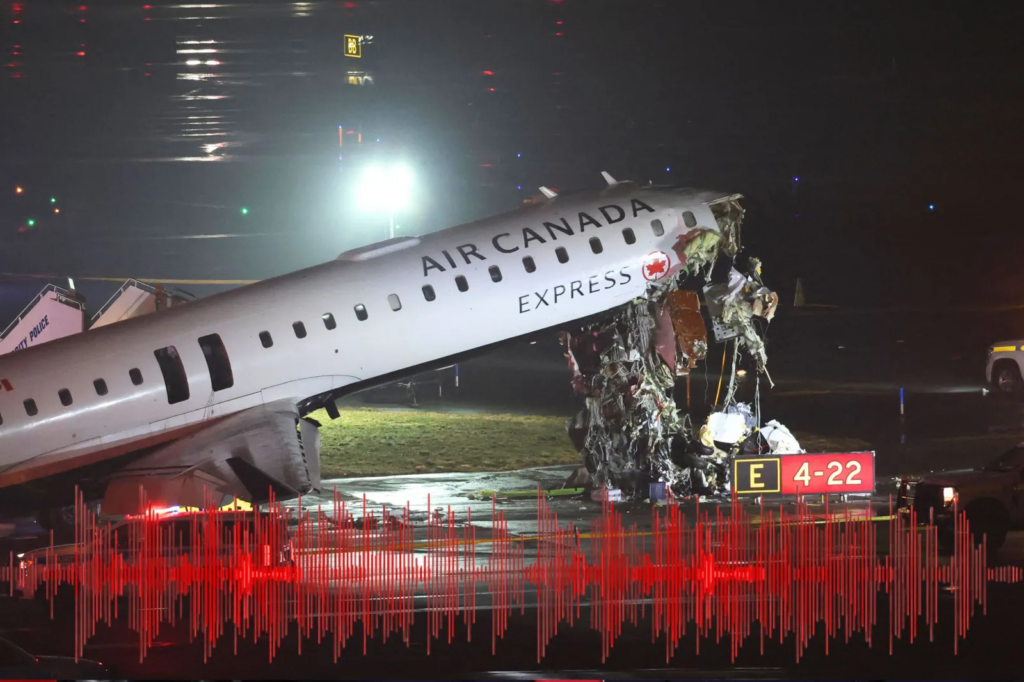
A deadly runway collision at LaGuardia Airport has left two pilots dead and dozens of passengers injured, raising urgent questions about airfield safety and coordination at one of the busiest airports in the United States.
The incident, involving an Air Canada Express flight and an emergency fire truck, is now under full investigation by aviation authorities.
What Happened in the Air Canada LaGuardia Crash?
The crash occurred late Sunday night during landing operations.
According to preliminary reports:
- A Bombardier CRJ-900 operated by Jazz Aviation was arriving from Montreal
- The aircraft struck a runway fire truck shortly after touchdown
- The collision happened at approximately 11:40 p.m. on Runway 4
Authorities say the fire truck belonged to the airport’s Aircraft Rescue and Firefighting (ARFF) unit and was responding to a separate emergency at the time.
Key Timeline
- 11:37 p.m.: Aircraft lands at LaGuardia
- ~11:40 p.m.: Collision with a fire truck
- Post-impact: Emergency response initiated; airport operations halted
This narrow time gap is now central to the investigation.
Who Was On Board the Aircraft?
The flight carried:
- 72 passengers
- 4 crew members
Casualties and Injuries
- Fatalities: Both pilots (captain and first officer)
- Injuries: Approximately 32 passengers
Most injuries were reported as non-life-threatening, though several passengers required medical treatment.
Why Was a Fire Truck on the Runway?
One of the most critical questions investigators are asking is why the aircraft and the emergency vehicle were on the same runway simultaneously.
Initial Findings
Officials indicated:
- The fire truck was responding to another incident involving a separate aircraft
- Reports suggest a possible connection to a United Airlines flight, though details remain unconfirmed
What Investigators Are Looking Into
Authorities will focus on:
- Air traffic control (ATC) communication
- Runway clearance procedures
- Emergency response coordination protocols
Even minor lapses in these systems can have catastrophic consequences.
How Do Runway Safety Protocols Normally Work?
Airports like LaGuardia operate under strict procedures designed to prevent exactly this kind of incident.
Standard Safeguards Include:
- Runway occupancy clearance: No vehicle or aircraft allowed without explicit ATC approval
- Radio coordination: Continuous communication between pilots, ground crews, and controllers
- Visual and radar monitoring: Tracks all movements on active runways
Where Things May Have Gone Wrong
Potential failure points could include:
- Miscommunication between ATC and ground vehicles
- Incorrect runway clearance instructions
- Delayed response to changing runway conditions
Investigators will reconstruct these interactions step-by-step.
The Aircraft: CRJ-900 and Its Operations
The aircraft involved was a Bombardier CRJ-900, commonly used for short- to medium-haul routes.
About the Aircraft
- Typically seats 70–90 passengers
- Widely used by regional carriers
- Operated in this case by Jazz Aviation on behalf of Air Canada
The reported impact speed—around 24 mph—suggests the collision occurred during rollout after landing, not during high-speed descent.
Airport Shutdown and Immediate Response
Following the crash, authorities quickly suspended operations at LaGuardia Airport.
Emergency Measures Taken
- Runways closed to all traffic
- Injured passengers were transported to nearby hospitals
- Crash site secured for investigation
Officials stated the airport would remain closed until at least Monday afternoon to allow a full assessment.
Who Is Investigating the Crash?
Multiple agencies are expected to be involved in determining the cause.
Likely Investigating Bodies
- Federal Aviation Administration (FAA)
- National Transportation Safety Board (NTSB)
- Port Authority of New York and New Jersey
What the Investigation Will Focus On
- Cockpit voice and flight data recorders
- ATC communication logs
- Ground vehicle movement records
- Witness statements from crew and passengers
A preliminary report could take weeks, while a full investigation may take months.
Why This Incident Raises Broader Safety Concerns
Runway incursions—situations where aircraft and vehicles occupy the same space—are among the most serious risks in aviation.
Key Concerns Highlighted
- Airport congestion: LaGuardia’s high traffic volume increases complexity
- Emergency overlap: Handling one incident while managing regular operations
- Human factors: Communication errors under pressure
While rare, such incidents often lead to sweeping safety reviews.
What Happens Next?
The investigation will determine whether the crash resulted from:
- Human error
- Procedural failure
- Systemic safety gaps
Possible Outcomes
- Updated runway safety protocols
- Changes in emergency response coordination
- Enhanced training for ATC and ground crews
Airlines and regulators worldwide will be watching closely.
TL;DR
- An Air Canada Express flight collided with a fire truck at LaGuardia Airport
- Two pilots were killed; over 30 passengers were injured
- The fire truck was responding to another emergency
- Authorities are investigating possible communication and coordination failures
- The airport was temporarily shut down following the incident