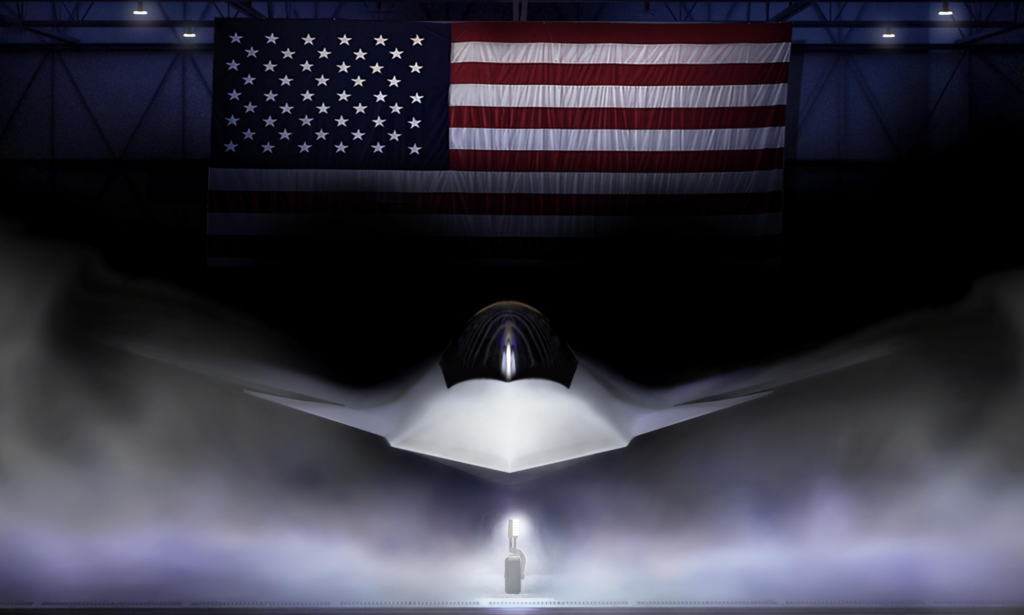
When Donald Trump stood on the stage at theWorld Economic Forum in Davos this week and called the F-47 “the most devastating plane, fighter jet ever,” the remark landed with equal parts bravado and intrigue. Hyperbole is familiar territory in political speeches. What’s different this time is that the aircraft behind the claim represents a genuine leap in air combat, one that could redefine how wars are fought in the skies.
The F-47 is not just another stealth jet. It is the US military’s first acknowledged sixth-generation fighter, designed for conflicts where airspace is saturated with sensors, missiles, drones, and cyber threats. Understanding why it matters requires looking past the headline and into how the jet is built, what it’s meant to do, and why the US Air Force is betting big on it.
What is the F-47 fighter jet?
The F-47 is a next-generation stealth aircraft being developed for the United States Air Force as part of its long-term plan to maintain air superiority against near-peer rivals.
Unlike fifth-generation fighters such as the F-22 or F-35, the F-47 is designed from the ground up for an era where dominance depends on information as much as speed or firepower. Its core mission is simple but demanding: survive, see first, strike first, and coordinate the rest of the fight.
Primary design goals include:
- Extreme stealth against modern radar systems
- Long-range operations across vast theaters like the Pacific
- Seamless coordination with autonomous drones
- Flexibility across high-end and conventional combat
How does the F-47’s design set it apart?
Advanced stealth beyond fifth generation
Stealth on the F-47 goes well beyond radar-absorbing coatings. Its shape, materials, and internal systems are engineered to reduce detection across multiple domains—not just radar, but infrared and electronic signatures as well.
Sensors are integrated rather than bolted on, reducing weak points and improving reliability. The result is an aircraft that can operate deeper into contested airspace without broadcasting its presence.
Canard configuration and flight control
One of the most visible departures from earlier US fighters is the canard design, small forward wings near the cockpit. This configuration improves stability at high speeds, precision during tight maneuvers, and control during complex flight profiles.
The design echoes experimental aircraft like Boeing’s YF-118G Bird of Prey, known for testing radical stealth concepts.
Built for range and adaptability
The F-47 is optimized for long-range combat, a critical factor in regions like the Indo-Pacific, where distances between bases and targets can stretch thousands of miles.
Key advantages include:
- Extended combat radius
- Easier forward deployment
- Modular systems that can adapt to different mission profiles
This adaptability means the aircraft won’t be locked into a single role as threats evolve.
Why does drone collaboration matter so much?
A defining feature of the F-47 is its ability to operate alongside autonomous systems known as Collaborative Combat Aircraft.
Instead of flying alone, the pilot becomes a mission commander, directing drones that can scout ahead in dangerous airspace, carry additional sensors or weapons, and act as decoys to confuse enemy defenses.
This approach spreads risk. Losing a drone is far less costly, strategically and politically, than losing a piloted jet. It also allows the F-47 to project power without exposing itself unnecessarily.
How does the F-47 compare to older fighters?
The leap from fifth- to sixth-generation aircraft is less about raw speed and more about systems integration.
Compared to older fighters, the F-47 offers:
- Greater operational range
- Improved survivability against advanced air defenses
- Faster decision-making through sensor fusion
- Built-in capacity to evolve with software upgrades
In practical terms, this means fewer jets can accomplish missions that once required large formations, tankers, and escort aircraft.
What are the US Air Force’s plans for the F-47?
In March 2025, the Air Force announced it had commissioned Boeing to build the F-47, signaling confidence in the platform’s design and production path.
The service plans to acquire at least 185 aircraft, with the first jets expected to enter operational service toward the end of the decade. The focus is on high-end conflicts, particularly in the Pacific, where range, survivability, and coordination across vast distances are decisive.
What did Trump say about the F-47?
Trump has referenced the aircraft multiple times, first from the Oval Office in March 2025 and again this week in Davos. He has highlighted its speed, maneuverability, and payload, describing it as unmatched by anything currently flying.
While such claims should be treated cautiously, presidential attention does matter. High-profile backing can protect funding during budget negotiations, accelerate development timelines, and shape public perception of military priorities.
Still, the jet’s ultimate success will depend on testing results, reliability, and long-term costs—not rhetoric.
Why is it called the F-47?
The designation carries several layers of meaning.
According to reporting by The War Zone, the name references the World War II-era P-47 Thunderbolt, which later became the F-47 after naming conventions changed. It also nods to 1947, the year the US Air Force became an independent service.
Finally, the number aligns with Trump’s role as the 47th president of the United States, adding a political dimension to the aircraft’s identity.
Why does the F-47 matter beyond the US?
The arrival of a sixth-generation fighter has global implications.
Allies may look to integrate similar technologies or adapt their air doctrines around manned-unmanned teaming. Rivals are likely to accelerate their own programs, intensifying competition in stealth, autonomy, and electronic warfare.
TL;DR
- The F-47 is the US military’s first acknowledged sixth-generation fighter
- It prioritizes stealth, long range, and drone collaboration
- The Air Force plans to acquire at least 185 aircraft
- It is designed with future conflicts, especially in the Pacific, in mind
- The name blends aviation history, symbolism, and politics
The F-47 is more than a new aircraft. It is a statement about where air warfare is headed—and how the United States plans to stay ahead.