

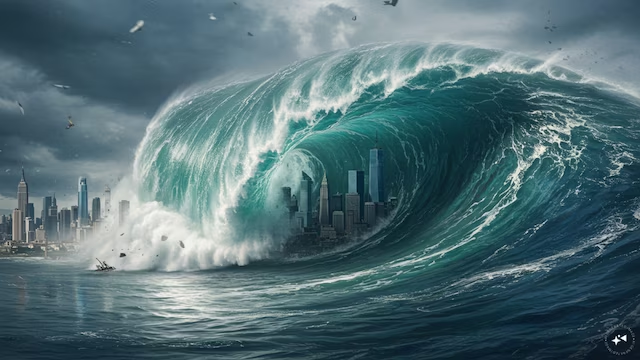
A massive seismic event brewing beneath the Pacific Northwest could trigger a 100-foot tsunami, potentially submerging vast swaths of the US and Canadian coastlines and transforming the region’s geography for centuries. This alarming prediction comes from a new international study led by Virginia Tech and published in the Proceedings of the National Academy of Sciences.
What is the Cascadia Subduction Zone, and why is it so dangerous?
The Cascadia Subduction Zone (CSZ) is a 1,126-kilometer-long fault line stretching from Northern California to southern British Columbia. It marks the boundary where the Juan de Fuca tectonic plate is being forced beneath the North American plate. This type of boundary is known for generating megathrust earthquakes—massive quakes that can trigger tsunamis and widespread destruction.
Unlike California’s San Andreas Fault, which produces more frequent but relatively smaller quakes, the CSZ has remained eerily quiet for over three centuries. The last known megathrust event occurred on January 26, 1700, estimated to be a magnitude 9 quake that devastated coastal areas, including British Columbia’s Pachena Bay.
The long silence since then isn’t a sign of safety—it’s a ticking geological time bomb.
How likely is a Cascadia megathrust earthquake in our lifetime?
According to the Virginia Tech-led study, there is a 37% chance that a major Cascadia earthquake and the resulting tsunami could occur within the next 50 years. By 2100, the probability of such an event is significantly higher.
Lead researcher Professor Tina Dura underscores the severity:
“This is going to be a very catastrophic event for the US, for sure. The tsunami is going to come in, and it’s going to be devastating.”
The team’s models predict that a magnitude 9.0 quake in the CSZ would unleash a 100-foot (30-meter) tsunami that would shear off up to eight feet of coastline, flooding major urban areas within minutes.
Which regions will be hardest hit?
The tsunami’s reach and destruction will not be uniform. Some areas will be far more vulnerable due to both geography and elevation:
US West Coast
- Washington, Oregon, and Northern California will bear the brunt of the tsunami’s force.
- The southern half of the US West Coast is also expected to see widespread inundation.
- Floodplains could expand by up to 115 square miles, putting additional homes, roads, and infrastructure at risk.
Canada
- Northern Vancouver Island and portions of British Columbia face serious threats, both from the initial quake and the subsequent tsunami.
The danger is compounded in areas experiencing land subsidence, where the ground is sinking due to natural or human-made causes. In these zones, the floodplain expansion could double.
What are the potential human and economic costs?
The Federal Emergency Management Agency (FEMA) paints a grim picture of the aftermath:
- 5,800 fatalities from the earthquake.
- 8,000 more deaths from the tsunami.
- 100,000 people injured.
- 618,000 buildings damaged or destroyed, including thousands of schools and over 100 hospitals.
- $134 billion in direct economic losses.
The long-term impact will be equally profound. Once flooded, these coastal regions will not return to their former state. In fact, the geography of the West Coast will be reshaped for hundreds of years, creating a “new normal” in both physical and economic landscapes.
What role will climate change play in worsening the impact?
The researchers warn that the devastation won’t happen in isolation. Rising sea levels, fueled by climate change, will significantly exacerbate the impact of any future tsunami:
- By 2100, global sea levels are expected to rise by at least two feet.
- This means that even modest tsunami waves will push further inland.
- Coastal defenses that might protect against today’s tides will likely fail under the combined force of a tsunami and elevated sea levels.
This compounding threat turns a high-impact, low-frequency event into a mass-casualty risk with increasingly severe outcomes over time.
How prepared are we for such a catastrophe?
Despite the well-documented threat, disaster preparedness along the Pacific Northwest remains a concern:
- Many communities lack tsunami warning infrastructure.
- Critical facilities such as schools and hospitals are not built to withstand major quakes or tsunamis.
- Evacuation routes are often outdated or poorly marked.
Comparatively, countries like Japan, which sits atop multiple subduction zones, have invested heavily in earthquake early warning systems and tsunami barriers. (Consider linking to a piece on Japan’s early warning system and its effectiveness.)
A key recommendation from the authors is greater investment in early detection, resilient infrastructure, and public education—all critical for reducing loss of life when the inevitable occurs.
Why this matters now more than ever
Though the next Cascadia megathrust event may still be years or decades away, complacency is the real danger. The increasing pace of coastal development, the rise in sea levels, and the lack of adequate infrastructure create a perfect storm for tragedy.
This isn’t just a geological curiosity—it’s an impending disaster with the potential to impact millions of people in the US and Canada. As Professor Dura puts it, “The longer we wait, the worse the outcome will be.”


