
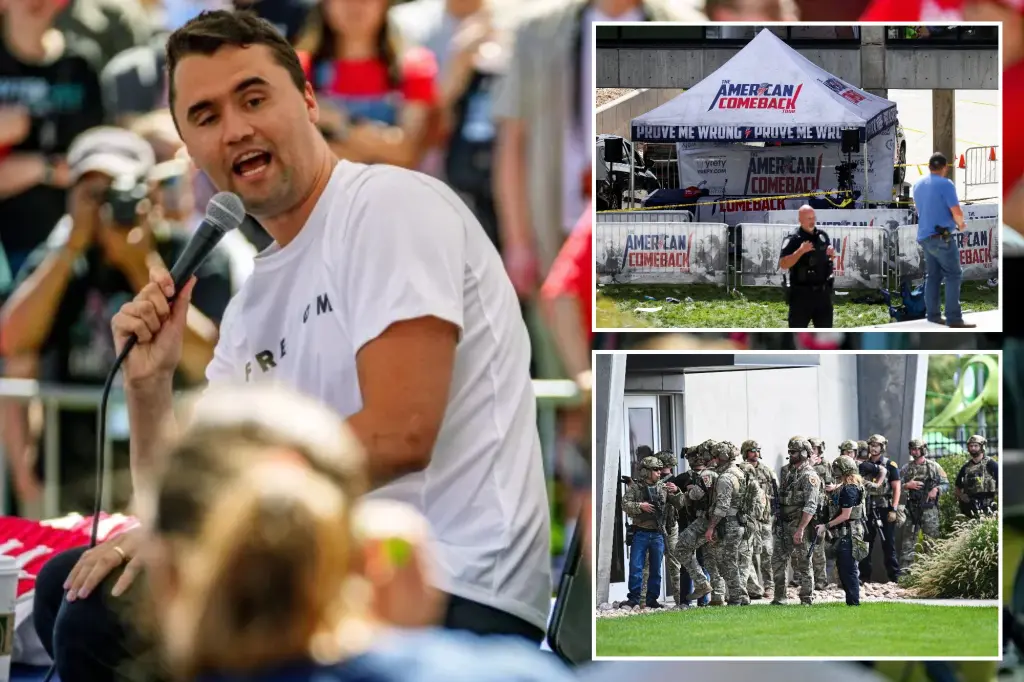
Confusion deepened in Utah after the fatal shooting of conservative activist Charlie Kirk, as the FBI and state authorities struggled to identify and capture the gunman. Two people were briefly detained and released, leaving the shooter still at large in what officials have now called a “targeted political assassination.” Suspect still at large after Charlie Kirk shooting in Utah
Confusion over arrests and the manhunt
At first, Utah Governor Spencer Cox told reporters that police had a “person of interest” in custody. Hours later, the Utah Department of Public Safety clarified that the suspected gunman remained on the run. FBI Director Kash Patel confirmed that a person had been detained for questioning but was released after investigators found no evidence of involvement.
“This shooting is still an active investigation,” state officials said in a joint statement. The Utah Department of Public Safety is working alongside the FBI, Utah County Sheriff’s Office, and local law enforcement agencies to track the shooter.
Officials said the attack was “believed to be a targeted strike” from a rooftop but declined to provide details, citing the integrity of the investigation.
What happened at Utah Valley University?
Charlie Kirk, 31, was speaking at an outdoor student event at Utah Valley University in Orem on September 10 when a single gunshot rang out at around 12:20 p.m. local time.
- Kirk had just begun responding to a question on the number of mass shooters in America over the last decade.
- The shot, fired from roughly 200 yards away, struck him mid-sentence.
- Social media videos showed attendees screaming and scattering as Kirk’s security team carried him into a waiting SUV.
- He was rushed to a nearby hospital, where he later died.
Surveillance footage reportedly shows a figure in dark clothing on a rooftop near the university grounds. Authorities have not released further details about the weapon used.
A political assassination
“This was a political assassination,” Governor Cox declared. “Charlie Kirk was first and foremost a husband and a dad to young children. He was also very much politically involved, and that’s why he was here on campus.”
The shooting sparked bipartisan condemnation. Lawmakers from both parties issued statements denouncing political violence, while conservative groups mourned Kirk as a rising star silenced in his prime.
Mourning and tributes
In Phoenix, Arizona, where Kirk’s Turning Point USA headquarters is based, supporters gathered outside the building with candles, American flags, and signs reading “Justice for Charlie.”
Kirk founded the organization as a teenager and grew it into one of the most influential youth movements on the American right. Over the past decade, Turning Point USA helped mobilize young voters around issues like gun rights, free speech, and opposition to progressive policies.
President Donald Trump, who shared a close personal relationship with Kirk, described his death as a “devastating blow to America’s patriotic movement.”
What we know about the investigation
- The FBI is leading the manhunt, with local police assisting.
- Investigators believe the gunman acted alone but have not ruled out accomplices.
- No weapon has been recovered so far.
- The suspect’s identity remains unknown, though law enforcement continues to review CCTV footage from the area.
Officials have urged the public to remain calm and report any suspicious activity.
Why it matters
The assassination of Charlie Kirk highlights several pressing concerns in American society:
- Rising political violence: The killing adds to a string of high-profile attacks against political figures in recent years, underscoring the dangerous polarization of U.S. politics.
- Gun control debate: Kirk, an outspoken supporter of the Second Amendment, was killed by gunfire while discussing mass shootings. His death is likely to deepen the national divide over firearms and public safety.
- Impact on conservatism: Kirk’s influence on the Republican Party, especially among Gen Z voters, makes his death a watershed moment. His absence could reshape the conservative youth movement heading into 2026 and beyond.
The road ahead
With the shooter still at large, authorities face mounting pressure to deliver answers. The FBI has promised updates as soon as credible information is available, but confusion around false arrests has already fueled public frustration.
For Kirk’s supporters, the coming days will be about both mourning and mobilizing. His assassination will not only be remembered as a personal tragedy for his family but also as a moment that could redefine the political landscape.