
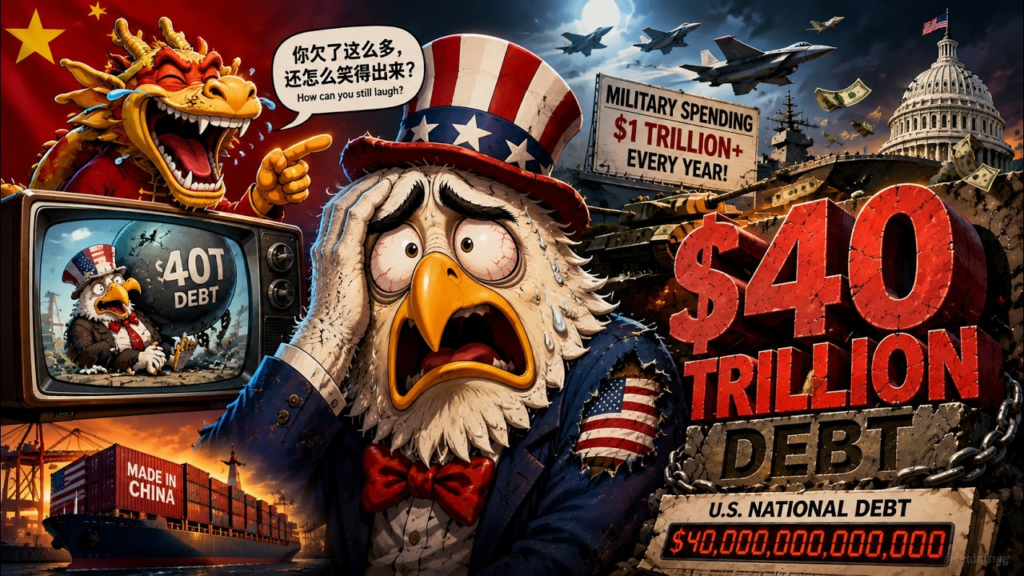
China has seized on a historic milestone in US borrowing to attack Washington’s economic and fiscal policies, describing America’s ballooning debt as a “monster” created by the United States itself.
The US national debt crossed $40 trillion for the first time in August 2026. Treasury data showed total public debt outstanding at about $40.05 trillion on August 18, a figure that has more than doubled since 2017.
Chinese state media has used the milestone to criticize what it describes as Washington’s reliance on borrowing, military spending and short-term political decisions. Xinhua described the debt as a “monster” spiraling out of control and argued that US military expansion has added to the fiscal burden.
The criticism comes as the United States faces rising interest costs, persistent budget deficits and growing pressure on the Treasury market. But the $40 trillion figure needs context: gross federal debt alone does not mean the United States is on the verge of bankruptcy, and the dollar’s unique role in global finance gives Washington advantages that most heavily indebted countries do not have.
How did US debt reach $40 trillion?
US federal debt has increased dramatically over the past two decades.
The national debt reached about $10 trillion in 2008, crossed $20 trillion in 2017 and surpassed $30 trillion in 2022. It then took only about four years to add another $10 trillion, according to the figures highlighted by Chinese state media.
The causes are spread across multiple administrations and multiple decades.
Major contributors have included:
- Large federal budget deficits
- Pandemic-era spending
- Tax reductions
- Rising spending on Social Security and Medicare
- Higher defense expenditure
- Increasing interest payments on existing debt
The $40 trillion milestone should therefore not be attributed to a single president or a single policy.
Reuters reported that the US fiscal outlook is being pressured by persistent deficits, mandatory spending and rising debt-servicing costs, while recent defense spending increases are adding to the challenge.
Is all $40 trillion really money America owes to outsiders?
No.
This is one of the most important distinctions when discussing the debt figure.
Gross federal debt includes both debt held by the public and intragovernmental holdings.
Treasury data cited by Reuters show that roughly $32.3 trillion was debt held by the public, while approximately $7.8 trillion was intragovernmental debt.
Intragovernmental debt largely represents obligations between federal government accounts.
The portion held by the public is more relevant when examining the government’s borrowing from investors, financial institutions, and other entities outside the federal government.
How much does the US pay in interest?
The growing debt creates another problem: servicing it costs money.
The Congressional Budget Office projects that US net interest outlays will reach about $1 trillion in fiscal 2026, equivalent to roughly 3.3% of GDP. It expects those costs to rise to about $2.1 trillion by 2036 under current law.
That makes interest payments one of the fastest-growing parts of the federal budget.
The issue is particularly significant because the government has to keep refinancing enormous quantities of debt as Treasury securities mature.
If interest rates remain elevated, newly issued debt can become more expensive.
That can create a feedback loop in which higher borrowing costs contribute to larger deficits, requiring still more borrowing.
Why is China mocking the US over its debt?
Beijing has long criticized Washington’s economic policies, particularly its use of financial sanctions and the dollar’s dominance.
The $40 trillion milestone gives Chinese state media another opportunity to challenge America’s portrayal of itself as the center of global economic stability.
Xinhua called the expanding debt a “Frankenstein” creation that has grown beyond its maker’s control. It also criticized Washington’s reliance on borrowing to finance spending and connected the fiscal burden to military expansion.
Chinese state media also released an AI-generated video depicting the United States as an eagle buying military equipment while accumulating more debt.
The symbolism is clear: Beijing is portraying US military power and financial borrowing as mutually reinforcing.
Is China right that US debt is spiraling?
The US fiscal trajectory is clearly a serious concern.
The Treasury’s $40 trillion milestone is real, and CBO projections show net interest costs rising significantly over the next decade.
But “spiraling out of control” is a political characterization rather than an economic measurement.
The US government continues to have enormous tax revenue, productive capacity and access to global capital markets.
More importantly, it borrows in its own currency.
That gives the United States considerably more flexibility than a country that borrows heavily in a foreign currency.
The central fiscal problem is therefore not simply that the US owes $40 trillion.
It is whether borrowing continues to grow faster than the economy’s ability to support that debt without imposing increasingly significant economic costs.
Why can the US borrow so much?
The dollar is the world’s dominant reserve currency.
That creates persistent demand for US financial assets, particularly US Treasury securities.
Governments, banks, pension funds, investment funds and other institutions around the world hold Treasury securities because they are highly liquid and backed by the US government.
The dollar’s global role therefore gives the US an unusual ability to finance large deficits.
This does not mean Washington can borrow without limits.
Higher debt can still push up borrowing costs, reduce fiscal flexibility and eventually undermine investor confidence.
But the United States has advantages that most other heavily indebted countries lack.
Does $40 trillion mean the US is about to default?
No.
Crossing $40 trillion does not itself indicate an imminent default.
A sovereign government that issues debt in its own currency is in a fundamentally different position from a household or company.
The United States can continue issuing Treasury securities to refinance existing debt and finance new deficits, provided investors remain willing to buy them and Congress maintains the legal authority to borrow.
The more immediate concerns are rising interest costs, fiscal rigidity, and the possibility that investors will eventually demand higher yields to compensate for growing fiscal risks.
What happens if Treasury yields rise?
Higher Treasury yields increase the government’s borrowing costs.
That matters because the US government continually refinances portions of its debt.
If new debt carries higher interest rates than older debt, average interest costs gradually increase.
Higher yields can also affect the broader economy because Treasury rates influence borrowing costs for mortgages, corporate debt, and other financial products.
A sustained rise could therefore have effects far beyond the federal budget.
Reuters reported that concerns about US borrowing and inflation have already contributed to changes in bond-market expectations and higher long-term borrowing costs.
Why does the debt-to-GDP ratio matter?
The size of the debt matters less in isolation than how it compares with the size of the economy.
Economists therefore frequently look at debt relative to GDP.
The supplied WION report puts the broader debt-to-GDP ratio at around 120%, although the precise ratio depends on whether one is measuring gross federal debt or debt held by the public.
That distinction should be made clear.
The United States can carry a very large nominal debt because its economy is also enormous.
But if debt grows substantially faster than GDP for an extended period, the burden becomes harder to manage.
Why is military spending part of China’s argument?
Chinese state media has specifically linked America’s fiscal pressures to defence spending.
That argument has a political purpose.
Washington spends heavily on the military, including personnel, equipment, overseas deployments, nuclear forces, weapons development, and support for allies.
Recent policy changes have also increased projected defence spending.
Reuters reported that a proposed 50% increase in defence spending through 2027 is contributing to fiscal concerns.
But defence spending is only one part of the US fiscal problem.
Mandatory programmes, particularly retirement and health spending, are major drivers of long-term expenditure.
Interest costs are another rapidly expanding burden.
Who actually owns US debt?
US Treasury securities are held by a wide range of investors.
These include:
- Federal government accounts
- Mutual funds
- Pension funds
- Banks
- State and local governments
- Insurance companies
- Individual and corporate investors
- Foreign governments and institutions
Foreign ownership is therefore only one part of the picture.
China is also no longer the largest foreign holder of US Treasury securities.
Japan has held a larger position, while the United Kingdom is another major foreign creditor.
That matters because it challenges the simplistic idea that “China owns America.”
China owns a significant amount of US debt, but the US Treasury market is supported by a much broader global investor base.
Why can’t China simply dump all its US Treasury holdings?
China could reduce its Treasury holdings, but doing so on a massive scale would be complicated.
Selling large quantities quickly could push Treasury prices lower and yields higher.
That would hurt the market value of China’s remaining US bond holdings.
It could also strengthen or weaken the dollar depending on how the proceeds were converted and invested.
In other words, China’s Treasury holdings give Beijing some financial leverage, but they also create exposure to the US financial system.
This is one reason Beijing has generally treated US Treasury holdings as a financial asset rather than a simple geopolitical weapon.
Could the debt hurt the dollar?
Possibly, but the relationship is complicated.
High debt can undermine confidence if investors begin to believe US fiscal policy is unsustainable.
That could weaken demand for Treasury securities and, under some circumstances, pressure the dollar.
But the dollar’s global status also provides a powerful cushion.
There is currently no other currency with the same combination of deep financial markets, global liquidity and international use.
That means even when investors worry about US debt, they may still consider dollar assets among the safest and most liquid places to hold money.
Why does the US debt matter to other countries?
America’s fiscal position affects the global economy because Treasury bonds sit at the centre of international finance.
If US yields rise substantially, investors around the world may shift capital toward dollar-denominated assets.
That can influence exchange rates and borrowing costs in emerging markets.
Countries with large dollar-denominated debts can be particularly vulnerable because a stronger dollar can make their liabilities more expensive in local-currency terms.
This is one reason movements in US Treasury markets can have consequences far beyond Washington.
Is China’s criticism entirely selfless?
No.
China has its own economic and geopolitical interests.
Beijing has long challenged America’s dominance of the international financial system and has promoted greater use of the yuan in international trade.
Criticizing US debt therefore serves a strategic purpose.
It supports China’s broader argument that the global financial system should become less dependent on American institutions and the dollar.
At the same time, China itself faces substantial economic challenges, including slower growth, property-market weakness and demographic pressures.
The US debt debate should therefore be viewed partly as a contest over economic credibility between two major powers.
Could America’s debt become a weapon against Washington?
Debt already constrains government policy.
A government spending more on interest has less room to respond to recessions, wars, natural disasters or other emergencies.
If interest costs continue rising, policymakers could eventually face difficult choices involving taxes, spending cuts or changes to entitlement programmes.
That is the real long-term risk.
The problem is not that the United States suddenly runs out of money because debt crosses a particular round number.
The problem is that increasingly large portions of government revenue could eventually be committed to servicing past borrowing rather than funding future priorities.
What does the $40 trillion milestone really tell us?
It tells us that the US fiscal position has become substantially more challenging.
The debt has doubled since 2017 and crossed another psychologically important threshold in August 2026.
Interest costs are approaching $1 trillion annually under CBO projections, while long-term projections show them rising considerably further.
But the milestone does not by itself prove that the United States is facing imminent financial collapse.
The bigger question is whether Washington can stabilise the debt trajectory before interest costs and mandatory spending consume an increasingly large share of the federal budget.
The bigger picture
China’s “Frankenstein monster” description makes for a striking headline, but the underlying issue is much more serious than a political taunt.
The United States now owes more than $40 trillion in gross federal debt, while the cost of servicing that debt is rising.
Yet America’s financial position remains unusual.
The country issues the world’s dominant reserve currency and has the deepest government bond market in the world.
That allows Washington to carry debt levels that would be far more difficult for most other countries to sustain.
The danger is therefore not simply the number $40 trillion.
It is what happens if borrowing continues to rise, interest costs consume more federal resources, and investors eventually demand substantially higher compensation for holding US debt.
China may mock the United States today.
But the fiscal challenge is not just an American problem.
Because Treasury securities and the dollar are deeply embedded in global finance, a major deterioration in America’s fiscal position would have consequences for markets around the world.
And that is precisely why Washington’s $40 trillion debt milestone is being watched far beyond America’s borders.