

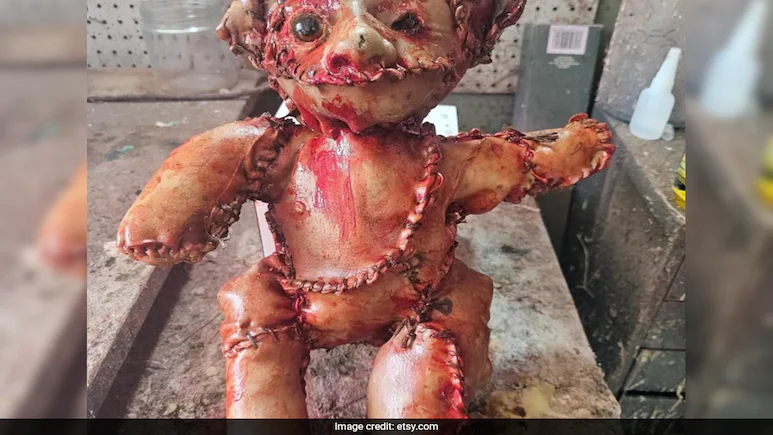
Authorities in Victorville, California, were alerted to a disturbing discovery on Sunday: a grotesque teddy bear seemingly crafted from human skin, found sitting at a bus stop near a gas station on Bear Valley Road. The object’s lifelike texture and facial features triggered widespread concern, prompting an official investigation.
Teddy Bear with Human-like Features Found at Bus Stop
Residents were unsettled by the sight of what appeared to be a mutilated doll. The teddy bear was found with leathery, flesh-toned material stretched tightly over its frame. Its design included disturbingly realistic facial elements—lips, nose, and hollow eye sockets, stitching across the surface suggested surgical-like precision.
Initial concerns quickly escalated, with many speculating whether actual human skin had been used in the creation of the bizarre figure.
Authorities Launch Investigation, Rule Out Human Remains
Responding to the discovery, police cordoned off the area and launched an inquiry into the bear’s origins. Forensic specialists examined the object and determined that the bear was not made from human tissue.
According to a statement from the coroner’s office, “Investigators determined this doll was made of a fabricated material and was not of human origin.” A forensic pathologist confirmed there was “no human tissue” involved.
Investigators traced the origin of the doll to a website that sells art pieces designed to resemble skin-covered objects. The product description had misleadingly claimed the dolls were “made of human skin.”
Artist Claims Responsibility for the Bear
Shortly after the investigation gained media traction, South Carolina-based artist Robert Kelly identified the bear as one of his works. In a Facebook post, Kelly, who runs a shop called Dark Seed Creations on Etsy, said he made and shipped the bear to a buyer in Victorville, California.
“Yes, I made the bear in the news video. Yes, that’s my Etsy shop screenshotted in the news articles,” Kelly confirmed in his post. “No, I did not have any knowledge of the buyer’s intentions, nor was I involved in a prank.”
Latex, Not Skin: Artist Explains His Work
Speaking to NBC News, Kelly revealed that his creations use latex castings to imitate human skin. “We take live castings of actual human models, which adds to the reality of the item,” he said. “We’ve put skin on everything—from guitars and teddy bears to couches.”
Kelly emphasized that while the pieces are meant to be hyper-realistic and provocative, they are entirely synthetic and designed as art.
‘Human Skin’ Teddy Bear: Public Reactions and Ongoing Questions
While the teddy bear has now been removed from the site, the incident has sparked online debate around the boundaries of art, public safety, and prank culture. It remains unclear whether local authorities will pursue further investigation now that the item has been identified and its origin verified.
The unusual incident highlights how hyper-realistic art can intersect uncomfortably with public spaces, especially when artistic intent is separated from its final context.


