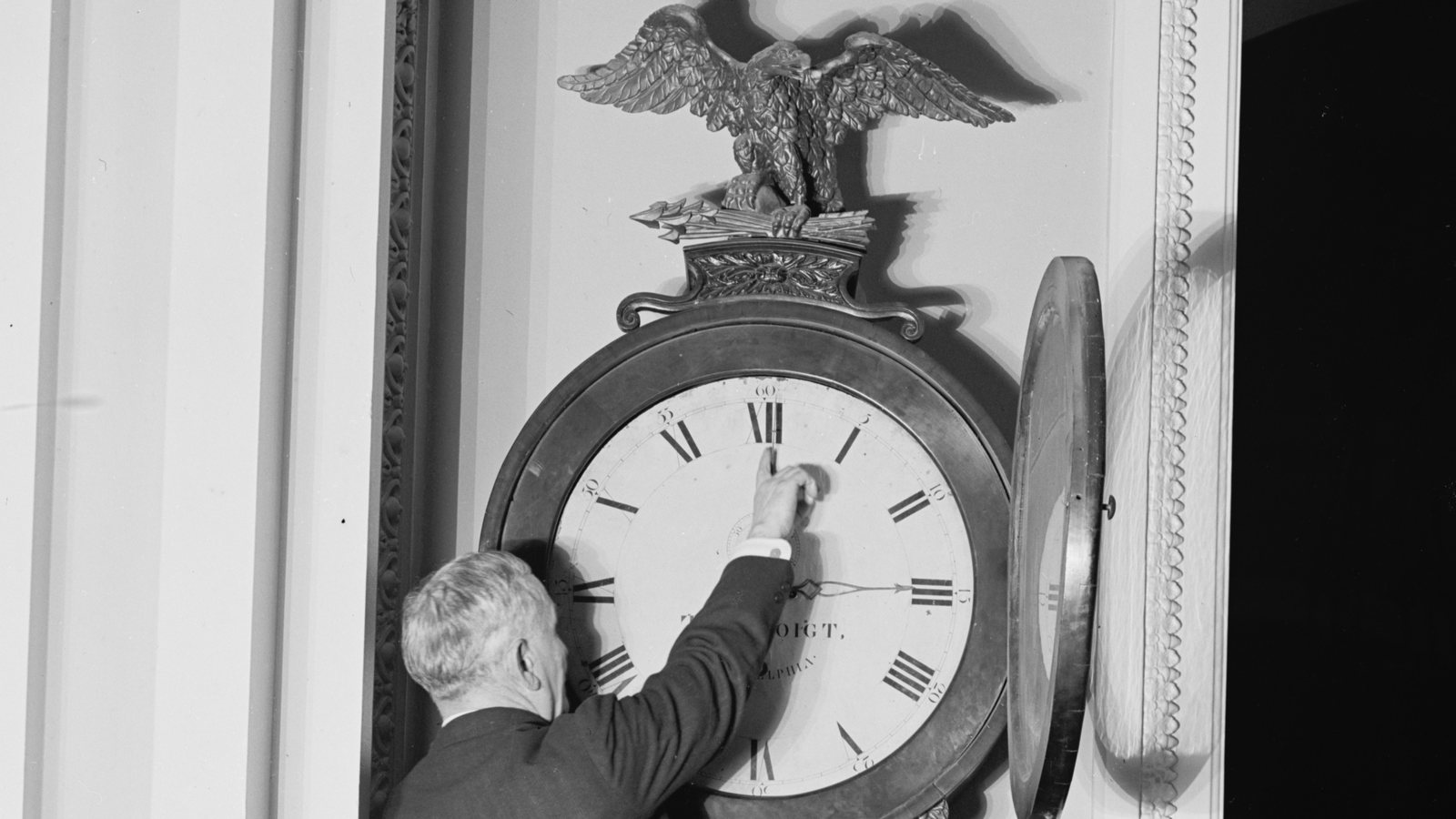
Daylight saving time ends at 2 a.m. local time on Sunday, November 1. Most Americans will set their clocks back one hour. A bill to make daylight saving time permanent passed the House in July, but the Senate has not touched it.
The Sunshine Protection Act would end the twice-a-year switch by keeping the country on summer time. President Donald Trump wants it, and so did 308 House members.
The obstacle is the Senate. The bill needs 60 votes there, floor time is short, and some senators represent places where the sun would rise after 9 a.m. in January.
When the clocks change, and who skips it
Federal law sets the dates. The Uniform Time Act, 15 U.S.C. 260a, starts daylight time on the second Sunday of March. It ends on the first Sunday of November, both at 2 a.m.
In 2026 that window ran from March 8 to November 1, according to the National Institute of Standards and Technology.
At 2 a.m. on Sunday, local time becomes 1 a.m. and that hour repeats.
Phones and computers adjust on their own. NIST says older “autoset” clocks built before the 2007 rule change may need a manual fix.
Not everyone changes. Hawaii, most of Arizona, Puerto Rico, Guam, American Samoa and the U.S. Virgin Islands stay on standard time, NIST says. The Navajo Nation in Arizona does observe daylight time.
If Congress does nothing, clocks spring forward again on March 8, 2027.
What the House actually passed
The House approved H.R. 139, sponsored by Rep. Vern Buchanan of Florida, on July 14. The roll call was 308 to 117.
The next day it went to the Senate Commerce Committee, where it remains.
The bill is short. It repeals the seasonal switch, then moves every U.S. time zone one hour ahead by amending the 1918 Calder Act.
In practice, today’s summer clock would become the new standard time. States that skip daylight time now, like Hawaii and Arizona, could keep their current clocks.
The vote count hides a split. Republicans backed the bill 193 to 22. Democrats were nearly even, 114 in favor and 95 against, according to the House Clerk’s tally. One independent voted yes.
In debate, Rep. Gus Bilirakis, a Florida Republican, called the clock change “a relic of the past,” the Associated Press reported. Rep. Frank Pallone, the top Democrat on Energy and Commerce, said evening sunlight would help tourism.
Rep. Madeleine Dean, a Pennsylvania Democrat, objected that “early morning light is an important environmental cue” for the body.
Why the Senate has not voted
The Senate has been here before. It passed an earlier Sunshine Protection Act by unanimous consent in March 2022. That bill then died in the House.
The most public holdout is Sen. Tom Cotton of Arkansas. Congress has made daylight time permanent before, Cotton posted on October 3, and “repealed it each time once Americans experienced absurdly late sunrises in the winter.” He added that Arkansans “don’t want their kids going to school in the pitch dark,” the Denver Gazette reported.
Trump has pressed the Senate on Truth Social. “People are sick and tired of having to change their Clocks twice a year,” he wrote this month. In one post he blamed Cotton by name, the Gazette reported. In another, he urged Arkansans to call and posted what the AP described as Cotton’s cellphone number.
Cotton is not the only obstacle. On the floor, the bill needs 60 votes to proceed, and Majority Leader John Thune has said it is unclear the votes exist. “Your geography probably has as much to do with your position on that as anything,” he told Politico.
Geography cuts both ways. Sen. Patty Murray said her state of Washington is “often dark earlier than 4 p.m. in the winter” and wants permanent daylight time.
Time is the other problem. Senators return on November 9, after the midterms covered in our guide to the 2026 Senate races. The AP counts 22 session days left this year. Government funding expires December 11, and a defense bill is also in line.
How late the sun would rise in winter
Cotton’s objection is about the morning. Under permanent daylight time, the sun would rise an hour later than it does now on every winter day.
We calculated each city’s latest winter sunrise using the National Oceanic and Atmospheric Administration’s published solar equations. Our results match the figures the AP reported for Little Rock (8:17 a.m.) and Des Moines (8:41 a.m.).
| City | Latest sunrise now (standard time) | Latest sunrise under permanent daylight time |
|---|---|---|
| Boise, Idaho | 8:18 a.m. | 9:18 a.m. |
| Grand Rapids, Michigan | 8:14 a.m. | 9:14 a.m. |
| Fargo, North Dakota | 8:12 a.m. | 9:12 a.m. |
| Indianapolis | 8:06 a.m. | 9:06 a.m. |
| Detroit | 8:01 a.m. | 9:01 a.m. |
| Seattle | 7:58 a.m. | 8:58 a.m. |
| Salt Lake City | 7:52 a.m. | 8:52 a.m. |
| Lincoln, Nebraska | 7:51 a.m. | 8:51 a.m. |
| Atlanta | 7:43 a.m. | 8:43 a.m. |
| New York | 7:20 a.m. | 8:20 a.m. |
| Little Rock, Arkansas | 7:17 a.m. | 8:17 a.m. |
Northern cities and those on the western edge of a time zone fare worst. That is why Indianapolis and Grand Rapids sit near the top.
Seattle shows Murray’s trade-off. Its earliest sunset, about 4:17 p.m. in December, would move to about 5:17 p.m.
The country has tried this once. The 1970s energy crisis brought daylight time to parts of the winters of 1974 and 1975. Sunrises after 8 a.m. meant schools opened in the dark, and it proved unpopular, the AP reported. A 1975 Transportation Department report to Congress found only “modest overall benefits.”
Sleep doctors want the opposite fix
Most people who want to stop changing clocks agree on that much. They split on which time to keep.
The American Academy of Sleep Medicine supports ending the switch, but in favor of permanent standard time. In its latest position statement, published in January 2024, the academy said standard time “aligns best with human circadian biology.” Its 2020 statement said the long-term effects of year-round daylight time “have not been well studied.” It added that daylight time could cause circadian misalignment, which some studies link to heart disease and metabolic risks. Sleep timing turns up in other research too, such as a Johns Hopkins study on daily naps and dementia.
Public opinion leans the other way. In an AP-NORC poll a year ago, 56% of respondents said they preferred year-round daylight time.
The debate often skips a legal asymmetry. Under current law, any state can move to permanent standard time on its own, as Hawaii and Arizona have done. No state can adopt permanent daylight time, because the Uniform Time Act overrides state laws that set clocks differently. So the Senate vote matters for only one side of the argument.
The next date to watch is November 9, when senators return with funding and defense bills ahead of this one. If nothing passes, clocks spring forward again on March 8, 2027.