
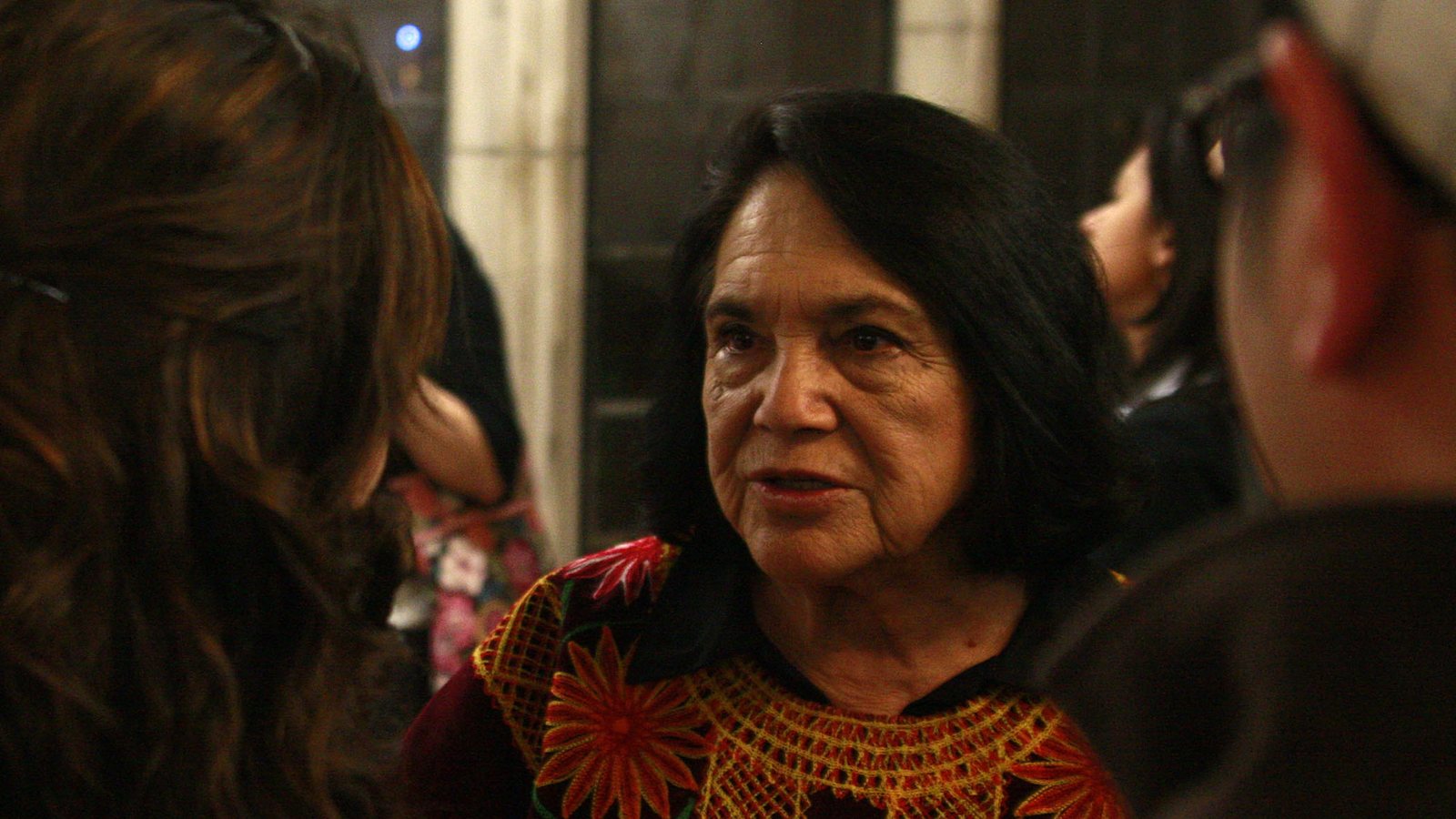

Dolores Huerta coined “Sí, se puede” in Phoenix in May 1972. The United Farm Workers co-founder, who died Wednesday at 96, said it to local leaders who told her farmworkers could not beat a new Arizona anti-union law. Thirty-six years later, Barack Obama ran for president on its English echo, “Yes, we can.”
Obama said as much on Wednesday. Huerta “came up with a pretty good slogan,” he said, one “that I too often get credit for. But as usual, Dolores got there first,” CNN reported. A family spokesperson said the cause of death was cancer, ABC News reported.
The slogan has a paper trail most protest chants lack. Her union holds it as a federal trademark. That record dates its first use to May 12, 1972.
The Arizona law that set it off
In May 1972, Arizona’s Legislature passed a bill backed by agribusiness. It denied farmworkers the right to strike and boycott during harvest seasons, according to the United Farm Workers’ history of the slogan. The union says Republican Gov. Jack Williams signed it within an hour. It also quotes his response to a farmworker protest: “As far as I’m concerned, those people don’t exist.”
Cesar Chavez, an Arizona native, went back and began a 24-day, water-only fast. The National Park Service calls it his second public fast. Phoenix’s Santa Rita Center hosted him for 19 of those days, Cronkite News reported in a story the UFW reposted. The Park Service later listed the building as one of five nationally significant Chavez sites. It is the only one in Arizona.
Arizona’s farm labor statute still reflects that thinking. Its declaration of policy says farmworkers are free to organize. It adds that the right to strike “must be limited and regulated.” The UFW says the 1972 law “is still on the books.”
Two tellings of the same moment
Every version shares the same core. People told Huerta “no se puede,” or “it can’t be done,” and she answered that it could.
The union’s account puts the exchange at Chavez’s bedside. Weak from fasting, he lay in a small room with Huerta beside him. Latino labor and political leaders came to brief them, and they argued the grower lobby was too strong. “No, no se puede!” they kept repeating, the UFW says. Huerta answered: “Si, si se puede!”
Huerta told it a little differently at Santa Rita Hall in 2022, 50 years later. She said she had gone to ask prominent Latinos for help overturning the law. “And they said to me, ‘No, aqui en Arizona, no se puede,'” she told KJZZ in Phoenix. Her reply: “Si se puede en Arizona.”
That night, at Mass in the hall, she told fellow activists about the meeting. “Everybody stood up and they started clapping ‘Si Se Puede,'” she said.
The Park Service version sits between the two. It says “some union supporters” made the argument. It credits Huerta with the reply and says she “popularized the slogan during the UFW campaign in Arizona.” Whichever room it was, every account gives her the line.
How credit drifted toward Chavez
For years, many retellings handed the phrase to Chavez anyway. The 2008 Cronkite News story the UFW reposted is one example. It says that out of the Phoenix protest “came Chavez’s rallying cry.”
That fits a wider pattern. Her contributions “were long overshadowed by those of Cesar Chavez,” CNN wrote in its obituary. In a 2018 documentary, she said she used the phrase whenever anyone doubted the union, CNN reported.
The two founders look different now. Earlier this year, Huerta said Chavez sexually abused her in the 1960s. She alleged he pressured her into sex once and raped her on another occasion. Chavez died in 1993, and his family told The New York Times it was “not in a position to judge” the allegations, CNN reported.
In March, the UFW canceled all celebrations tied to Chavez, Arizona Luminaria reported. Tucson renamed its Chavez holiday.
From a Phoenix hall to “Yes, we can”
Obama made the English phrase his refrain on Jan. 8, 2008. That night he finished second to Hillary Clinton in New Hampshire. He closed with “three words that will ring from coast to coast,” according to a CNN transcript. The words were “Yes, we can.”
Four years later, he named the source. He awarded Huerta the Presidential Medal of Freedom in May 2012. At the ceremony, he said she “was very gracious when I told her I had stolen her slogan, ‘Si, se puede.’ Yes, we can.” He added that he was pleased she “let me off easy,” according to the White House transcript.
The translation is looser than the campaign made it sound. “Se puede” is impersonal. The UFW’s trademark filing translates it as “yes it can be done” or “yes you can.” The Park Service uses “Yes, it can be done.” Obama’s version added a “we,” which turned a reply to doubters into a campaign promise.
A trademark, and a federal law that leaves farmworkers out
The UFW owns “SI SE PUEDE” as a registered federal trademark. It applied on Nov. 28, 1997, and won registration on Dec. 22, 1998, according to the U.S. Patent and Trademark Office record. The union has renewed it twice, and the record lists it as live.
The registration covers union services, worker education and benefits administration. It gives May 12, 1972, as the date of first use. That is the same month the UFW says Chavez began his Phoenix fast.
The union says it allows its marks only on goods or services “completely in harmony” with its political and social values. During the COVID-19 pandemic it adopted a spinoff, “She Se Puede,” to honor Latina organizers.
The fight behind the slogan isn’t settled either. The National Labor Relations Act governs most private-sector organizing. But its definition of an employee excludes “any individual employed as an agricultural laborer,” under 29 U.S.C. 152.
That federal law sits behind this month’s news that Dallas Cowboys cheerleaders formed a union. It also covers baristas like those in Starbucks Workers United’s 2024 holiday strikes. Farmworkers rely on state laws like Arizona’s instead.
“Her life’s work was to empower her community to face and overcome injustices,” UFW President Teresa Romero said, according to ABC News. Huerta’s family has said it will share plans to celebrate her life, and memorial details, later.