
Why Is Jimmy Kimmel’s Show Off-Air?
Jimmy Kimmel’s late-night program was abruptly pulled from ABC affiliates on Thursday after Federal Communications Commission (FCC) Chair Brendan Carr called for its suspension.
Carr, a Donald Trump appointee, accused Kimmel of “directly misleading the American public” with comments about the killing of right-wing activist Charlie Kirk. He warned broadcasters that they could face license revocations if they did not comply with FCC directives.
“I think Brendan Carr is outstanding. He’s a patriot. He loves our country, and he’s a tough guy,” President Trump told reporters, according to BBC and NDTV.
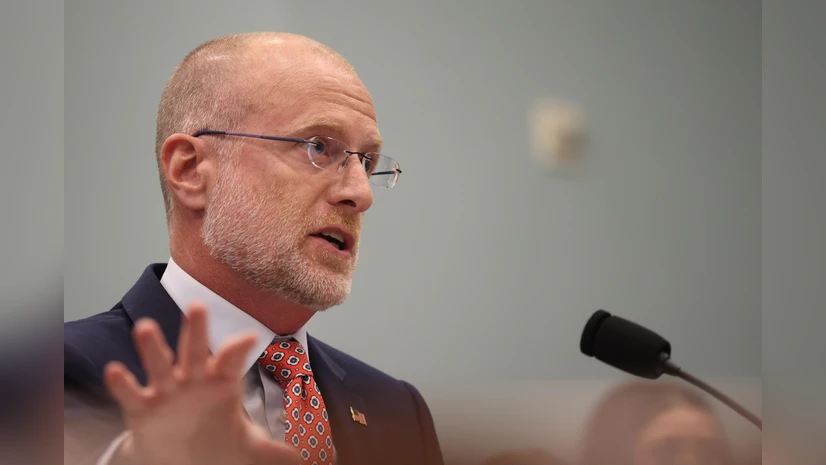
The episode has pushed Carr into the national spotlight, raising questions about who he is and how he rose to one of the most powerful media regulatory roles in the U.S.
Brendan Carr’s Early Life and Education
- Born: January 5, 1979, Washington, DC
- Undergraduate: Bachelor of Arts, Georgetown University (2001)
- Law School: Columbus School of Law, Catholic University of America (2005)
Carr’s legal career began in private practice. He clerked for a federal judge and later joined Wiley Rein, a prominent D.C. law firm specializing in communications law.
Carr’s Path to the FCC
Carr entered the FCC in 2012 as a staff attorney. His career advanced quickly:
- 2014: Became legal advisor to Commissioner Ajit Pai.
- 2017: Appointed FCC General Counsel when Pai became FCC Chair.
- 2017: Nominated by President Trump to serve as FCC Commissioner.
- 2024: Re-nominated after Trump’s re-election, later elevated to Chair.
His trajectory reflects close ties to Trump-era FCC leadership and alignment with deregulatory policies.
Carr’s Policy Record as FCC Chair
Carr has been a central figure in reshaping U.S. communications policy under the Trump administration. Key moves include:
- Net Neutrality: Finalized removal of net neutrality rules, which had already been struck down in court, to formally eliminate them from FCC regulation.
- Media Mergers: Blocked deals involving companies with diversity, equity, and inclusion (DEI) programs.
- Example: The $8.4 billion Paramount-Skydance merger was stalled until Skydance agreed to end DEI initiatives and commit to programming with a “range of viewpoints.”
- Culture Oversight: Increasing scrutiny of media content under the FCC’s “public interest” mandate—seen most recently in the Kimmel case.
These actions position Carr as one of the most influential conservative voices in American media regulation.
Personal Life
Carr is married to Machalagh Carr, who has worked as chief counsel for House Republicans. The couple is well-connected in Washington’s legal and political circles.
Why Carr’s Role Matters
The FCC Chair wields enormous influence over U.S. broadcasting:
- Determines which companies receive and keep licenses.
- Reviews mergers and acquisitions in the media sector.
- Shapes the balance between free speech rights and the FCC’s obligation to regulate content in the “public interest.”
Carr’s recent actions suggest a willingness to use FCC powers not just for technical oversight but for direct intervention in cultural and political disputes—a shift that could redefine the relationship between broadcasters, the government, and free expression in America.
TL;DR
- FCC Chair Brendan Carr ordered Jimmy Kimmel’s show suspended over “misleading” comments on Charlie Kirk’s killing.
- Carr, 45, is a Trump appointee with a background in communications law.
- He’s known for removing net neutrality rules and blocking media mergers tied to DEI programs.
- Married to Machalagh Carr, he is now one of the most powerful—and controversial—media regulators in the U.S.