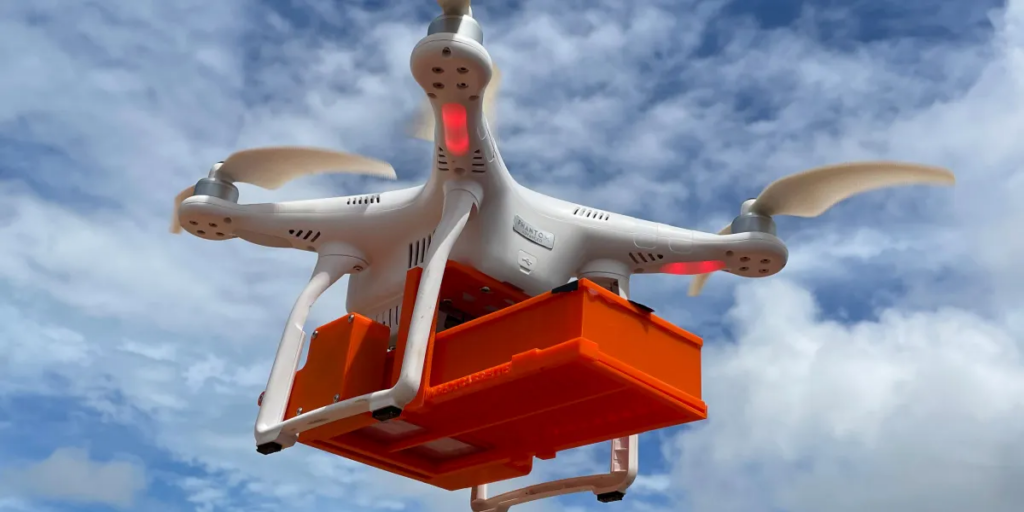
Florida officials are taking the battle against mosquitoes airborne — with drones carrying thousands of sterile insects.
The Lee County Mosquito Control District has begun deploying sterile male mosquitoes using drones in an effort to suppress populations of the invasive Aedes aegypti mosquito, a species known for spreading diseases such as dengue, Zika, chikungunya, and yellow fever.
The project combines drone technology, insect sterilisation, and precision mapping in what local officials describe as a faster and more effective way to control mosquito populations in hard-to-reach areas.
And despite how it sounds, the mosquitoes being released do not bite.
Why is Florida releasing mosquitoes on purpose?
At first glance, releasing more mosquitoes to fight mosquitoes sounds backward.
But the strategy is based on a decades-old biological control method called the Sterile Insect Technique (SIT).
Here’s how it works:
- Scientists breed male mosquitoes in laboratories
- The males are sterilized using radiation
- They are released into the wild
- Wild female mosquitoes mate with them
- The resulting eggs fail to hatch
Over time, mosquito populations shrink because fewer viable offspring are produced.
Since male mosquitoes do not bite humans, officials say the releases do not increase the risk of mosquito-borne disease transmission.
Why the Aedes aegypti mosquito matters
The program specifically targets Aedes aegypti, one of the world’s most dangerous mosquito species.
The insect is especially concerning because it:
- Thrives near humans
- Breeds in urban environments
- Bites aggressively during daylight hours
- Spreads multiple viral diseases
Unlike many native mosquito species, Aedes aegypti adapts extremely well to cities and suburban neighbourhoods.
Florida’s warm, humid climate makes it an ideal environment for the species to spread.
How the mosquito drones work
The Lee County Mosquito Control District is using a Skydio X10 drone equipped with a specialized release system capable of carrying up to 35,000 mosquitoes at a time.
But officials stress that the drone does not simply dump thousands of insects in one location.
Instead, the mosquitoes are gradually released across wide areas to create even distribution patterns.
Why Drones are Changing Mosquito Control
According to Rachel Morreale, who manages the district’s sterile insect technique program, drones help teams access places that are difficult or impossible to reach by road.
That includes:
- Wetlands
- Dense vegetation
- Marshes
- Coastal zones
- Isolated residential pockets
The drone can reportedly:
- Fly up to 45 mph
- Stay airborne for roughly 40 minutes
- Cover large geographic areas quickly
Officials say that improves both efficiency and consistency compared to ground-based releases.
“Before we were stuck with whatever we could access by road,” Morreale told local outlet WGCU.
Now, she said, teams can place sterile mosquitoes directly into habitats where the insects naturally gather.
How scientists sterilize the mosquitoes
The mosquito production process is surprisingly sophisticated.
Officials say the insects are:
- Bred in controlled laboratory conditions
- Raised to adulthood in about 10 days
- Sterilized using X-ray technology
- Prepared for release into the environment
The radiation process resembles technology used in medical imaging and cancer treatments.
Importantly, the sterilization does not make the mosquitoes radioactive.
Instead, it damages reproductive cells so they cannot produce viable offspring.
The fluorescent tracking system
Researchers also coat released mosquitoes with fluorescent powder.
That allows scientists to:
- Track survival rates
- Measure dispersal patterns
- Identify released insects during recapture studies
- Evaluate whether the program is reducing wild populations
The district says it has even developed a mosquito strain adapted specifically to the Captiva and Fort Myers regions.
That local adaptation could improve mating success in the wild.
Why mosquito control is becoming more urgent
Mosquito-borne diseases are becoming a growing concern in parts of the United States due to:
- Climate change
- Urbanization
- Global travel
- Expanding insect habitats
In recent years, Florida has seen periodic concerns involving:
- Dengue fever
- West Nile virus
- Eastern equine encephalitis
- Locally transmitted malaria cases
Public health officials increasingly view mosquito control as both an environmental and healthcare issue.
Why traditional mosquito spraying faces criticism
For decades, mosquito control largely depended on chemical insecticides sprayed from trucks or aircraft.
But that approach faces growing challenges:
- Insecticide resistance
- Environmental concerns
- Harm to non-target insects
- Public opposition to chemical spraying
Sterile insect programs are often promoted as a more targeted alternative because they affect only the intended species.
Does the sterile mosquito method actually work?
Research suggests sterile insect techniques can reduce mosquito populations significantly when deployed consistently and at large scale.
Similar programs have been tested in:
- Brazil
- China
- Singapore
- Mexico
- Parts of the United States
Results vary depending on:
- Release frequency
- Mosquito density
- Climate conditions
- Community participation
Experts say the method works best as part of a broader mosquito management strategy rather than a standalone solution.
The biggest challenge: scale
Mosquitoes reproduce rapidly, meaning control programs must release large numbers of sterile males continuously.
That is where drones may offer an advantage.
By automating distribution and expanding geographic reach, officials hope to improve coverage while lowering labour demands.
Why this project reflects a bigger trend in pest control
Florida’s mosquito drone program is part of a broader shift toward precision pest management.
Around the world, governments and researchers are increasingly using:
- AI-powered insect monitoring
- Genetic control methods
- Drone-based environmental mapping
- Biological suppression systems
The goal is to move away from blanket pesticide use and toward targeted interventions that minimise ecological damage.
In many ways, mosquito control is becoming a technology industry as much as a public health operation.
Are there concerns about releasing sterile mosquitoes?
Yes — although most experts consider sterile insect techniques relatively low-risk compared to chemical alternatives.
Some concerns include:
- Ecological disruption
- Cost of long-term deployment
- Effectiveness at scale
- Public skepticism
- Confusion about genetic modification
Officials emphasize that the mosquitoes used in Lee County are sterilised through radiation, not genetically engineered.
That distinction may help avoid some of the controversy associated with genetically modified insect programs tested elsewhere.
What happens next?
Lee County officials will continue monitoring released mosquitoes to determine:
- Survival rates
- Mating success
- Population reduction trends
- Overall effectiveness
If successful, drone-assisted releases could become a model for mosquito control districts nationwide.
As climate conditions continue to expand mosquito habitats across the U.S., local governments may increasingly look toward technology-driven approaches like this one.
TL;DR
- Florida’s Lee County is using drones to release sterile male mosquitoes.
- The goal is to reduce populations of the invasive Aedes aegypti mosquito.
- The mosquitoes are sterilized using X-ray technology and cannot reproduce.
- Male mosquitoes do not bite humans.
- Officials say drones improve mosquito distribution in hard-to-reach areas.
- The program is part of a growing push toward tech-driven mosquito control.