Ted Kaczynski’s story began in a world of mathematics and academia and ended with him becoming one of the most notorious domestic terrorists in modern American history. Known as the “Unabomber,” Kaczynski spent 17 years mailing or placing homemade bombs across the United States. His campaign killed three people and injured 23 others, according to the FBI.
For years, investigators searched for the man responsible but struggled to identify him. The bomber deliberately avoided leaving conventional forensic evidence and often used materials that were difficult to trace.
Then came an unusual breakthrough in 1995.
Kaczynski sent a roughly 35,000-word manifesto attacking modern technological society and demanded that major newspapers publish it. Investigators agreed to publication, hoping someone might recognize the author’s writing.
That gamble worked.
A family member recognized similarities between the manifesto and Kaczynski’s earlier writings. The resulting evidence helped the FBI connect a name to one of the longest-running manhunts in its history.
Less than a year later, federal agents were at Kaczynski’s isolated Montana cabin.
Who was Ted Kaczynski?
Theodore John Kaczynski was born in Chicago in 1942 and displayed exceptional mathematical ability while still a child.
He entered Harvard University at 16 and graduated in 1962. He later earned a master’s degree and doctorate in mathematics from the University of Michigan.
In 1967, Kaczynski joined the University of California, Berkeley, as an assistant professor of mathematics. He was only 25.
His academic career, however, was brief. He resigned from Berkeley in 1969 and increasingly distanced himself from mainstream society.
In 1971, Kaczynski moved to a remote piece of land near Lincoln, Montana, where he built a small cabin. The primitive structure had no electricity or running water, and he increasingly attempted to live away from modern infrastructure.
Over time, his hostility toward technological and industrial development became central to his worldview.
The FBI later said his writings showed a deeply held opposition to modern technology and industrial society. His manifesto would eventually provide investigators with the most important clue in the case.
How did the Unabomber campaign begin?
The first known bomb associated with Kaczynski appeared in May 1978 at the University of Illinois at Chicago.
A package found in a parking lot was made to appear as though it had been sent by a professor at Northwestern University. When it was ultimately opened by a campus security officer, it exploded and injured him.
The attacks continued.
In 1979, a bomb aboard an American Airlines flight traveling from Chicago to Washington, D.C., caught fire and caused smoke-related injuries. Other devices were subsequently sent to universities, professors, businesses and executives.
The targets varied, but investigators eventually noticed recurring connections to universities, airlines, computer-related businesses and people Kaczynski associated with technological society.
The FBI eventually linked 16 bombings to the Unabomber investigation between 1978 and 1995. The attacks killed three people and injured 23.
Why was he called the Unabomber?
The nickname came from the FBI’s original case designation: UNABOM.
The term was formed from “UNiversity and Airline BOMbing,” reflecting the types of targets involved in the early investigation.
In 1979, federal authorities created an FBI-led task force involving the Bureau of Alcohol, Tobacco, Firearms and Explosives and the U.S. Postal Inspection Service.
The investigation eventually expanded into a massive operation involving more than 150 full-time investigators, analysts and other personnel.
But Kaczynski had several advantages.
He lived far from ordinary society. He rarely used modern conveniences. His bombs were constructed with materials that investigators found difficult to trace. He also intentionally varied aspects of his devices and methods.
For years, forensic examination of the bombs offered investigators little that could directly identify their maker.
Why did it take so long to identify him?
One of the biggest problems was that investigators had to work from fragments.
They knew what the bomber’s victims had in common only in broad terms. They had bomb components, locations, letters and occasional eyewitness information, but no name.
The investigation developed theories about where the suspect came from and where he might have lived. Investigators believed he had connections to Chicago and later to the San Francisco and Salt Lake City areas.
But the suspect’s background did not fit the image investigators initially built.
Kaczynski had attended Harvard at 16, earned a Ph.D. in mathematics and become a Berkeley professor. The FBI’s early profile did not lead investigators to suspect someone with that particular academic history.
That mismatch helped keep him hidden in plain sight.
The Unabomber made his biggest mistake in 1995
After years of attacks, Kaczynski sent a lengthy manuscript to newspapers and other publications.
He called it “Industrial Society and Its Future.”
The roughly 35,000-word manifesto laid out his arguments against modern technological society and the industrial system. Kaczynski claimed that publishing his work was important enough that he threatened further violence if it was not distributed.
For investigators, the document presented an extraordinary opportunity.
The FBI debated whether newspapers should publish a terrorist’s work. Ultimately, FBI Director Louis Freeh and Attorney General Janet Reno approved the recommendation to publish it, with investigators hoping that someone who knew the author would recognize his language or ideas.
The Washington Post and The New York Times published the manifesto in September 1995.
The strategy produced the breakthrough investigators had been waiting for.
How Ted Kaczynski’s brother helped crack the case
The crucial lead came from Kaczynski’s family.
David Kaczynski’s wife, Linda Patrik, read the manifesto and noticed that some of its language and arguments resembled writing she had encountered from Ted.
David initially struggled to accept that his brother could be responsible.
Eventually, he compared the manifesto with older writings by Ted and became convinced that the similarities were too strong to ignore.
David contacted the authorities and supplied documents written by his brother.
The FBI then brought linguistic analysis into the investigation.
That analysis concluded that Kaczynski’s earlier writings and the manifesto were almost certainly written by the same person. Combined with information about his background, travel history, and the geographic pattern of the attacks, investigators had enough evidence to seek a search warrant.
The extraordinary irony was that Kaczynski had spent years trying to avoid identification, only to provide investigators with his own words.
The FBI finally closes in on the Montana cabin
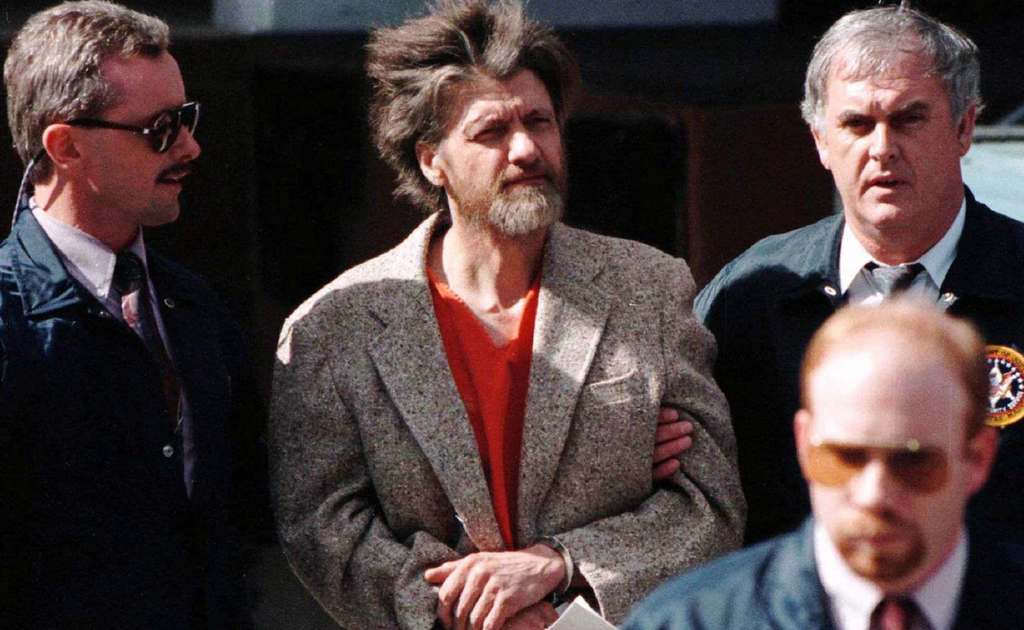
On April 3, 1996, the search came to an end.
Federal agents surrounded Kaczynski’s remote cabin near Lincoln, Montana.
According to the Smithsonian’s National Postal Museum, investigators used a property-survey pretext as part of the operation to approach him, and Kaczynski was arrested without violence.
The location was exactly the kind of place that had allowed him to remain hidden for so long.
The cabin was tiny and isolated, surrounded by wilderness and deliberately separated from the modern world he had spent years condemning.
But inside, investigators found evidence that transformed the case.
What did investigators find inside the cabin?
The search uncovered a remarkable collection of evidence.
FBI agents found bomb-making materials, electrical wire, metal and plastic components and other items connected to the construction of explosive devices.
They also discovered tens of thousands of handwritten pages documenting Kaczynski’s activities, including bomb-making experiments and descriptions of crimes.
One completed bomb was found hidden beneath a bed.
The FBI eventually stopped searching after about 24 hours because the discovery of the live device posed a serious hazard.
Investigators also recovered the original manuscript of the manifesto.
The document that had helped expose Kaczynski’s identity was now found inside the home of the man accused of writing it.
The evidence inside the cabin helped prosecutors build the case that the FBI had been searching for him for nearly two decades.
What happened to Kaczynski after his arrest?
Kaczynski was charged with federal offenses connected to the bombings, including murder.
Rather than proceed through a conventional trial, he eventually pleaded guilty in January 1998.
He was sentenced to multiple life terms without the possibility of parole and imprisoned in federal custody.
The case officially ended, but the questions surrounding Kaczynski’s life, ideology, academic career and relationship with technology continued to attract scrutiny.
Kaczynski died in prison on June 10, 2023, at the age of 81. The Bureau of Prisons later confirmed his death.
The investigation’s lasting lesson
The Unabomber investigation is remembered for its enormous scale, but the most striking part of the story is how ordinary the decisive clue eventually became.
For almost two decades, investigators searched bomb fragments, studied victims and constructed behavioral theories.
None produced the answer they needed.
The breakthrough came from text.
Kaczynski’s decision to put his worldview into a manifesto gave investigators something they had never possessed before: a large sample of his writing that could be compared against material from a suspected individual.
His brother’s recognition of the language turned that document into an investigative tool.
The FBI then combined the linguistic evidence with the suspect’s biography and physical evidence from the Montana cabin.
That combination finally ended the hunt.
The man who had hidden behind anonymous bombs, remote wilderness, and careful planning had ultimately left his most revealing fingerprint in words.