
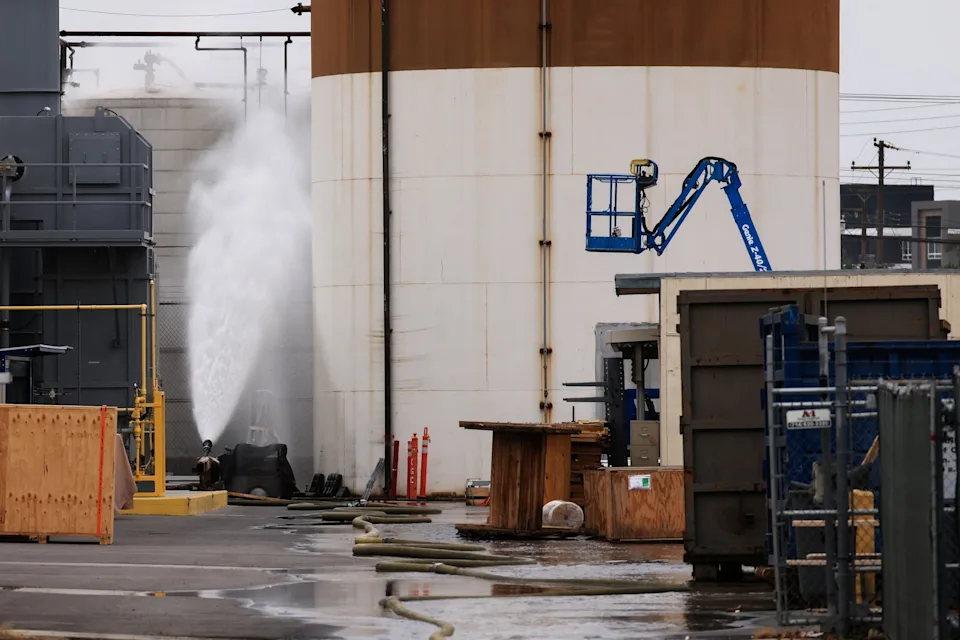
A volatile chemical emergency in Southern California has entered a critical phase as firefighters and hazardous materials teams work around the clock to prevent a pressurized tank from exploding at a GKN Aerospace facility in Garden Grove.
The incident, centered around a 34,000-gallon tank containing methyl methacrylate, has already forced evacuations affecting roughly 50,000 residents across parts of Orange County. Officials say the threat is not over.
Emergency crews are now racing against pressure buildup, heat, and the possibility of a “thermal runaway” event — an industrial failure scenario that can escalate rapidly and violently.
TL;DR
- A chemical tank containing methyl methacrylate overheated at a GKN Aerospace facility in Garden Grove, California.
- Officials warn the tank could rupture or explode if pressure cannot be controlled.
- Around 50,000 residents remain under evacuation orders or warnings.
- Firefighters are using continuous water cooling and conducting inspections inside the facility.
- A possible crack in the tank may be slowly relieving pressure, though authorities are still verifying that assessment.
- California Gov. Gavin Newsom declared a state of emergency and requested federal assistance.
- Residents have filed a class-action lawsuit against GKN Aerospace.
What Happened at the Garden Grove Aerospace Facility?
The emergency began Thursday at GKN Aerospace’s Transparency Systems facility on Western Avenue in Garden Grove, a city in Orange County near Anaheim and Disneyland.
Authorities said a large industrial tank storing methyl methacrylate overheated and began venting chemical vapours. Since then, local and state agencies have been trying to stabilize the tank before it reaches a catastrophic failure point.
The Orange County Fire Authority (OCFA) says there are still two possible outcomes:
- The tank could rupture and spill thousands of gallons of chemicals.
- The tank could explode due to a thermal runaway reaction.
That second scenario is what has prompted large-scale evacuations and emergency declarations.
What Is Methyl Methacrylate and Why Is It Dangerous?
Methyl methacrylate (MMA) is a highly flammable industrial chemical commonly used to manufacture acrylic plastics, coatings, adhesives, and resins.
It is widely used in industries including:
- Aerospace
- Automotive manufacturing
- Construction
- Medical device production
Under normal industrial controls, MMA can be handled safely. But when exposed to excessive heat or pressure, the material becomes significantly more dangerous.
Key risks associated with methyl methacrylate:
- Highly flammable vapors
- Risk of explosion in confined environments
- Respiratory irritation
- Eye and skin irritation
- Potential toxic smoke release during combustion
The concern in Garden Grove is not simply a chemical leak. It is the combination of heat, pressure, and containment inside a massive industrial tank.
How Are Firefighters Trying to Prevent an Explosion?
The current emergency response strategy centers on cooling and pressure management.
According to OCFA officials, crews have been continuously spraying water on the tank in an effort to stabilise temperatures and prevent a thermal runaway reaction.
Current cooling strategies include:
- Constant water application
- Temperature monitoring
- Pressure assessment
- Structural inspections
- Controlled recon missions inside the facility
One of the most significant developments came late Saturday when firefighters entered the site to inspect the tank directly.
OCFA Interim Chief TJ McGovern said crews identified what appeared to be a possible crack in the tank.
If confirmed, that crack may be slowly releasing pressure — potentially reducing the risk of an explosion.
But officials have stressed that the finding is still being verified and could alter the entire response strategy.
Why this matters
Industrial tank failures can become exponentially more dangerous once pressure reaches a critical threshold. Cooling the tank buys responders time, but it does not guarantee stability.
A small pressure release could help prevent catastrophic failure. It could also introduce new complications depending on the integrity of the tank wall.
How Large Is the Evacuation Zone?
Evacuation orders and warnings remain in effect across sections of Orange County, impacting approximately 50,000 residents.
Officials have not disclosed all blast modeling details publicly, but authorities confirmed they analysed potential explosion zones based on:
- Tank pressure
- Chemical volume
- Fire exposure
- Debris projection risk
The OCFA later stated that areas outside the designated evacuation zone are considered safe for normal activity.
Still, the scale of the response underscores how seriously authorities are treating the threat.
Nearby landmarks are raising public concern
One of the most searched questions online has been the proximity of Disneyland to the incident.
The resort area lies several miles east of Garden Grove. Officials have not announced impacts to Disneyland operations, but the association has amplified public attention and concern.
What Impact Has the Leak Had on Schools and Residents?
The disruption has extended far beyond the evacuation perimeter.
Families have been displaced for days, schools in affected zones have faced operational uncertainty, and businesses have dealt with closures and restricted access.
Several evacuation centers remain open across Orange County.
Meanwhile, companies including Uber, Planet Fitness, and 24 Hour Fitness are offering free support services for evacuees and emergency personnel.
The City of Garden Grove has also published resource information online for displaced residents.
The broader community impact includes:
- Temporary housing displacement
- Traffic disruptions
- School schedule uncertainty
- Business interruptions
- Air quality concerns
- Heightened anxiety among nearby residents
This incident also highlights a recurring issue in Southern California: industrial facilities operating near densely populated residential areas.
Why the Legal Fallout May Last Long After the Emergency Ends
Even before the immediate danger has passed, legal action has already begun.
Attorneys filed a class-action lawsuit against GKN Aerospace on behalf of evacuated residents, alleging the company failed to adequately protect surrounding communities from a known hazardous condition.
The Orange County District Attorney’s Office has also launched:
- An anonymous tip hotline
- An online reporting system tied to the incident
Those moves suggest investigators are already collecting information that could shape future regulatory or legal proceedings.
Key questions investigators may examine:
- Whether safety protocols were followed
- Tank maintenance history
- Chemical storage compliance
- Emergency preparedness planning
- Prior warning signs or equipment failures
Why This Garden Grove Chemical Leak Matters Beyond Orange County
Industrial chemical incidents are not rare in the United States. But events involving large-scale evacuation zones near dense suburban populations tend to expose deeper infrastructure and regulatory concerns.
This case raises broader questions about:
- Industrial zoning near residential neighborhoods
- Aging chemical storage infrastructure
- Emergency response coordination
- Hazard communication with the public
The situation also illustrates how modern emergency management increasingly depends on multi-agency coordination between:
- Local fire authorities
- Public health officials
- State emergency agencies
- Federal disaster response systems
Gov. Gavin Newsom’s emergency declaration — and California’s request for federal assistance — signals that officials view the incident as more than a localized industrial problem.
What Happens Next?
For now, the response remains focused on stabilisation.
Officials continue monitoring:
- Tank temperature
- Pressure levels
- Structural integrity
- Vapor release conditions
The next major developments will likely depend on whether the suspected crack is confirmed and whether it safely relieves enough pressure to prevent a larger failure.
Until then, evacuation orders remain a reality for tens of thousands of Orange County residents waiting to learn when — and if — it is safe to return home.