
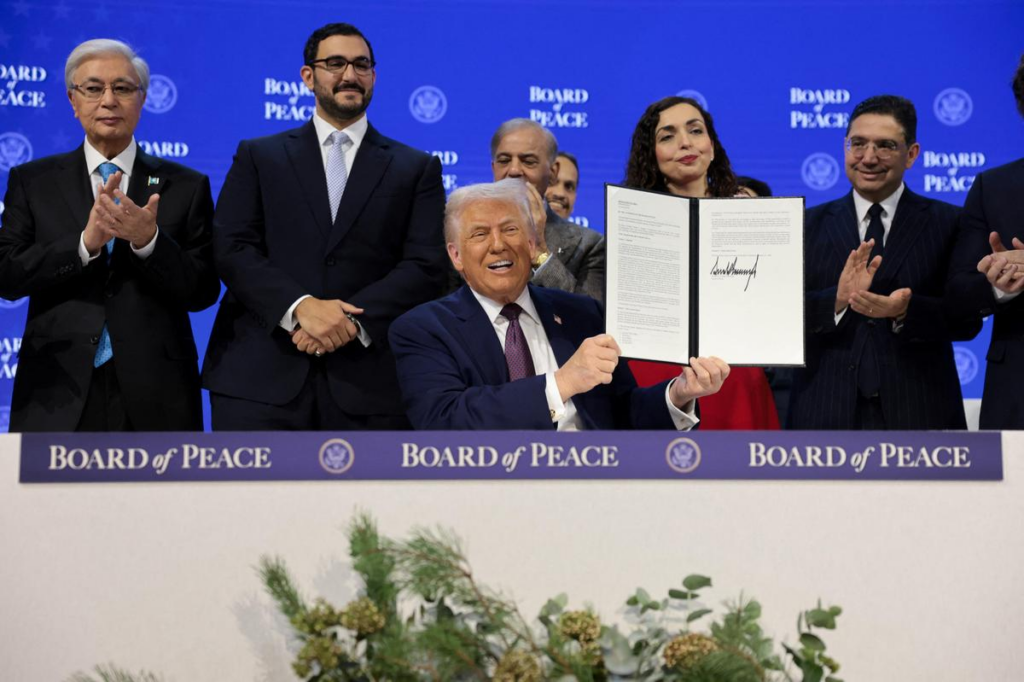
India’s decision to stay on the sidelines of US President Donald Trump’s newly launched Gaza Peace Board has raised eyebrows in diplomatic circles. Prime Minister Narendra Modi was among leaders invited to join the initiative, unveiled at the World Economic Forum in Davos. Yet New Delhi has not signed on, even as Pakistan and 18 other countries did.
This is not a routine case of diplomatic hesitation. India’s reluctance reflects deeper concerns about global governance, the future of the United Nations, and the long-term implications of aligning with a US-led structure whose mandate and permanence remain unclear.
This article explains what the Gaza Peace Board is, why India is cautious, and what this moment reveals about shifting power equations in global diplomacy.
What is Trump’s Gaza Peace Board?
Announced on January 15 as part of phase two of Trump’s 20-point peace plan, the Gaza Peace Board is designed to oversee post-war reconstruction and governance in Gaza following the Israel conflict.
What the board is supposed to do
According to the charter signed in Davos, the Board of Peace aims to:
- Oversee demilitarisation in Gaza
- Coordinate humanitarian aid delivery
- Supervise infrastructure rebuilding
- Help establish a technocratic Palestinian administration
This administration would function under the National Committee for the Administration of Gaza, led by Palestinian leader Ali Shaath.
A visual explainer here showing Gaza’s reconstruction phases under the board’s plan could help readers understand the scope of the proposal.
Who is running the board?
The founding executive committee includes a mix of political heavyweights, financiers, and Trump loyalists:
- US Secretary of State Marco Rubio
- Former UK Prime Minister Tony Blair
- Jared Kushner, Trump’s son-in-law
- Special envoy Steve Witkoff
- World Bank President Ajay Banga
- Billionaire investor Marc Rowan
- Adviser Robert Gabriel
Trump has positioned himself as the board’s permanent chairman, a detail that has unsettled many capitals.
How it relates to the United Nations
Trump has said the board will work “in conjunction” with the UN, arguing that the UN has failed to use its full potential. Yet the charter also grants the board authority to challenge or undermine existing international frameworks for conflict resolution.
That clause is where the trouble begins.
Why has India not joined the Gaza Peace Board?
India has not rejected the board outright. Instead, it is watching carefully. That pause is deliberate.
Concern over sidelining the United Nations
India has long been a vocal defender of multilateral institutions, even while pushing for reforms. Any structure that appears to rival or weaken the UN raises red flags in New Delhi.
- India has consistently argued that global conflict resolution must flow through established multilateral mechanisms.
- Supporting a parallel body led indefinitely by one country risks legitimising a world order driven by ad hoc power blocs.
This is especially sensitive for India, which seeks a permanent seat on the UN Security Council. Backing an alternative forum that dilutes UN authority could undermine that long-term objective.
Consider linking here to your explainer on India’s push for UN Security Council reform.
No major global powers have signed on
One striking feature of the Gaza Peace Board is who is missing.
- No permanent UN Security Council member has joined, apart from the US
- No G7 country has signed the charter
India is unlikely to step forward alone when countries like France, the UK, Russia, and China are holding back. Diplomatic alignment often moves in clusters, not solo acts.
Indian policymakers are reportedly watching France and Russia closely. If they stay out, India’s hesitation hardens into a quiet no.
Ambiguity in the board’s mandate
Despite being widely described as a Gaza-focused initiative, the board’s charter does not explicitly mention Gaza.
Instead, it grants itself a broad mandate to intervene in global conflicts and governance structures. That open-ended authority worries countries that value predictability in international law.
For India, which prizes strategic autonomy, signing a document with such elastic language is risky.
Trump’s permanent leadership role
The idea of Trump remaining chairman “forever” has unsettled even US allies.
From India’s perspective:
- Leadership continuity tied to one political figure makes the board vulnerable to domestic US politics
- A future administration could abandon or radically reshape the initiative
- Decisions could become personalised rather than institutional
India tends to prefer platforms where leadership rotates or is governed by clear rules, not personalities.
Why did Pakistan join while India stayed out?
Pakistan’s decision to sign the board’s charter alongside 18 other countries highlights contrasting diplomatic priorities.
Pakistan’s calculus
For Islamabad, joining offers:
- A seat at a US-backed global table
- Visibility in Middle East diplomacy
- Alignment with Washington at a time of economic vulnerability
Pakistan has often used multilateral forums to amplify its relevance, even when the long-term payoff is uncertain.
India’s different approach
India’s foreign policy has shifted toward cautious engagement rather than symbolic participation.
- New Delhi prefers outcomes over optics
- It avoids frameworks where its influence would be limited or diluted
- It is wary of initiatives that could constrain future policy choices
This divergence explains why India is comfortable being absent while Pakistan signs on quickly.
A comparative chart here showing India and Pakistan’s recent multilateral alignments could add clarity.
Does the Gaza Peace Board weaken global governance?
This is the question many diplomats are asking quietly.
A rival system in the making?
While Trump denies creating a UN alternative, the structure suggests parallel authority:
- Independent funding streams
- A closed executive committee
- Power to override or challenge existing institutions
History offers cautionary tales. Parallel systems often fragment consensus rather than strengthen it.
Risks for smaller and mid-sized powers
For countries like India, such boards can:
- Reduce transparency in decision-making
- Concentrate power among a few actors
- Marginalise voices outside the founding circle
India has spent decades building credibility as a responsible stakeholder. Associating with a loosely defined power club could weaken that image.
How India views Gaza and West Asia more broadly
India’s stance is not indifference to Gaza. On the contrary, New Delhi has carefully balanced its relationships in the region.
India’s established position
- Supports a two-state solution
- Maintains strong ties with Israel
- Engages diplomatically with Palestine and Arab states
- Prioritises stability in West Asia due to energy and diaspora interests
Joining a US-led reconstruction authority without broad international backing could upset that balance.
Consider linking here to your coverage on India-Israel relations and India’s West Asia strategy.
What could change India’s mind?
India has not closed the door completely.
Conditions that might prompt reconsideration
- Clear alignment with UN frameworks
- Defined leadership tenure and governance rules
- Participation by major global powers
- Explicit, limited focus on Gaza reconstruction
Absent these changes, India is likely to remain an observer rather than a participant.
The strategic wait-and-watch approach
India’s restraint reflects confidence rather than hesitation. In a world crowded with initiatives, choosing when not to join can be as important as joining.
Why this matters beyond Gaza
The Gaza Peace Board is not just about rebuilding a war-torn territory. It is a test case for how global power is exercised.
- Will future conflicts be managed by institutions or coalitions?
- Will legitimacy come from consensus or convenience?
- Can durable peace be built through personalised diplomacy?
India’s answer, for now, appears cautious but consistent.
TL;DR
India has not joined Trump’s Gaza Peace Board despite an invitation because it fears the initiative could undermine the United Nations, lacks participation from major global powers, and concentrates authority under indefinite US leadership. New Delhi prefers to wait, watch allies like France and Russia, and avoid endorsing a parallel global governance structure with unclear long-term consequences.